
by Eric Bies
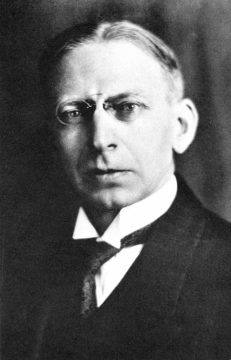 In 1930, the German anthropologist Berthold Laufer published a monograph on the phenomenon of people eating dirt.
A sinologist by training, Laufer’s study—“the evaluation of the whole question of geophagy”—begins with a trip through Ancient China, where for hundreds of years Han, T’ang, and Sung soil disappeared down eager gullets. From there, the globe: he tours Malaysia, Polynesia, Melanesia, Australia, India, Burma, Siam, Central Asia, and Siberia, stopping off among Persians and Arabs before continuing on to Africa, Europe, North America, Mexico, Central America, and South America. His conclusion? People all over have eaten dirt for a very long time … And yet rarely does one find a Malaysian or an Indian, a Siberian or an Arab, an African or a Mexican swallowing down the plucked clod raw. Almost always water is added to the earth first: in the Yun-ho Mountains, white clay “is mixed with water and beaten on a stone” before it is eaten; in the Philippines, “it is a common thing to mix the earth taken from the nests of ‘white ants’ with water”; in Nishapur, where Omar Khayyam penned his Rubáiyát, the clay is softened with “rose-water and a little camphor,” then shaped into loaves.
Of course, few have particularly prized the practice Laufer describes in all its inventive renditions: as when the occupants of Leningrad remained under unremitting siege for 872 days and turned, in the interest of evading death by starvation, to their suppers of book glue and snow, so the chronically hungry everywhere and forever have tended to eye the lumps of mud out back with all the despairing expediency of a cratered gut.
Even now it remains common practice in the poorer parts of places like the Subsaharan to attempt to recuperate certain vital minerals as iron, calcium, and zinc, including incidental traces of vitamins B and C, through a sometime diet of dirt. Read more »
 My grandmother’s bird of choice is the rooster. She was raised in rural Kentucky and now lives in rural Wisconsin. She collects all sorts of roosters (and, by extension, some hens): wall art, printed dish towels, ceramic statues as small as a pinky and as large as a lamp, coin bowls and blankets and something nostalgic in each one.
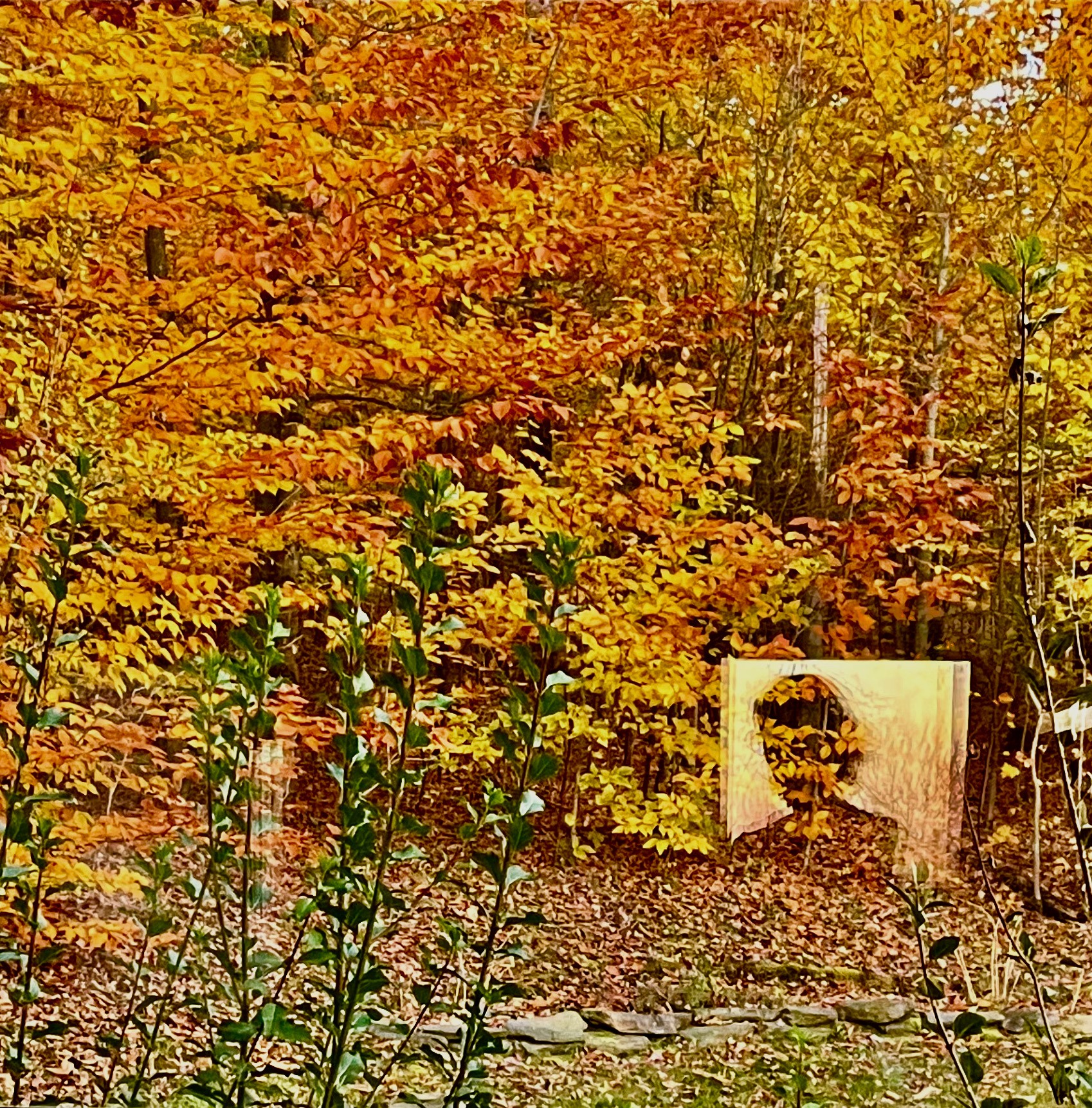 Sughra Raza. Shadow Self-Portrait in a Reflection of a Window in a Window.
  A couple of years ago I briefly became famous for hating Vancouver. By “famous” I mean that a hundred thousand people or so read

 It was announced last week that scientists have integrated neurons from human brains into infant rat brains, resulting in new insights about how our brain cells grow and connect, and some hope of a deeper understanding of neural disorders.
  Visualize a purple dog, the exercise said. Imagine it in great detail; picture it approaching you in a friendly way. So I did. I thought of a spaniel: long silky ears, beautiful coat, all a nice lilac color. Pale purple whiskers. The dog was friendly but not effusive. I’m not a dog person, but I wouldn’t have minded meeting this dog. All right, now what? The exercise went on to say something along the lines of “Wonderful! If you can visualize that purple dog, can’t you imagine your own life as being full of amazing possibilities?”
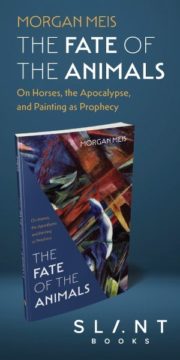 The Fate of the Animals: On Horses, the Apocalypse, and Painting as Prophesy (Three Paintings Trilogy), by Morgan Meis, Slant
 Scheduled departure at Dulles came and went as we waited for the last passenger to board. Although the non-smoking section in the rear cabin was full, the smoking section where I sat was half empty. Death by asphyxiation on the flight to Paris was a distinct possibility but with three empty, adjacent seats in the centre nave there was some chance that my obituary might read, “She died peacefully, in recumbent sleep.”