by Akim Reinhardt
^
Royalty
Aristocracy
Church Officials
The Merchant Class
Skilled Crafts Workers
The Goddamned Peasants
The Unbelieving Under Class
Criminals to Be Caged & Tortured
Those Whom We Will Publicly Execute
^
WASPS
White Catholics
White-Skinned Jews
Model Minority Asians
White-Skinned, Anglo-Latinx
American Indians as they are Imagined
Dark-Skinned Hispanic Latinos and Latinas
American Indians in Real Life, Not Your Fantasies
African or Indigenous Americans, Depending Where You Are
^
Hahvahd
Harvard and Yale
Princeton, Cornell, Columbia
The Other three Ivy League Schools
Other Elite Private Colleges/Universities
A Small Number of Elite Public Universities
United States’ Elite Military Academy Universities
Flagship Public Research Universities in Most U.S. States
Second Class Public Research Universities across the United States
Former Teacher’s Colleges and Other Underfunded Public Universities
Real Colleges You Have not Heard of and Think, Huh, Is That a Real College?
^
University
4-Year Colleges
Community Colleges
Accredited Online Colleges
Sham, For-Profit Online Colleges
Secondary Schools (aka High Schools)
Middle Schools (aka Junior High Schools)
Primary Schools (aka Elementary or Grade schools)
Daycare Single Mom Sends Child to While Studying for GED
^
Profs
Associate Profs
Untenured Assistant Profs
1-Year Visiting Assistant Professors
Lecturers on Renewable 1-Year Contract
Long Term Adjuncts Who Keep Showing Up
Grad Students with New Syllabi and Fragile Dreams
Come-and-Go Adjuncts Juggling 6 Classes at three Schools
Politician Who Teaches PoliSci Class & Votes to Slash Ed Funding
^
The PhDs
The Medical Degrees
Law/Engineering Degrees
Other Hip Professional Degrees
Various Master of Sciences Degrees
Various Master of Art/Philosophy Degrees
Bachelor of Science Four Year College Degrees
Bachelor of Arts Four Year Degrees: Social Sciences
Bachelor’s of Arts Four Year Degrees in the Humanities
Associate of Arts Degree from a 2 year Community College
M.A., B.A., or A.A. Degrees from an Accredited Online Colleges
Four Year High School Degrees from Expensive Private High Schools
Four Year High School Degrees from Very Selective Public High Schools
Four Year High School Degrees from Open Admissions Public High Schools
General Equivalency Diplomas Earned Taking an Exam Instead of enduring HS
^
3QD Readers
Elite Mag Readers
NYT/WaPo/WSJ Readers
Tabloid Newspaper Readers
People Magazine and SI Readers
Facebook and Twitter Doom Scrollers
Young Adult Fantasy/Sci Fi Book Readers
Small Children Reading Cute Children’s Books
Readers of Graffiti on Doors of Bar Bathroom Stalls
^
Activists
Honest Critics
The Numb Underclass
The Blind Underclass Strivers
Paranoid, Neurotic Middle Classes
Justifiers, Rationalizers, & Excuse Makers
People Who Embrace, Profit from these Pyramids
Precious Children of Embracers & Profiteers of Pyramids
Parents, Furiously Indignant I Dared Slight their Precious Children
Me, Despite My Money & Credentials, Skulking Down Here Like I Belong
^
I
Us
You
Them
All of ‘Em
Eight Billion
Or Thereabouts
And Still Counting
The World’s Many Souls
Drifting and Stumbling About
Each 1 a Human Stone Slotted into
Pyramids of Social, Cultural, Economic
Ranking, Status, Power, Privileges, Opportunity
Perhaps Knowing, or Not, That They Are Very likely
Stuck in Those Slots, More or Less, for All of Their Days
Wallowing in Resentment or Finding a Way to Look Past It
Because At Least They Can Write their Name in Capital Letters
akimreinhardt’s
website is the
publicprof
essor.
com
.

 Let’s talk about voter suppression. Not about whether it’s good or bad or legal or moral (you can get more than enough of that virtually 24/7), but about what practical implications it might have.
 I discovered my ideal radio station by accident.
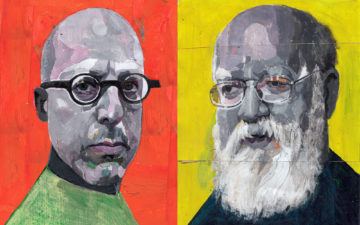
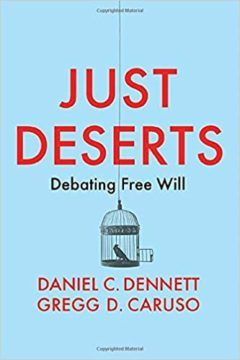 I’ll return to that second crack once we’ve explored the first one. But why do that at all? Does free will matter to anyone but a couple of bickering philosophers? Of course it does! Sam Harris noted in his recent
 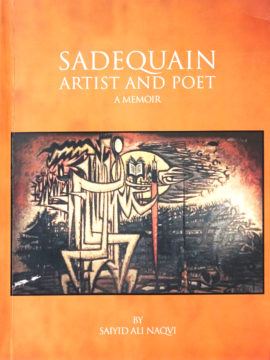 “Sadequain!” The very name is like a magic word that triggers a tumult of images in the mind. Arguably, no Pakistani artist has elicited more admiration, evoked more passion, and received more adulation than Saiyid Sadquain Ahmad Naqvi, the subject – and really, the hero – of the book “Sadequain: Artist and Poet – A Memoir” by Saiyid Ali Naqvi. In the world of art, be it painting, music, or literature, it is the pinnacle of achievement to be recognized by a single name – to need no further introduction. And rare indeed is the artist who achieves this distinction in his or her own life, as Sadequain did remarkably early in his career as an artist. And this delightful, beautiful, and insightful book shows why. Beginning with the earliest and formative years of Sadequain when he was not yet a legend, it takes the reader systematically through all stages of his life and his growth as an artist, laying bare both the immense determination and the perpetual restlessness of the artist’s genius.
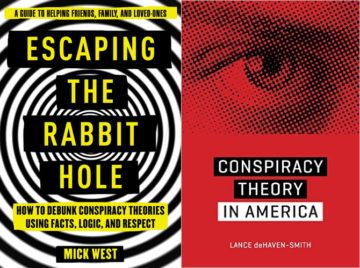

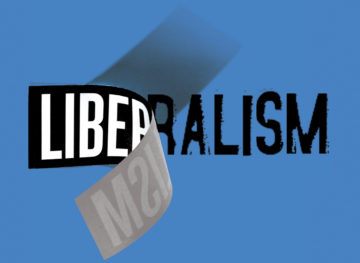 The world we live in is changing, and our politics must change with it. We are in what has been called the ‘anthropocene’: the period in which human activity is threatening the ecosystem on which we all depend. Catastrophic climate change threatens our very survival. Yet our political class seems unable to take the necessary steps to avert it. Add to that the familiar and pressing problems of massive inequality, exploitation, systemic racism and job insecurity due to automation and the relocation of production to cheaper labour markets, and we have a truly global and multidimensional set of problems. It is one that our political masters seem unable to properly confront. Yet confront them they, and we, must. Such is the scale of the problem, the political order needs wholesale change, rather than the small, incremental reforms we have been taught are all that are practicable or desirable. And change, whether we like it or not is coming anyway: between authoritarian national conservative regimes, which with all the inequality, xenophobia, or that of a democratic, green post-capitalism. The thing that won’t survive is liberalism.