by Brooks Riley

Though we are an aggregator blog (providing links to content elsewhere) on all other days, on Mondays we have only original writing by our editors and guest columnists. Each of us writes on any subject we wish, and the length of articles generally varies between 1000 and 2500 words. Our writers are free to express their own opinions and we do not censor them in any way. Sometimes we agree with them and sometimes we don’t.Below you will find links to all our past Monday columns, in alphabetical order by last name of the author. Within each columnist’s listing, the entries are mostly in reverse-chronological order (most recent first).
by Brooks Riley
by Mark Harvey
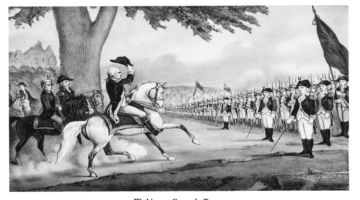
Here’s a weird thought: if it weren’t for 18th-century vaccines, America might have lost the revolutionary war to the British. That would have meant that all the anti-vaxxers today touting their freedom not to get a vaccine might have inherited quite a different destiny of eating scones and clotted cream under the British crown. Viruses have always been with us and they always will be, but in the early days of the revolutionary war, an invisible enemy probably killed more American soldiers than the British did. That quiet killer with no generals, no cannon, no forts, and no muskets was smallpox. The weapon against smallpox back then wasn’t truly a vaccine, for modern vaccines hadn’t been invented. But the inoculations were based on a similar principle of introducing a pathogen into a human to develop immunity to a disease.
It’s hard to know exactly how long smallpox has been with us, but we do know that it has been around for at least a few thousand years and probably killed Pharaoh Ramses V in 1157 B.C. When archaeologists unwrapped the linens and layers of resin preserving the pharaoh, his skin showed the characteristic pockmarks of a bad case of smallpox.
George Washington himself had suffered a bout of smallpox when he was traveling with his brother through Barbados at the age of 19. The illness incapacitated him for a solid month but also left him with a lifelong immunity, and a respect and understanding of the disease that would come to play a huge role in the revolutionary war and even the destiny of our country. Read more »
by Mike O’Brien

Last month I took a trip that had a profound impact on me. Departing from a small staircase, my short flight had stopovers on the edge of a sofa and a magazine rack, before finally reaching my final destination on the floor. Being the overly intellectual sort that I am, I proceeded though most of the itinerary head-first. As soon as it was over, I questioned how best to process the experience, and how it might change me as a person, going forward. (Lord, how I despise that expression. As if freezing or going backwards were options, plutonium-powered Deloreans notwithstanding.) I didn’t seek medical attention, given that I was half-vaxed at the time and not disposed to sitting in hospital waiting rooms with the Delta variant coming into bloom.
I had taken a similar voyage to the floor years ago, and knew the protocols for returning. The last time, I adhered as closely as possible to a 10-14 day regimen of silence, darkness, sleep and dietary fat, with an absolute prohibition on screens, reading, physical activity and alcohol. This is a much more stringent regimen than those prescribed by most Canadian health guidelines regarding concussions, for the same reason that dairy-producing countries prescribe more cheese in a balanced diet. To whit, if Canadian health authorities took the long-term effects of concussions seriously, we would have to cancel North-American-style hockey and football (and boxing and MMA and Judo and racing and that competition where Russians slap each other really hard), and any professional league with money in its pockets would be sued into oblivion.
I do take the long-term effects of concussions seriously, having taken a heap of psychology classes at the very neurologically-inclined McGill University (Go Martlets!), and having done a fair bit of rather rough martial arts (safely). Concussions scare the living daylights out of me, and I’m struck by the tone of much public health information on the subject, which seem to be structured around the question of when Timmy can lace up his skates again. Read more »
by Carol A Westbrook

Chocolate. The very word makes your mouth water; it conjures up images of childhood, of ice cream sundaes, of Valentine’s Day, of love. A small piece in your mouth makes you happy and improves your outlook—and makes you want more. chocolate is a stimulant, a mood elevator. And so many people reached for a piece of chocolate to help get through the dark days of the Covid-19 pandemic, as reflected in the increased chocolate sales during those months
Can chocolate really do all of these things? A surprising amount of research has been done to try to answer this question, with inconclusive results. Yes, there are pharmacoactive substances in chocolate, the most prominent of which is theobromine. This chemical which is named for the plant in which it was discovered, the cacao tree, (Theobroma cacao), the source of chocolate. Carl Linnaeus, the great Swedish botanist, gave the plant its name, perhaps in recognition of its importance to the natives that cultivated it. Theobroma contains the Greek words theo (god) and broma (food), meaning food of the gods—there is no bromine in the substance. Theobromine is a mild stimulant, similar to caffeine. It is also present in green tea and Yerba mate. A milk chocolate bar contains about 60 milligrams of theobromine, while dark chocolate has about 3 times as much. Consumption of an entire dark chocolate bar can have some pleasant mood effects, while three dark chocolate bars can cause sweating, trembling, and headaches. But keep your chocolate bars away from your dogs, because theobromine cannot be metabolized by animals, and it is toxic to them. Read more »

Mountains are very large. Look at the also-large, in its own way, three-story building in the lower-right of this photo taken in Brixen, South Tyrol, in June of this year.
by Nicola Sayers
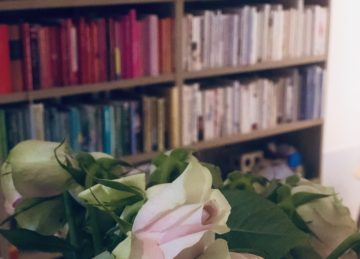
To be clear: I was snooty, too. I first saw colour-coordinated bookshelves in my friend’s home, and I have to admit that, even then, I liked the look. Each neatly stacked shelf, bright and orderly. It reminded me of the new packets of felt-tipped pens I used to love getting as a kid. But in the same moment, a well-trained habit of literary condescension kicked in (I blame grad school – at heart I’m more an enthusiast than a critic, but they beat that out of you pretty quickly) and I heard myself asking a series of cringey questions. Questions designed to belittle, to declare my own bookishness in some way superior to my friend’s. But how do you find the book you’re looking for? Isn’t it weird to separate books by the same author? How do they all look so clean? (Subtext: do you even read these books?)
But several years and a mild-to-moderate Pinterest addiction later, I found myself one rainy morning, stuck at home with a baby whose sweet smile did not, on that day, quite make up for her conversational shortcomings, and in need of some cheer. And so it was that, a few frenzied hours later, my husband came home to find all of our books rearranged according to colour. (His shelves, he’d no doubt want me to point out, have since been returned to what he views as their rightful order – yes, although we share children, a home and a bank account, our respective bookshelves are still clearly demarcated).
My reasoning behind the reorder was admittedly entirely superficial, but the effect was surprising. I look at, engage with, and even re-read my books much more since the change. Before, I had a feeling that I knew what was there: the classics, my Frankfurt School lineup, my ever-expanding gang of contemporary female writers, and so on. Now, my book collection is both more and less familiar to me. The pops of colour draw my eyes in more frequently, but I find that the thematic disorder left in the wake of the coloured order is also strangely welcome. I not only look at the books more often, I also look at them anew. Read more »
by Andrea Scrima
Oh patria mia, mai più ti rivedrò!
Mai più! Mai più ti rivedrò!
O cieli azzurri o dolci aure native
Dove sereno il mio mattin brillò
O verdi colli o profumate rive
O patria mia, mai più ti rivedrò!
(Oh my homeland, I will never see you again!
No more! Never see you again!
Oh blue skies and gentle breezes of my village
Where the calm morning shone
O green hills and perfumed shores
O my homeland, I will never see you again!)
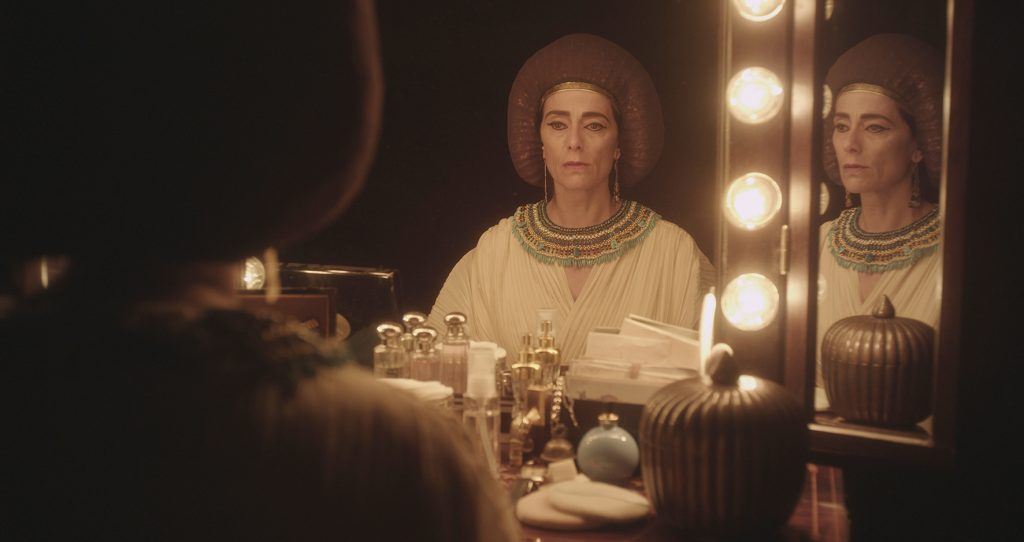
Giuseppe Verdi’s opera Aida premiered at the Khedivial Opera House in Cairo on December 24, 1871. A century and a half later, David Krippendorff sets his film Nothing Escapes My Eyes, which won the Berlin Short Film Festival in 2016, in a parking garage on Meidan el-Opera, or Opera Square, erected after the opera house was destroyed by fire. Verdi’s aria Padre, a costoro schiava non sono provides the soundtrack for a work that embodies nostalgia and absence in a precision of ambiguity that does not seek to reenact the opera, but present it as a metaphor within a metaphor, one uniquely suited to express the drama of identity with all the intensity it possesses in an individual’s life. Read more »
You do not need to leave your room. Remain sitting at your table and listen. Do not even listen, simply wait, be quiet, still and solitary. The world will freely offer itself to you to be unmasked, it has no choice, it will roll in ecstasy at your feet. ―Franz Kafka
From the top down is a magnificent square Jamawar shawl, circa 1870s, clipped to a dowel. I bought it about 40 years ago, when I still had petty cash, from a shop with a big sign board, “Shawl King, Lambert Lane, Srinagar, Kashmir” where I was born a Scorpio at Midnight. The shawl has the history of Kashmir woven into it, and more about that later.
Centered below the shawl is a large bright painting, oil on canvas. It’s titled “Vegetable Jewelry,” by Charles Hossein Zenderoudi, an Iranian living in Paris, the first Muslim or non-Western artist to achieve notoriety contemporizing the Arabic script, repeating just one alphabet across the width and breadth of the canvas. Imagine the prosperous belly of the English letter S but facing left, wearing a ~ (tilde) as a hat. That’s the Arabic letter ‘Hay or Hey:’ hay hey hay hey . . a sole hay playing its own solitary sonata.
Gracing “Vegetable Jewelry” on either side are small miniature paintings in the Mughal style, hand-painted on ivory, showing Mughal royalty in various romantic scenes inside a royal court, or on the rooftop reclined on serpentine-shaped divans upholstered with velvet, scented and shaded by blooms . . . Sigh!
There are family photos as well on this wall, all black and white. Here’s one of my younger brother Tariq, and myself, 4 and 7 years of age respectively, wearing white wool Pakols, a soft, round-topped Pashtun hat, in Murree, Pakistan in the 1950s. Chubby lads! I am beaming. Tariq has a faint smile. He was the youngest of six who, on his 63rd birthday, went for a swim in the Arabian sea off the coast in Goa. The sea, never known to give up her human bounty, washed his corpse ashore a day later. I miss him. Read more »
by Pranab Bardhan
All of the articles in this series can be found here.
 In spite of my abiding interest in literature when I came to college I was vaguely inclined to major in History. In the long break between school and college I chanced upon two books of Marxist history which opened me to a new vista of looking at history. The first was Maurice Dobb’s Studies in the Development of Capitalism. This book showed me that there is a discernible pattern in the jumble of facts in history, which attracted me. Soon after, I read a lesser Marxist history book, A.L. Morton’s People’s History of England which showed me how recasting the old widely-known history of England from the people’s perspective gives you new insights. These books whetted my appetite to read more of Marxist history.
In Presidency College there was a thriving tradition of Marxist history; the doyen of the historians there was the Marxist historian Susobhan Sarkar, who had inspired generations of history students there. (I managed to attend a couple of his lectures as a sit-in student, but soon he was to leave Presidency after a long career there). Sarkar’s son, Sumit, also a famous historian now, was a contemporary of mine in College. All around me, in College and in the coffeehouse, the dominant intellectual current was that of Marxists.
In College Street, the main thoroughfare in front of the College, and the road which I walked everyday between my home and College, was a-throb with energetic leftist movements, the most important of which were the protracted agitations in the demand for adequate food at affordable prices for the poor. Loud processions, barricades, blocking of streets, tear gas, police chasing of students, and occasional police shooting became part of my daily excitement. Read more »
by Ali Minai
 The events in Afghanistan over the last week are being seen as yet another “hinge moment” in history. The images of helicopters evacuating personnel from embassies and people chasing aircraft in desperation to get on them have been seared into the memories of all who have seen them. As a person from the region (Pakistan), a student of history, and as someone interested in the current state of the world, I too have watched these events with a mixture of amazement, trepidation, horror, and perplexity. It is not clear yet whether “hope” or “fear” – or both – should be added to that list. The things I say in this piece are just the thoughts and speculations of a non-expert lay person trying to make sense of an obscure situation. As will be obvious from the rest of this piece, for all the pain and suffering the new situation in Afghanistan will bring to people in Afghanistan, I think that the American decision to withdraw was the only rational choice. The alternative of staying on for years – perhaps decades – to build a better Afghanistan would just be another exercise in paternalistic colonialism. However, the way the withdrawal is happening is a great failure of American leadership and the blame for that lies mainly with the American policies of the last two decades. Perhaps its biggest failure was in not preparing Afghanistan for this day that was sure to come sooner or later. Now the Afghan people – especially women – will pay a price for that failure, but it may also come back to haunt the United States and other great powers. It has happened before….
It is tempting to see the fall of Afghanistan to the Taliban as a bookend with the events of 9-11. What happened that fateful morning in the US began a series of world-altering events that, it seems, have come full circle in Kabul today. The Taliban, ousted shortly after 9-11 by the US and NATO, have now ousted the US and NATO from Afghanistan to retake control. The wreckage of the intervening period lies scattered all over the world in broken societies, shattered lives, and altered states of mind. But are we done with all that? Has the humiliation of another great power – and it certainly is a humiliation – by another guerilla force broken the fever? Almost certainly not. Yes, Afghanistan seems to have returned to an approximate status quo ante. Yes, the United States seems to be turning inward to its own problems and westward to look warily at emerging Chinese power, seemingly writing off the regions that previously engaged its attention. But if there’s one lesson that can be learned from the events of this week, it is that the plans even of great powers are built mostly on hope and prayer. History always has other ideas.
Nor should it be taken for granted that what we see on the ground in Kabul today presages any sort of stability. The Taliban are the dog that have caught the car. It is far from clear if the car will stop, though it may slow down briefly. Afghanistan’s history over the last several decades – indeed, over the last two centuries – should make us skeptical. But that famous rhyming of history that is supposed to inform our surmise does often lapse into blank verse. Sometimes, things are different. To that end, consider two things. First, when the Taliban came to power in 1996, they were literally a ragtag Lord of the Flies bunch conquering the devastated landscape of a long civil war. This time, they are returning as a politics-savvy, battle-tested, well-organized group with a distributed leadership, a PR operation, and – very importantly – a rolodex worth of international diplomatic contacts. This is unlikely to turn them into benign liberals, but it can turn them into much more polished autocrats, which is a very dangerous species. Second, they are going to inherit the fruits of all the infrastructure, organization, and workforce development that has occurred – however imperfectly – under the US and NATO occupation in the last fifteen years or so. The Kabul the Taliban are walking into is a functioning modern city. If they just have the wisdom to exploit this gift rather than destroy it, they will start light-years ahead of where they began in 1996. But does any of this guarantee that their hegemony will last? Not at all! The other forces who have tasted power in the preceding decades are already gathering to regain some of it. The world should keep its eye on cities like Mazar-e-Sharif and Herat, and on the Panjshir Valley. The embers of resistance are surely alive in such places, and you never know where a wind might come from to fan them into a fire. That is why the moment at hand is not necessarily a hinge moment in history. It may turn out to be one in retrospect, but it is far too early to conclude that. Read more »
by Joseph Shieber
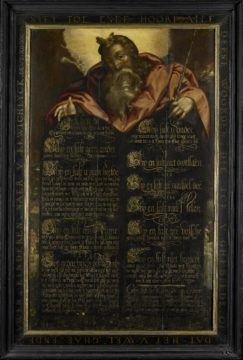
In a recent essay on Slate, Phil Zuckerman, Professor of Sociology & Secular Studies and Associate Dean of Faculty at Pitzer College and the author of the 2020 book, What It Means To Be Moral: Why Religion is Not Necessary for Living a Moral Life suggests that atheists are more moral than religious believers.
It’s important to be clear about the claim Zuckerman is defending. In particular, in contrast to the stated thesis of his book, Zuckerman is not arguing that religion is not necessary for a moral life. Rather, in his Salon essay, Zuckerman instead suggests that nonbelief is in fact more compatible with morality than religious belief. As Zuckerman puts it, “When it comes to the most pressing moral issues of the day, hard-core secularists exhibit much more empathy, compassion, and care for the well-being of others than the most ardently God-worshipping.”
Zuckerman’s brief for the moral superiority of nonbelievers consists of a list of the positions held more often by nonbelievers than the most dedicated religious believers. In addition to prizing public health during the Covid-19 pandemic, affirming the truth of anthropogenic climate change, and pursuing gun control measures, Zuckerman provides a laundry list of other positions that he suggests highlight the nonbelievers’ greater moral standing:
In terms of who supports helping refugees, affordable health care for all, accurate sex education, death with dignity, gay rights, transgender rights, animal rights; and as to who opposes militarism, the governmental use of torture, the death penalty, corporal punishment, and so on — the correlation remains: The most secular Americans exhibit the most care for the suffering of others, while the most religious exhibit the highest levels of indifference.
My sense is that I actually agree with Zuckerman that the positions that he associates with nonbelievers are the morally right ones. Nevertheless, I am not confident that Zuckerman’s argument establishes what he thinks that it does. Here are three reasons why. Read more »
I thumb down the stack of books:
Paper Dance—55 Latin Poets
Poetry Like Bread (full as loaves
my mother made) subtitled
Poets of the Political Imagination
and here’s Billy Collins Sailing Alone Around the
Room—which is pretty much what we all
do to a great extent
until, at the bottom:
Precise V-5
which is not a book at all
but the label on the black pen
that lies here in incandescent light
at the bottom of a ziggurat of books
its axis aligned with their stepped spines
upon the golden oak table so perfectly here
for a moment Buddha is
“See,” he says, “I’m as real as
as joy and lament”
by Jim Culleny
by Martin Butler
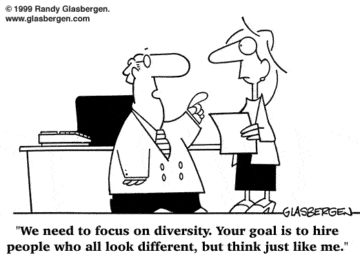
Diversity is all the rage. It has even reached the boardrooms of the UK’s top companies and indeed those that are not so top. Targets are set for the percentage of women and ethnic minorities who should populate these boardrooms. A group known as the 30% Club aims for “30% representation of women on all FTSE 350 boards” and “to include one person of colour”.[1] We are told that although we have some way to go, things are moving in the right direction. This all seems very progressive and few voices, even from the more conservative corners of the business world, object. But there’s something odd about this. Why has an idea about boardroom composition that would further the interests of a diverse population to a far greater extent (and which has been around in the UK since the 1970s) been implacably opposed by the business world? What is even more puzzling is that, far from finding the wholesale acceptance achieved by the aims of the 30% Club, this idea has been rejected out of hand without shame or negative publicity. The idea is that boardrooms ought to incorporate an element of democracy, that employees in a company ought to have at least one elected representative on the board of directors who can advocate for their interests. There is no club to promote a modicum of democracy in UK boardrooms, and there is no pressure for one either.[2]
In the UK, the Bullock Report of 1977 recommended a system of worker directors on the boards of large companies, an idea to those of my generation which seemed as compelling as the idea that boardrooms should be ‘diverse’ is to today’s generation.[3] Of course this report was never implemented, and the coming Thatcher years saw the rise of the neoliberal ideal that the prime purpose of any public company was the ‘maximization of shareholder value’ (known as the Friedman doctrine after the economist Milton Friedman[4]). This excludes any room for boardroom democracy. Over the last two decades there has been talk of a company’s ‘stakeholders’ – in other words, all those with an interest in the success of a company (not just shareholders) – but no mechanism has been introduced that might actually rebalance the scales in favour of the ordinary employee. Short term profits and shareholder value reign supreme. Teresa May timidly suggested introducing some kind of worker representation on the steps of Downing Street after the 2017 election, but again this idea was quickly buried by the powerful business lobby. The experience of the last 50 years seems to be that if companies can get away with low pay and degraded working conditions, by and large they will, which is why the Labour government needed to imposed a minimum wage in 1998. Read more »
by Derek Neal

As far as I know, Bret Easton Ellis is the only person with the audacity to charge money for a podcast. Every other podcast I listen to is free or at least becomes free shortly after an exclusive period for subscribers. While Ellis’s podcast used to function in this way, a couple of years ago he started charging two dollars per episode, and I stopped listening.
In truth, this is a reasonable price. The podcasts are two to three hours long and feature interesting guests, usually from the film world. For the time and effort he puts into it, it’s worth the money. And yet I’m of the generation who grew up downloading music for free, streaming pirated TV shows and movies, and torrenting expensive music making software. I’ve downloaded thousands of dollars’ worth of stuff for free. I’m not trying to justify my actions, but asking me to fork over two bucks for a podcast (a podcast!?) is a lot. Expecting me to pay seems like a violation of my rights, or something.
Nevertheless, on a day a few weeks ago circumstances conspired against me: I was in a city that I’d moved to during the pandemic, where I knew no one. I was alone in my studio apartment. I needed some human companionship, and Ellis had just released a three hour conversation with Quentin Tarantino. To make matters worse, I’d watched Tarantino’s film Jackie Brown for the first time a week or so prior and had been listening to its soundtrack of late 60’s and 70’s soul and funk non-stop. What can I say, The Delfonics are pretty good. With all these forces stacked against me, I was powerless to resist. I cursed Bret Easton Ellis and punched in my credit card number. Then I called my father to give him my login information and see if he wanted to go in 50/50 with me.
As I started to listen to the podcast, I was surprised to discover that it began not with a monologue from Ellis, as it did when I had listened in the past, but with a reading of a new chapter from his memoir/novel, The Shards. I was immediately hooked. Read more »
 Sughra Raza. Temple Wall Philosophy. Galle, Sri Lanka, 2010.
Digital photograph.
by Godfrey Onime

At the physicians’ lounge recently, a colleague asked me, “How are the new interns? Aren’t you glad another July is over?”
I told him that our new class of first-year medical residents, or interns as they are commonly called, seemed quite strong. As for his celebratory comments about the vanquishing of July, I knew what he meant. After all, a common sage in American teaching hospitals is, “Don’t get sick in July.” The reason for this sentiment is because that’s when most of the doctors are the most green, or inexperienced.
It happens that when we consider medical errors, the level of experience of a doctor or other healthcare providers — as with any profession for that matter — is quite important. Less experience often equals more mistakes – from writing to accounting to carpentry. These screwups can become learning opportunities for these professionals. But medicine is different. Often, people die.
The so-called July effect in American teaching hospitals is one example of how inexperience can come to bear in the vexing world of medical errors. For one, July 1st or thereabout is the date when fresh medical school graduates transform into new interns, ready to practice — on you. That’s when they begin to zig-zag about the hospitals at frenzied paces in their yet shinny, starched white coats and introducing themselves as Dr. Superman (or woman). To truly understand the forces at play here, let’s for a moment get into the head of the new intern. Read more »
by Tamuira Reid
I.
I lost my father in August 2017. My son lost his a year later. I’ve always hated summer. Maybe because I was born on a cold January morning and I’ve got winter running through my blood. Maybe because the warm days always felt suffocating to me, in their endlessness. Maybe because it’s when everyone dies.
My father’s death was not a quick one off but a slow easy spread, permeating every organ, every passageway, every out he had left. Death teased him. Came at him hard then relented just long enough to make its presence known. To him. To us. To everyone at home who had their health still, dotting the hills of the small valley town around us. It pushed and pulled until every last hope for a dignified ending was filibustered. Until the man who had somehow managed to avoid hospitals for the better part of his life knew, very clearly, it would be the last place he’d see. One wall, three curtains, and a gurney. The daughters and the wife. The younger by not much brother who had already seen how this would play out because after all, cancer is no stranger in the branches of the Reid family tree.
The surgeon was wheeled into my father’s room – his concerned, televised face, skyping from a nearby trauma unit – to break the news. All systems a fail. Nothing more to be done.
I couldn’t help but think that if he were younger, they’d do more. Try harder. Not give up.
I told the nurses that the man in the bed bared no resemblance to our real father. Our real father still hiked and lifted weights and hauled timber without getting winded. Our real father could annihilate The Times Sunday crossword in under thirty minutes. Our real father read Huck Finn at eight years-old and Steinbeck at ten. Our real father could do anything they could, except save his own life.
But in the end, cancer is cruel. It’s ugly and thoughtless. And it couldn’t give two shits about who you might’ve been before it got there. Read more »
by Dick Edelstein
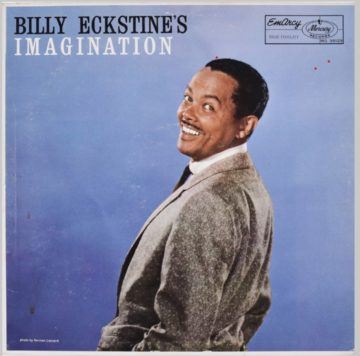
Not all jazz fans today will understand why an ultra-talented singer and musician like Billy Eckstine aspired to be a famous crooner. But his full, rich bass-baritone voice was ideally suited to that singing style – his voice was as smooth as that of Der Bingle, as Bing Crosby was affectionately known in those days. And crooners were the most admired singers in the 1940s, although it hardly escaped notice that they were all white men. Crosby topped the list of popular crooners – he was idolized by Sinatra – and his style was not merely influenced by jazz; he had built his reputation by fronting prominent jazz bands like the Paul Whiteman Orchestra, whose music suited the taste of white America. Crosby was good at that style of singing, sure, but Billy Eckstine could do as well without breaking a sweat and he wanted to prove it.
In a previous article I discussed how Billie Holiday’s vocals reflected the sound of horn solos. Eckstine, a friend of hers and a contemporary, was part of that story. An innovator, like Holiday, he too incorporated horn styling into his vocals, particularly when he was singing big band arrangements. This came naturally enough since he was a talented horn player who regularly performed on trumpet and trombone. His singing style was not like Holiday’s, but each found their own way of bringing the sound and feeling – and the excitement – of horns into their vocals. Eckstine didn’t imitate Holiday’s mercurial rhythmic shifts and unusual inflections; his vocals sounded more like studied compositions, ornamented with his faultless vibrato, which industry figures called the widest in the business. What the two singers had in common was their use of vocal styling to give expression to lyrics as they incorporated up-to-the-minute styles like progressive jazz and bebop into their expanded palette of vocal effects. Also, both of them were not only composers of popular hits, but successful lyricists as well.
So how great a singer was Eckstine? Read more »
by Brooks Riley
by Pranab Bardhan
All of the articles in this series can be found here.
One remarkable redeeming feature of my dingy neighborhood in Kolkata was that within half a mile or so there was my historically distinctive school, and across the street from there was Presidency College, one of the very best undergraduate colleges in India at that time (my school and that College were actually part of the same institution for the first 37 years until 1854), adjacent was an intellectually vibrant coffeehouse, and the whole surrounding area had the largest book district of India—and as I grew up I made full use of all of these.
College life was a big and refreshing change for me in many ways. There was a lot of independence and opportunity to think in new ways and participate in a great deal of vigorous discussion in a whole range of discourse, including radical thoughts and risqué topics. Interaction with so many bright young minds all around was scintillating. Also, the proximity of so many women (this was my first experience of a co-educational institution) added to the excitement. There was, of course, a lot of one-upmanship, intellectual pretensions, and showing-off. But in general the discussion both in college, and in the coffeehouse (which was really an extension of the college) usually rose above all that. There were invidious class distinctions among students, many of them coming from far richer households than mine, thus with more access to not just material goods—they were much less shabbily dressed than I was–but cultural artifacts and networks and the inevitable name-dropping. But soon I figured out that I was not any less well-read and politically less aware or informed than some of the rich or culturally snobbish students, and that, to my giddy delight, even some women were prepared to listen to what I had to say. Slowly I developed an intellectual confidence to overcome some, though clearly not all, of the class barriers. Read more »