by Mike Bendzela

The term “Little Apocalypse” is borrowed from New Testament studies, referring to the Olivet Discourse in Jerusalem. This speech first appeared around the year 70 CE, in Chapter 13 of the original written gospel, the Gospel of Mark. After the scene of the cleansing of the temple, before the Last Supper and the arrest, one of the disciples draws attention to the massive stones of the temple, evoking from Jesus the promise that the temple would be destroyed. They sit “on the Mount of Olives opposite the temple” (hence “Olivet Discourse”), and the disciples ask Jesus to elaborate, thus prompting his long monologue predicting the End, when “Heaven and earth will pass away,” a view to be developed later in what might be called the “Big Apocalypse,” the Book of Revelation.
“Apocalypse” in its Greek sense means an “unveiling,” particularly when a visionary prophet or writer is vouchsafed a revelation of God’s plan. Emily Dickinson’s vision of the cosmic order in the poem “Safe in their Alabaster Chambers” is much briefer than Jesus’s Little Apocalypse but is no less striking. Her vision extends beyond traditional Christian boilerplate imagery to encompass something distinctly more up-to-date.
The poem’s first stanza discloses a portrait of the Christian dead lying in their tombs, awaiting the End of Days:
Safe in their Alabaster Chambers—
Untouched by Morning—
and untouched by noon—
Sleep the meek members of the Resurrection,
Rafter of Satin and Roof of Stone—
The utter stasis of the scene is housed in a single inverted sentence, in which the predicate comes first, with the sentence’s only verb–“sleep”–continually delayed by those “untouched” phrases. Then, finally, appears the subject, “the meek members of the Resurrection,” lying there inertly near the end of the sentence. The whole thing is capped off with a metaphor of a dwelling, the “Satin” interiors of their coffins represented as “Rafter” and the “Stone” tomb covering as “Roof.” Read more »






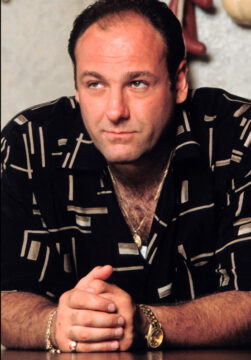 In an attempt to understand my relationship to the Italian-American identity, I recently began watching episodes of The Sopranos, which I avoided when it first aired twenty-five years ago. I was on a nine-month stay in New York at the time, living in a loft on the Brooklyn waterfront, and I remember the ads in the subways—the actors’ grim demeanors; the letter r in the name “Sopranos” drawn as a downwards-pointing gun. I’ve always been bored by the mobster clichés, by the romanticization of organized crime: as an entertainment genre, it’s relentlessly repetitive, relies on a repertoire of predictable tropes, and it has cemented the image of Italian Americans we all, to one degree or another, carry around with us. But the charisma of Tony Soprano, played by James Gandolfini, exerts an irresistible pull: I jettison my critical abilities and find myself binge-watching several seasons, regressing for weeks at a time, losing touch with what I was hoping to find.

 I was listening to “
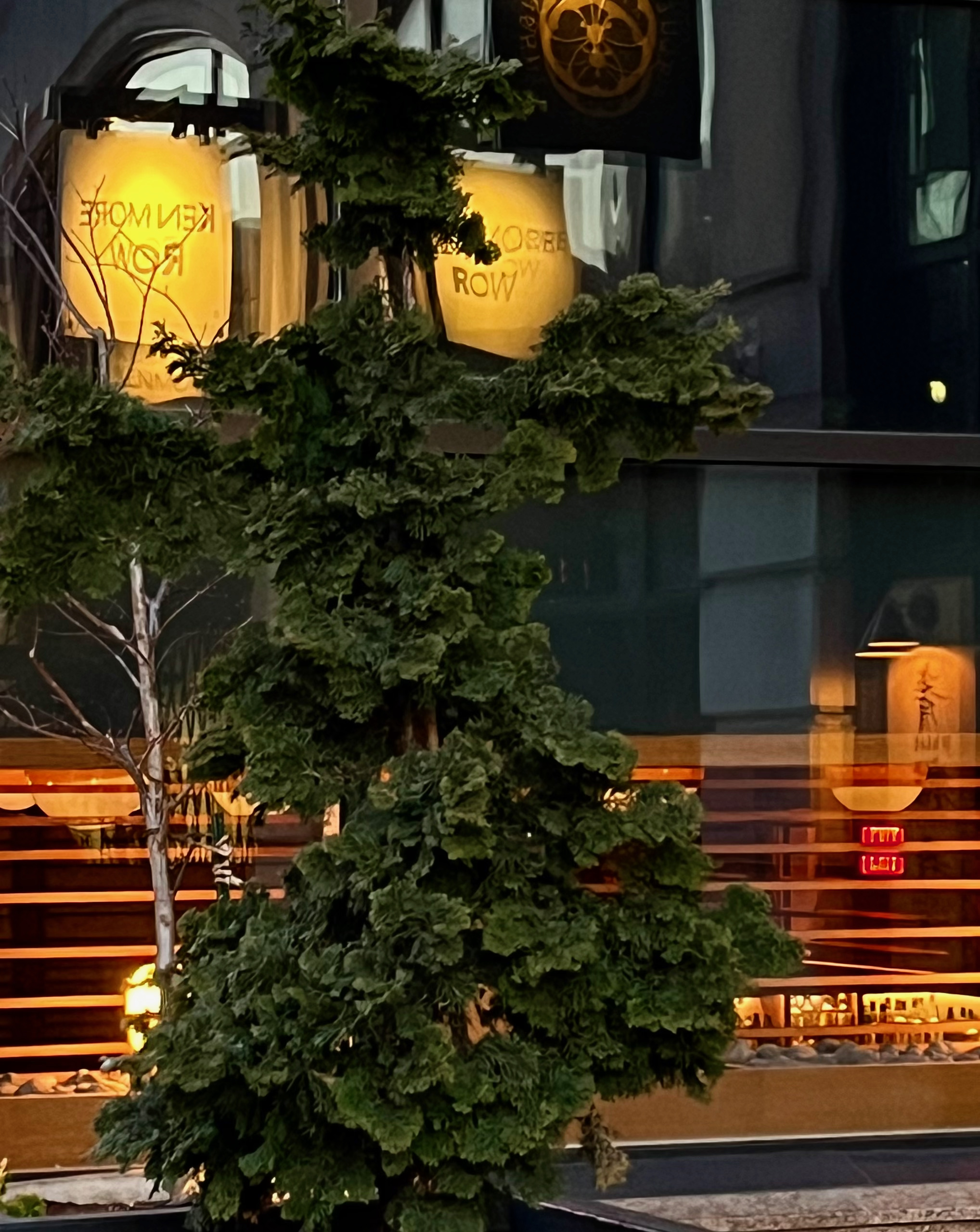 Sughra Raza. Random Street Composition While Walking Home, March 2, 2024.