by Monte Davis
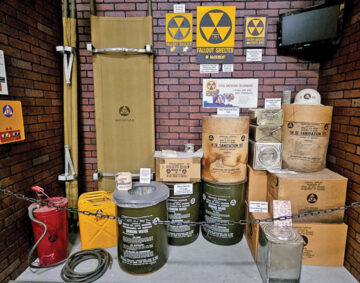
If you know more about fallout shelters than a dark TV comedy based on a video game, you probably know that people are still finding relics in basements and storerooms of old schools, hospitals, and factories: olive-drab drums of water, cartons of high-nutrition crackers, first-aid and sanitary supplies, even bicycle-driven fans to bring in filtered air through a vinyl hose. Boomers have a few snapshot memories, their children and grandchildren just the memes: “duck and cover” exercises, CONELRAD emergency warnings (their loud hum surviving in weather warning and AMBER alerts), and the yellow-and-black trefoil signs.
For me, the snapshots are frames in a private documentary: Nine Hot Weeks, with Misgivings. In 1967, I spent the summer after my first year of college in a thousand or so basements, surveying potential sites for those shelters in El Barrio, aka East Harlem, Manhattan, New York City. Two-man teams were dispatched in pairs with computer printouts listing every building in our assigned area, as other teams covered other neighborhoods. We also carried a letter of introduction in several languages, which asked building owners, superintendents, and ground-floor businesses to cooperate. Because the Big Apple was well connected, the letter was machine-signed by President Johnson as well as Mayor Lindsay. Because the Army was well connected — and 1967 was yet another long, hot urban summer — the NYPD supplied a patrol officer to accompany us and radiate yes, please cooperate vibes at the front door. (That chickenshit assignment must have gone to the least popular rookies in the precinct.) But we appreciated their presence, as neither I nor my partner Vytautas Jankauskas – an immigrants’ son a few years from Kaunas, Lithuania, with silver-blond Baltic Targaryen hair – could pass for a homie.
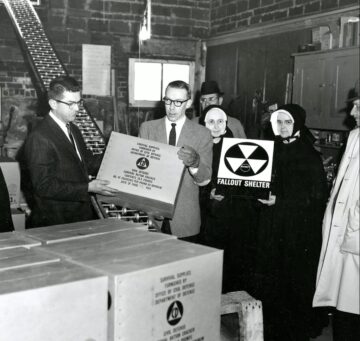 How did the survey come about? FDR had created an Office of Civil Defense in 1941, but it took the USSR’s first atomic bomb test to prompt Truman to reboot it in 1950 as the Federal Civil Defense Administration. In 1958 the FCDA begat Eisenhower’s Office of Civil and Defense Mobilization; in 1961 the OCDMA, moved by Kennedy from the executive into the Defense Department, became the Office of Civil Defense (tradition!), which soon launched its National Fallout Shelter Survey Program. Including those designated earlier, by 1963 the government had identified shelter spaces for 121 million people, and stocked enough of them for 24 million. Read more »
 For a couple of days, some things at 3QD may not work exactly as expected. We will be updating some of the pages at the site in the next few days. We appreciate your patience!
 .
.
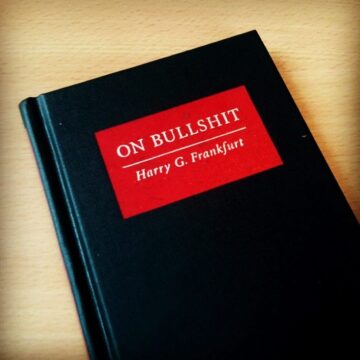 Some things in life are very hard to give up. For me, I hope in a most singular manner, it is bullshit. I have spent nearly twenty years reading whatever literature I can find on what bullshit might be. Since the publication of Professor Harry Frankfurt’s
 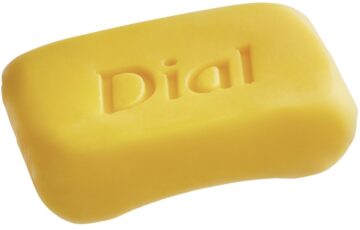 In the late 1960’s and early 70’s, my maternal grandmother spent a lot of time in the United States. She would return to Iran, her suitcase filled with presents like candy and fruity bubble gum for her grandchildren, and pretty shirts and dresses for our mom. She also brought back a part of her daily American life: cartons of red Winston cigarettes, Crest toothpaste, hand and face creams with English writings on the bottles, and Dial Soap in that beautiful saffron gold color that was unlike any soap I had seen or smelled before. Our soaps in Iran were usually either flower scented and over perfumed, or green and organic because of the local olive oil used to make them. Everyone valued the green soaps, but I just wanted the American gold soap. I would watch her put the soap back in a plastic container after her shower to keep it from drying and when she was away from her room, I would go open the plastic container and smell the