by Hasan Altaf

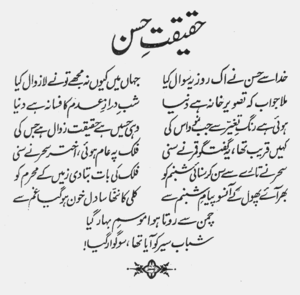
“Pity the Nation,” Justice Khosa's addendum to the court's decision, has struck quite a chord. It has earned slaps on the wrist not only from the Prime Minister's counsel, but also from a former ambassador (who would like to shift the conversation entirely – “cit[ing] poetry instead of law while sentencing an elected leader on questionable charges reflects Pakistan's deep state of denial about its true national priorities” – as if the accountability of leaders were not a hallmark of a functioning democracy; as if in focusing on extremism and terrorism we should ignore all the other injustices of the country; as most of what happens in the government of Pakistan is not “questionable”) and an Express Tribune columnist who saw Khosa's Gibran and raised him a Byron. It has also become a Twitter catchphrase that within a few days has been used across the political spectrum (PML, PPP, PTI, P-ick your own), for matters personal (“…where children of judges get admission in aitchison college even after failing the entry test”) and national (loadshedding), for criticism of literature (“…where bad poetry is appreciated”) and tradition (“…where political parties are transferred over a will like family property”), and even the requisite clever meta-tweets invoking pity for the nation that pities itself on Twitter.
Justice Khosa's cri de coeur led me to feel pity mostly for Justice Khosa – and, by extension, the rest of our “public servants.” Being a Pakistani has become hard enough; seeing what has become of the country (what has been done to it, what has been done to us, what we have done to ourselves and to our country and to each other and to others) is hard enough; caring about Pakistan has become, in a time when every day brings bad news, hard enough. Imagine being one of those who truly does make it what it is, who truly has the power to shape and control some portion of the country's destiny; it must be impossible to sleep at night. Considering the bizarre situation in which the Court has been placed and has placed itself (the chain of causes and effects here, the schematic of who is scratching whose back and how and why and when, is so ridiculous that to talk about is pointless), the justice's poem seems to me an entirely understandable response, the breaking of the camel's back by a particularly absurd straw. And sometimes, as any self-respecting angst-ridden teenager will tell you, there really is nothing to do but write a poem and put it online.