by Leanne Ogasawara
“Every night God takes his glittering
merchandise out of his showcase–
holy chariots, tables of law, fancy beads,
crosses and bells–
and puts them back into dark boxes
inside and pulls down the shutters: “Again,
not one prophet has come to buy.”
–Yehuda Amichai
Jerusalem: utterly obssessed by the place, I even love finding copies of the holy city– both imaginal and real. There are, for example, William Blake's rural England of his imagination (Ah, Jerusalem) and the Puritan's “city upon a hill” in America. There are also the real Jerusalems built of brick and stone.
Such real-life copies can be found mainly in European cities, from Cambridge to Bologna. My own favorite “new Jerusalem” is the holy city of Lalibela in Ethiopia, however, where it is believed that pilgrims receive the same blessing visiting that city as they would if they had visited Jerusalem itself. It is a place I long to see someday.
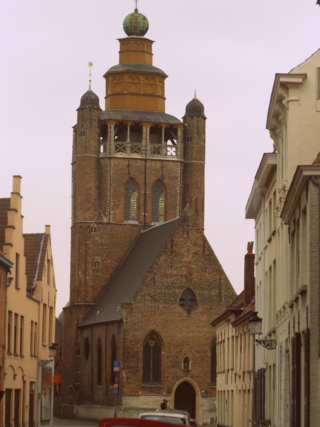
Despite knowing that copies of Jerusalem can be found dotted around Europe, I never really expected to find one so far north as in the Flemish city of Bruges.
Belgium's greatest poet Guido Gezelle referred to the city as a “copy of the holy land.” But, in the movie In Bruges, the mob boss Harry calls the town a “fucking fairy tale.”
In any event, my astronomer and I were visiting the city on a van Eyck pilgrimage. Starting in Paris, we looked at van Eyck pictures in the Louvre, in Ghent and then in Bruges –and I was struck over and over again by the way time was conflated in the paintings. Like a wormhole connecting discrete and distant points in time, these late Medieval and early Renaissance pictures were stunningly transportive in terms of time and space so that, for example, Mary and the baby or the Lamb were depicted side-by-side with contemporary figures. Contemporary donors appeared in the paintings accompanied by their patron saints, who thereby formed a link between these two worlds. The church authorities not surprisingly clamped down on this practice and the early Renaissance donor portraits disappeared –but it was in Bruges that I realized how wonderful it would be to see oneself in a picture like that. If I lived back then, I certainly would have desired a picture of myself like that, depicted alongside saints, pilgrims and God. Is it not the ultimate selfie?