by Zaheer Kazmi
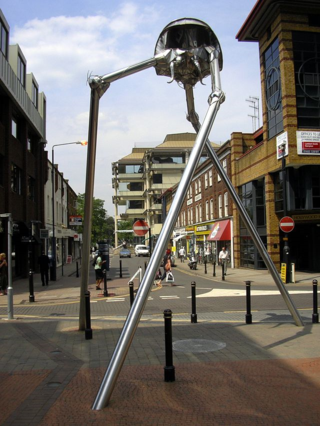
Did the Martians that landed at Horsell Common live on in the souls of dead Muslim soldiers? Just over a century before the ‘War on Terror', H. G. Wells penned his own fin de siècle mythic battle to protect God's empire. The setting for the alien invasion in The War of the Worlds (1898) was later to become the final resting place of some of the British Empire's Muslim fallen. Yet the Muslim Burial Ground at Horsell Common is only part of the trans-global history of Woking in Surrey, the outlying town at Greater London's edge. In 1889, nearly a decade before the publication of Wells's classic allegory of imperial anxiety, England's first purpose-built mosque, the Shah Jahan, was constructed in Woking by Gottlieb Wilhelm Leitner, a Hungarian Jew. Wells himself lived in the area at the time of writing his book. He would have been aware no doubt of the mosque just beyond the railway line that ran along his lodgings in Maybury Road. He would also have known of the vast nearby London Necropolis, or Brookwood Cemetery, where, among its Muslim graves, two of the most influential translators of the Qur'an into English were later to be buried: Marmaduke Pickthall and Abdullah Yusuf Ali, the former, an English convert, the latter, an Indian Ismaili Bohra.
Space and time collapse in a nondescript part of suburban England where Muslims and aliens live and die. Until very recently, Brookwood Cemetery, the largest in England, was owned by Turkish Cypriots, the Guney family, who had founded Britain's first Turkish mosque in 1977. Their fate was intimately tied to their involvement in far off battles with Greek Cypriot compatriots in that divided island's wars of resistance with their strong religious undertones. Barely a few miles away, the environs of Woking where Wells resided still retain small tightly-packed Victorian terraces, several of whose current Muslim inhabitants, of which there are now many, hark from the Subcontinent. In one of these houses, in Stanley Road adjoining Wells's Maybury Road retreat, the latter-day Dickensian chronicler of working-class life, Paul Weller, grew up to find artistic inspiration while his mother worked as a cleaner at the local mosque. Years later, in his ode to nostalgia, ‘Amongst Butterflies', he would retrace his steps to Horsell Common where he played as a child, reminiscing that ‘God was there amongst the trees' by the soldiers' tomb. He also paid his own respects to this sacred confluence of memory by pledging to help finance the burial ground's restoration.