by Carl Pierer
 Fig. 1
Braids are fairly simple to picture. A few interleaved strands of string, say, gives a complex and mesmerising object. They are aesthetically appealing, as their widespread use as ornament testifies. While most will be familiar with the standard braid used for braiding hair, there is basically no limit to complexity and beauty. Yet, braids are more than merely nice, artistic adornments for clothes and jewellery. The more and deeper you delve into braids and their complex interconnections, the more fascinating they become. Trying to look at them with a mathematical eye opens up pathways and connections to many deep and beautiful fields of pure mathematics.
Studied as mathematical objects, braids need to be defined rigorously. However, for present purposes it is enough to specify what we intuitively have in mind when thinking about braids. (Fig. 1) may well serve as an example. A braid consists of a certain number of strands n, say, together with a specification of how and where these strands cross each other. Furthermore, these strands (if they are not crossing) run parallel and we may adopt the convention that they are running from top to bottom. To avoid ambiguity, we require further that there are no two crossings at the same horizontal level. It is clear that for the braid to have any crossings at all, it must have at least two strands. If a braid does not have any crossings, it is called the trivial braid.
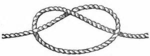
Braids also have a close connection to (mathematical) knots. Mathematical knots are simply everyday knots where the loose ends have been joined together. If you take an overhand (or trefoil) knot (Fig. 2) and join the loose ends, you have a mathematical knot. Imagine an extension cords where one end has been plugged into the other. One important feature is that there is no way of undoing this mathematical knot by pulling or stretching or any other deformation that does not break the connection. If you reconsider our
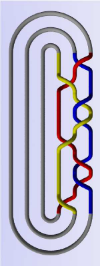
initial braid (Fig. 1), imagine that the ends have been joined up as in (Fig. 3). As all loose ends are now joined up, we can consider (Fig. 3) as a mathematical knot. Indeed, every mathematical knot can be expressed as a braid. Unfortunately, this is not a one to one correspondence. So, two different braids may end up as the same
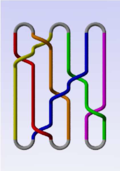
knot. Or one and the same braid may give you two different knots. One problem is that there is no particular reason to join up ends of the braid as we did in (Fig. 3). If we have an even number of strands, we can equally well join up the endings that are next to each other (as in Fig. 4), which would give a very different beast altogether. Indeed, this is not a knot anymore but a so-called link, because it consists of 4 different components. A knot is a one component link. However, this connection between braids and knots is not the main concern here.