by Jonathan Kujawa
(this is the sequel to last month's 3QD essay on the Pancake Problems)
I frequently come across a rafter of wild turkeys on bike rides through the countryside near my home. This particular group is recognizable thanks to having a peahen as an honorary member. Just this morning I was treated to a startling surprise: the peahen was busily herding a brood of chicks! I would have thought peacocks and turkeys were too distantly related to successfully breed. Apparently nobody told the peahen. I haven't seen any other peacocks in the neighborhood, so it would seem that she is more than friends with one of her turkey buddies. According to the internet, peacock/turkey hybrids (turcocks? peakeys?) are a thing which can happen.
Going by looks and their natural geographic ranges, my wrong guess was that peacocks and turkeys should be pretty distant on the tree of life. In the not-too-distant past, classification of species depended on such observational data.
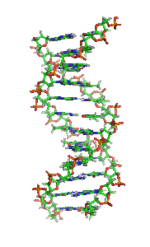
It's one thing to have the data, it's another to put it to use. To deal with the flood of information pouring out of DNA sequencers an entirely new field called computational molecular biology has sprung up. It's a wonderful combination of biology, mathematics, and computer science.
Even better, Palmer and company saw that the kind of rearrangements which occur are of specific kind. When a mutation occurs, what happens is that a segment of DNA consisting of some number of genes is snipped out, flipped around, and put back in, now in reverse order. For example, if genes were the numbers one through five, a typical sequence of mutations might look like:
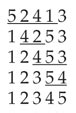
Here at each step the segment of genes to be snipped out and reversed is indicated with an underline. Because each mutation reverses the order of some of the genes, folks call it a reversal.