— 'You may call it “nonsense” if you like … but I've heard nonsense, compared with which that would be as sensible as a dictionary!'
—The Red Queen in Through the Looking-Glass
by Richard King
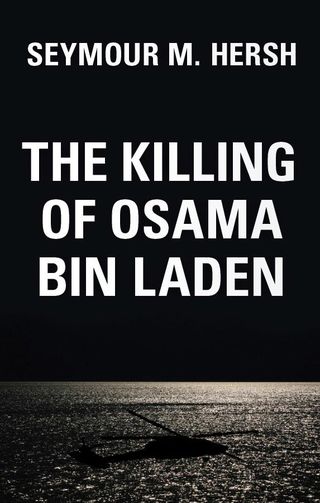
I am certainly not the first to notice how the reaction to Hersh's article – which was published in the London Review of Books and alleged, inter alia, that the CIA had lied about the provenance of the information that led the Navy SEALs to Abbottabad; that Pakistan's military leaders had secretly agreed to the murder/execution of Osama bin Laden; that a frail and unarmed bin Laden was killed, not at the end of a chaotic shoot-out, but at close range and with high-calibre rifles; and that his mangled body was thrown, bit by bit, from a helicopter over the Hindu Kush – displayed a lack of journalistic rigour. A few days after the story broke, Trevor Timm published an essay in the Columbia Journalism Review anatomising the media's response to the piece. Noting that the online magazine Slate had run no less than five hit-jobs on Hersh's story in the space of just thirty-six hours, and noting as well the collective deaf ear turned to the many documented falsehoods offered by the CIA to the US government and by the US government to the US citizenry, Timm described that reaction as ‘disgraceful'. This was the kind of press, he implied, of which most governments can only dream. No wonder the White House Press Secretary Josh Earnest looked so relaxed when he fronted the media in order to rebut Hersh's version of events.
The principal allegation levelled against Hersh (who has recently published the essay in book form) is that his story is ‘a conspiracy theory' – a fantasy concocted on the back of sources too scarce and too anonymous to be trusted. This is a charge to which Hersh's record of breaking big stories is apparently no impediment, though anyone making it feels called upon to pay the grizzled old muckraker his due, noting in particular his sterling work on the My Lai massacre (for which he won a Pulitzer) and his key role in breaking the Abu Ghraib story.



 Math works pretty well. We can count apples and oranges; we can scribble equations and then launch a rocket that lands gently upright. When an argument is indisputable, we colloquially say “do the math,” and we speak of events that will happen with “mathematical certainty.” Math works so well that you're forced to wonder: why, and what does it mean about our world? I won't fully answer these questions, but I'll offer a few perspectives.