by Hari Balasubramanian
Just as the distribution of wealth exhibits dramatic skews – a small percent owns a disproportionate share of the total wealth – so too does the distribution of healthcare expenditures. When individuals in the US population are ranked based on their healthcare expenditures in a particular year, then it turns out that:
1. The top 1% of individuals account for 22.8% of the total healthcare expenditures
2. The top 5% of individuals account for 50.4 % of the total healthcare expenditures
3. The bottom 50% account for only 2.8% of total healthcare expenditures
https://meps.ahrq.gov/data_files/publications/st497/stat497.pdf
(Healthcare expenditures refer to all payments made related to health events – either by insurer or out-of-pocket.)
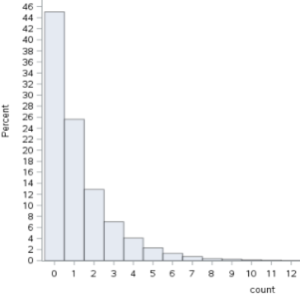
A similar trend emerges when we look instead at the prevalence of health conditions. If we were to plot the percent of individuals in a population (y-axis) who had no health conditions (count=0 on the x axis), exactly 1 health condition (count=1), exactly 2 health conditions (count=2) and so on, we would get something like the graph to the right. About 45% of the population has no apparent health conditions; about 25% has exactly one health condition; 12% has exactly two health conditions. The percentages start to decline as the count of conditions increases, indicative of the few who have 6, 7, 8, 9 or more conditions. We are now at the tail of the distribution where healthcare costs are most likely to be concentrated.
Because most of us in any particular year are healthy, the challenges faced by this small segment of the population can remain somewhat distant. Yet at some point in our lives – hopefully later than earlier or even better not at all: who can say – there is always a chance that we might join their ranks.
In this column, I will present visualizations of healthcare use by individuals at the tails of the cost and health condition count distributions. I started creating these visualizations while researching a publicly available dataset called the Medical Expenditure Panel Survey – MEPS for short. This is the same dataset that was used to characterize the expenditure distribution above. Aggregate trends are valuable, but it is by looking closely at individual cases that one can begin to sense what is going on. Each year MEPS collects granular data on health events for members of thousands of households across the United States. Households are chosen in the survey to represent the national demographic; each household is compensated for the time spent filling out questionnaires. To protect the identities of those surveyed, the data is anonymized before it is released to the public.