
by Thomas R. Wells
Suppose a company wants to fill a job. They would advertise it together with the requirements for any successful candidate. HR would screen out all the applicants not good enough to do the job and everyone else’s name would go into a lottery.
 Do you find this prospect upsetting? Perhaps you think it is unfair for someone to get a job without a good reason for why they deserve it rather than anyone else. Perhaps you think such a system would decrease your chances of getting the job you want. If so then you may be under the influence of the cult of excellence.
Excellence is the false religion of our time. Like all cults it fosters unhealthy and delusional behaviour, and benefits only a handful of insiders. We need to throw it out, reconcile ourselves to the essential truth that none of us is particularly special, and build a society fit for that.
The first problem with excellence is that we use it in a purely relative sense, to rank ourselves against each other to decide for who gets what. This turns society into a race in which we are trained to see each other as competitors for scarce resources rather than as fellows in a community of equals. Over time the race to the top takes over more institutions and more of our lives. In education, for example, cramming schools appear to help kids get into the right preschools, while a whole industry of consultants exists to help rich high-schoolers write their Ivy League application essays. In such a toxic meritocracy no one has the time or compassion to help the less fortunate. Winners congratulate themselves on their wonderfulness, as proven by their salaries, but retain an existential anxiety about their position. Losers blame themselves for not running faster. Inequality rockets. Read more »


 In the 70s our church caught bus fever as an effort to bring in the sheaves with greater volume (we pass the salvation savings on to you!). We began deploying a fleet of ancient school buses, painted Baptist blue, out into the neighborhoods of town to bring anyone that so wished to church. Heathen parents gleefully signed up their kids so they could read the paper and drink coffee in peace. Today such an effort would be like inviting people to sue you and then providing a free ride to the courthouse. Come for the mass transit; stay for the litigation.
 When the father of your child is in jail, pray even if you don’t believe in God. Pray even though in your head of heads you know it won’t do shit. Stop staring at the walls, at the clock, at the phone. At your baby, now eight, sleeping next to you, his sneakers, caked with mud, still tied to his feet. Pray because it will distract you from what’s coming, from a conversation millions of mothers have already had with their sons. You are not different, not an exception to some rule. Start praying instead of feeling sorry for yourself. Buck the fuck up because he will need you.
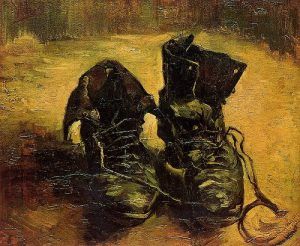 Despite the continued influence of formalism in the 20th Century there were currents of dissent that took an opposing position. Thinkers as diverse as Heidegger, Whitehead and Deleuze were arguing that genuine aesthetic appreciation is not about form but the unraveling of form. Despite their considerable differences, each was arguing that the most important kinds of aesthetic experiences are those in which the dominant foreground and design elements of a work are haunted by a background of contrasting effects that provide depth. It’s the conflict between foreground and background, surface and depth, between what is known and what is mysterious that give art its allure. The uncanny is the key to art worthy of the name. For example, for Heidegger in his famous study of Van Gogh’s A Pair of Shoes, it’s the seemingly insignificant brushstrokes in the background of the painting that allow amorphous figures to emerge and begin to take to shape as we view it. The background figures preserve ambiguity and allow the concealing and unconcealing of multiple interpretations to take place, which Heidegger argues, are at the heart of a work of art.
  Actors come to each role in a new film bearing the stamp of their old ones so they are richer and more interesting in the new incarnation—the whole more than the sum of the parts. Just last week one saw Nargis as the innocent and naive mountain girl pining away for the love of the ‘shehri babu’, and today she is the femme fatale, all hell and brimstone, plotting the downfall of her rival. Or, as Mother India, upholding principles of honesty and justice, shooting her favorite son dead for raping a village girl.
 Donald Trump is not a fascist. He’s far too stupid to be a fascist, or to coherently advocate for any complex national political doctrine, evil or otherwise. He is, however, a would-be tin pot dictator. And his largely failed but still very dangerous attempts to establish himself as a right wing autocrat need to be countered, not just by opposition politicians and the press, but also by responsible citizens.
 This past Sunday, November 11, marked the Centennial of Armistice Day, the European commemoration of the agreement to end World War I. Representatives from more than 60 countries attended carefully choreographed ceremonies to honor the sacrifice of those who fought.


 In a recent study, data scientists based in Japan found that classical music over the past several centuries has followed laws of evolution. How can non-living cultural expression adhere to these rules?


 The crocodiles know. They form pincers on either side of the crossing point. Richard says they feel the vibration of all those hooves along the riverbank above them.