by Holly A. Case (Interviewer) and Tom J. W. Case (Hermit)
The following is the continuation of an interview with Tom, a pilot who has largely withdrawn to a small piece of land in rural South Dakota.
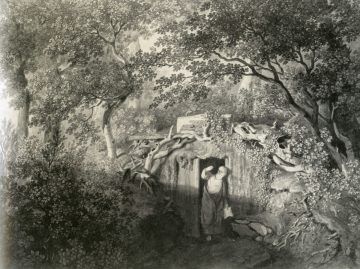
Interviewer: Have you ever experienced something annoying that got transformed by hermitude into something at least harmless if not good?
Hermit: Right. Sure. I used to be annoyed by wind, now I like the thing. Used to prefer summer to winter, now that has reversed. Rain will ruin a hermit picnic as quickly as it will a regular person’s, but usually with nice enough after effects. Perhaps my best example at the moment is what happened when I started sleeping with very minimal heat in winter, just above freezing. It was miserable at first, but I got used to it. The thing what amazed me most is that I lost weight (the opposite of what I was used to during winter) burning calories to keep warm, alongside consuming far less fuel for heating my living space. An apparent win-win. So obvious, but it never had crossed my mind.
Interviewer: What’s so great about wind, and after-rain from the hermit point of view? And what does it mean to “get used to” almost freezing?
Hermit: Only the obvious things. The wind cools and makes difficult the movement of flying insects in the warmer months, and is easily dealt with in winter by dressing appropriately. The rain, you know, rainbows, plants love it, etc..
And I’ve so far kept my space just above freezing for the sake of the liquids. Tried dipping below once, determined I lose more liquids that way as they burst their containers, also destroyed my water filters on that one. There is likely a physiological process which allows one to get used to the cold, but I think it is as much a mental acclimatization. Easier to get used to the cold than the heat, in my experience. In the end, so long as your fingers still work, all is well. Read more »
 Yesterday was James Joyce’s birthday. His one-hundred-and-thirty-seventh. Or would have been, if he hadn’t died, in Zurich, in January 1941, but were instead swelling the ranks of the current generation of supercentenarians, their increasing longevity bedeviling the demographics departments of local life insurers. Joyce is buried in Fluntern Cemetery on Mount Zurich, his grave marked by a wry-looking seated effigy, like a jocular, unaccommodated Lincoln Memorial; he is further commemorated in the eccentric orthography of the names of the city’s two rivers, the Limmat and the Sihl, in a plaque mounted on the point at which they diverge downstream from the Swiss National Museum, where the letter “i” in both names has been replaced with a “j”.
 Banners waved, the converted preached and hawkers peddled hats, buttons, “Impeach This” sweatshirts and dodgy conspiracy theories. T
 Welcome to Des Moines, where unmarked satellite trucks troll snowy streets, coffee houses and hotel lobbies are broadcast-ready, and legions of reporters and crew and a few political tourists have swept up and besieged an entire town.
 First off, let me just get this out of the way: we share too much data about ourselves knowingly with companies and they collect, use and share even more than most of us are aware of (read through those lengthy privacy notices recently?). And unless you live in Europe with its pretty extensive GDPR rules, or
  Another not-necessarily-the-best-of-the-year mix, but there do seem to be a number of 2019 releases. Warning: this one’s pretty drony, so don’t be driving or anything. Sequencers next time, I promise! (A few anyway.)
 You’ve been an on-again, off-again working band for a decade. During that period there have been numerous breakups and seemingly endless lineup changes. Then, after years of grinding and uncertainty, you finally hit it big in 1975. You earned it.
 At least since Roe v. Wade was decided in 1973 the issue of Conscientious Objection (henceforth CO) has been an important one in the context of Catholic hospitals and women patients. Such hospitals object to the provision of abortions, contraceptives, sterilization, fertility care, and “gender-affirming care” such as hormone treatments and surgeries.


 The United States continues to be virtually the
  Sughra Raza. Rorschach on the River Li. Yangshuo, China, January, 2020.
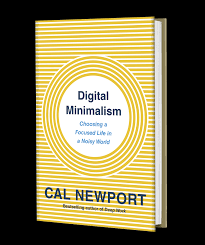 While you might not break into a neighbor’s house to log onto your Facebook account if your internet were down, a case can be made that many of us are victims of at least a moderate behavioral addiction when it comes to our smartphones. At the playground with our kids, we’re on our phones. At dinner with friends, we’re on our phones. In the middle of the night. At the movies. At a concert. At a funeral. (I was recently at a memorial service for my friend’s mother, and someone’s cell phone rang during my friend’s reminiscence.)