
by Joseph Shieber

In our pluralistic society, could First Amendment protections of religious freedom, say, clash with other firmly entrenched legal norms? So, to take a particular example, suppose a Muslim woman was called as a prosecution witness in a criminal trial. Could her religious obligation to wear the niqab trump the defendant’s right to confront his accuser?
I began thinking about this particular sort of case because of a September 2018 decision in the Pennsylvania murder trial of Tyreese Copper, who was convicted and sentenced to life in prison. One of the witnesses for the prosecution was a Muslim woman named Davina Sparks, who insisted upon being allowed to wear the veil covering her face while giving testimony in open court.
Here’s what happened next, according to the account at the Volokh Conspiracy blog. The defendant’s attorney
objected to Ms. Sparks testifying while wearing her Muslim garb that covered her face. Ms. Sparks refused to remove the garb, citing her religion as the reason for her refusal. Out of deference to Ms. Sparks’s religious beliefs, the court decided to clear the courtroom for Ms. Sparks to testify without her face garb “so I can at least have her taking off her covering only in the presence of the people who are absolutely essential to being here,” i.e. the jury, court staff, defense counsel, and defendant.
Now, as Volokh goes on to discuss in his post, Commonwealth v. Copper has become an object of debate because the judge’s clearing the courtroom impinged upon Copper’s Sixth Amendment right to a public trial (via the Fourteenth Amendment). But I want to look at the case from a different perspective. Read more »

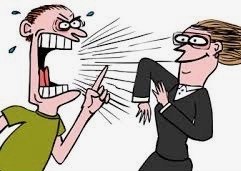 Recently, I was waiting to board an American Airlines flight from Boston to Rochester, when, along with ten of my fellow passengers, I was summoned to the desk in front of the boarding gate. There we learned, by listening intently to what the AA gate agent told the first passenger in line, that we were being bumped from the flight, that AA would try to find alternative flights for us, and that we would each receive a voucher worth $250, redeemable on AA bookings, valid for one year.
 Wine writers often observe that wine lovers today live in a world of unprecedented quality. What they usually mean by such claims is that advances in wine science and technology have made it possible to mass produce clean, consistent, flavorful wines at reasonable prices without the shoddy production practices and sharp bottle or vintage variations of the past.




 r a train and someone passed through begging for change. I’ve lived in New York City long enough that I don’t just start taking my wallet out and going through it in crowded public spaces, but beyond that, I don’t have change. I normally don’t carry cash. If I have cash on me its for one of two reasons, either someone has paid me back for something in cash (which in these days of Venmo is increasingly unlikely) or I have a hair or nail appointment where they like their tips in cash. So even if I have cash, it’s bigger bills and certainly no coins. And I’m sure I’m not unusual. I pay for things with credit cards. I pay other people using Apple Pay or Venmo. I mentioned this thought to someone who told me that they had seen someone begging in New York with details of their Venmo account. On the one hand, there seems to be a certain chutzpah to that, after all, if you have a bank account to receive the money in and some kind of smart phone to access it, is your situation as dire as you’re making out? On the other hand, it’s pretty smart. Of course, there are serious privacy issues involved in giving money to a random stranger through an app like Venmo, it’s not private, so I probably wouldn’t do that either, but it’s an interesting idea, if it could be made more anonymous and secure. Apparently, at least in China,
 It has been a little over a week since the redacted Mueller Report was released, and so many words have been spilled that there could be a drought by summer if the umbrage reservoirs are not refilled. Can we just retire the word “closure”?
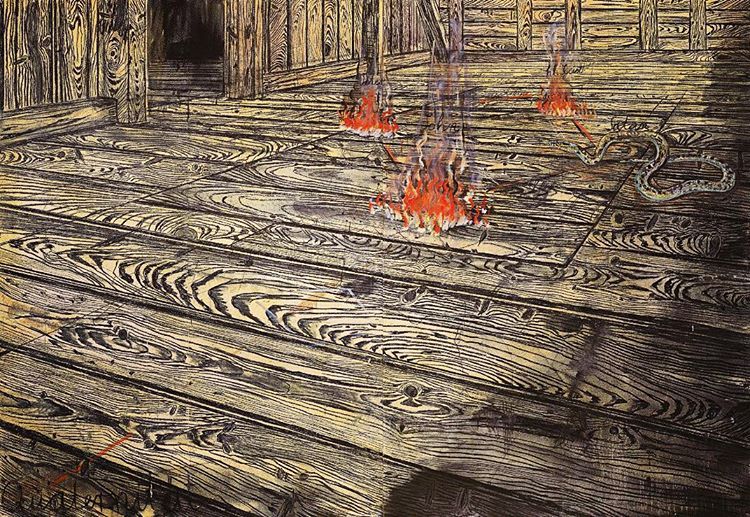 The attic of Notre Dame cathedral, with its tangled, centuries-old dark wooden beams, was affectionately known as the ‘forest’. The fire that originated up there last week made me think of an early Anselm Kiefer painting Quaternity, (1973), three small fires burning on the floor of a wooden attic and a snake writhing toward them, vestiges of the artist’s Catholic upbringing in the form of the Father, the Son, the Holy Ghost and the Devil. Metaphor meets reality in the sacred attics of stored mythologies.