by R. Passov
 Johnny spoke softly in a voice just past the threshold of manhood. His smile, mistaken for charm, was longing. I could see the pentimento of the child still in him.
One day I watched a conversation that confirmed my suspicions. Johnny had returned from somewhere Big Greg had sent him. He danced as he spoke, swinging a long arm up over his head, around and down.
“The dude’s wife’s right there. I grab his guitar and bust it all up. Broke that shit right in front of em. Yeah, I said, this is what I mean.”
He had tried to be violent but in the retelling I could see his heart wasn’t in it. “Davy doesn’t play guitar,” Big Greg said. “Where the hell did you go?”
To the wrong house.
He was tall but thin. Black, but feline. Not black like the men he hosted when he had his apartment. Men who turned the living room into a weight room, sitting on benches all day doing curls, out of prison but still in. Johnny wasn’t like that.
Though I didn’t know of Lou Reed, didn’t have a radio, or a stereo or even a record, Johnny belonged in a Lou Reed song. He wanted to be a colored girl.
I know that now. Then I spied his gentleness, his out of place-ness, his role playing, that he lived between lives. Someone with you and somewhere else at the same time. Something children see but not adults.
He and Big Greg wore their green shirts, sleeves cut off, Alexander and Diles marked in black over their hearts. I decided to believe their experience in war freed them of law. Read more »



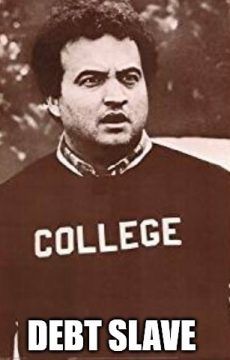 It does not take long for history to repeat itself. It was only a little over a decade ago that overzealous lending, lax underwriting standards, unrealistic collateral valuations, borrowers not understanding loan terms, an exploding derivative securities market–and a dozen or so other factors–led to a massive crash in the housing market. Today in the United States we have outstanding student loan debt of $1.5
 While Trump’s immigration politics makes international headlines almost every day, the disaster of the European immigration policies rarely becomes international news. A recent exception is the case of Captain Carola Rackete, and it is a telling one. With all the potential for a good story, Rackete’s journey is both standing for and at the same time distracting from the actual complex mess of European immigration politics.
 When the flight delay is announced, we ask what it is we have done wrong. From airlines and the world at large, the answer is rarely forthcoming, so we must look inward instead.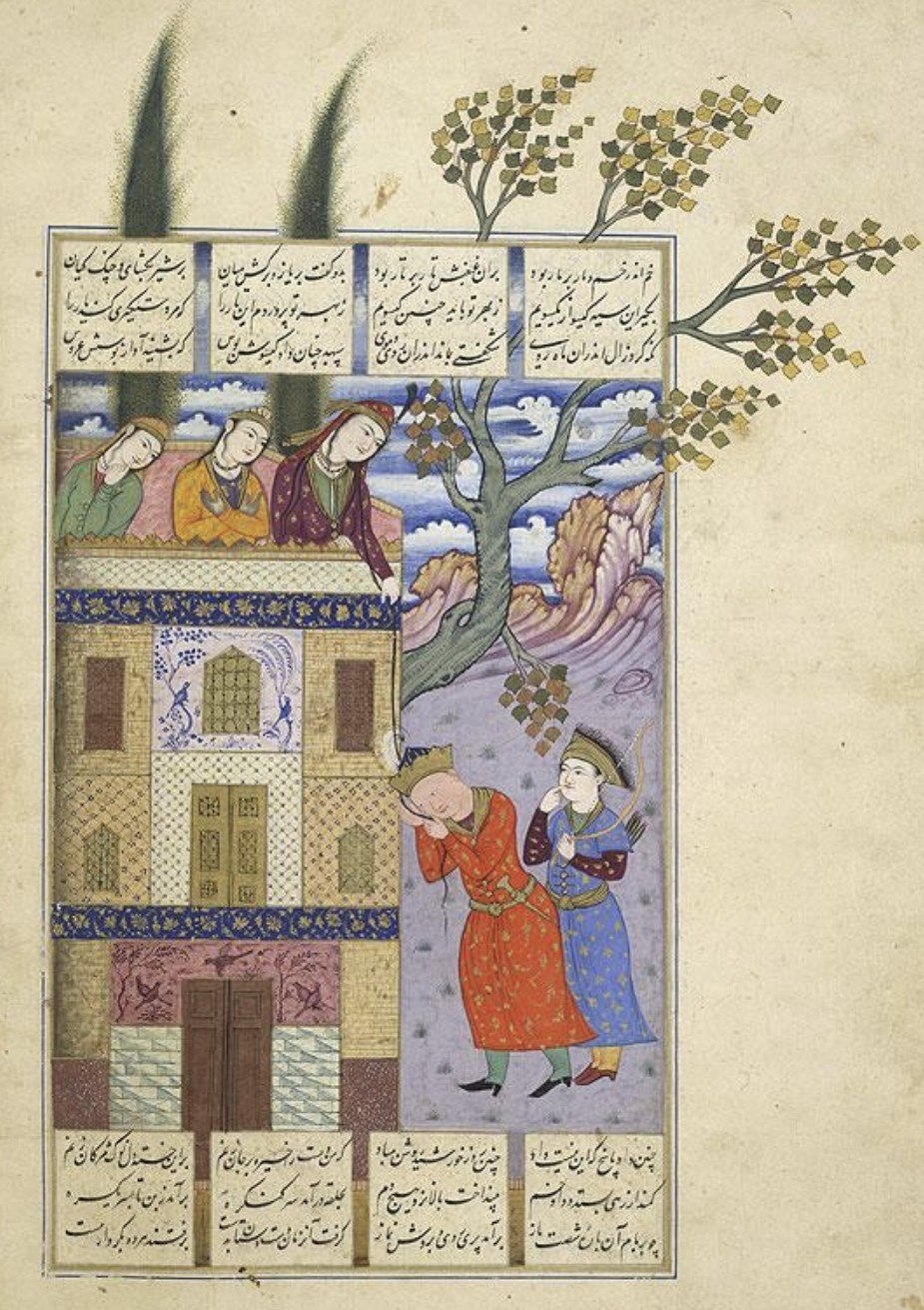
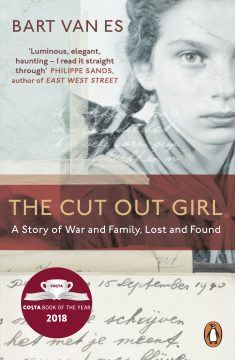 There is a great deal of literature available on the experiences of the horrors, suffering and the injustice that the Jewish people experienced during World War II. Bart Van Es’s The Cut Out Girl adds to that literature.
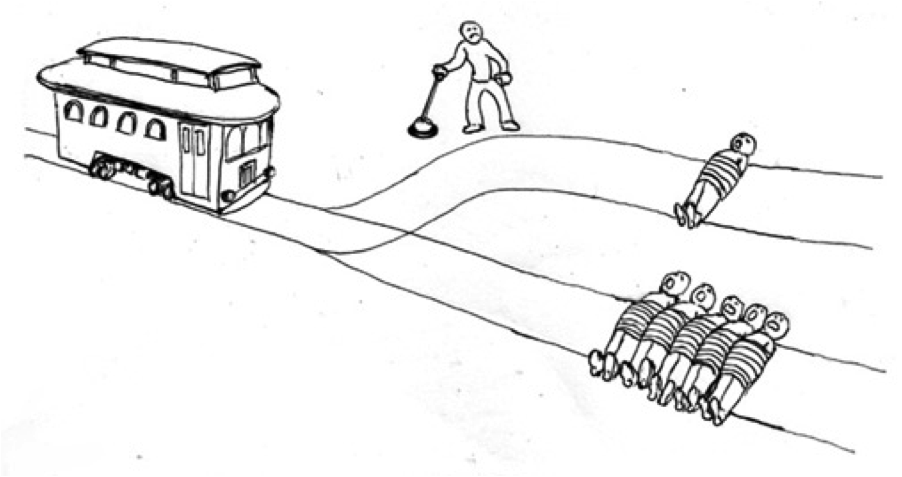 In “The Moral Landscape: How Science Can Determine Human Values” Sam Harris argues that the morally right thing to do is whatever maximizes the welfare or flourishing of human beings. Science “determines human values”, he says, by clarifying what that welfare or flourishing consists of exactly. In an early footnote he complains that “Many of my critics fault me for not engaging more directly with the academic literature on moral philosophy.” But he did not do so, he explains, for two reasons. One is that he did not arrive at his position by reading philosophy, he just came up with it, all on his own, from scratch. The second is because he “is convinced that every appearance of terms like…’deontology’”, etc. “increases the amount of boredom in the universe.”
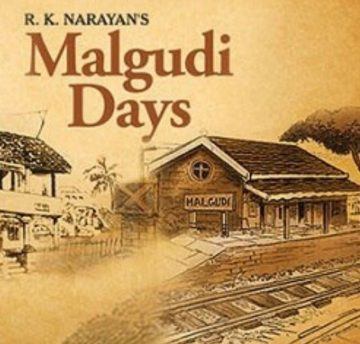 A British friend of mine once told me that when he feels stressed he often turns to re-reading R.K. Narayan’s stories about Malgudi, the fictional placid small town in south India. Much earlier, in the 1930’s, a fellow-Britisher, the writer Graham Greene, had discovered Narayan and became his life-long friend, mentor, agent for the wider literary world, and even occasional proof-reader. He found a kind of ‘sadness and beauty’ in Narayan’s simple depiction of the idiosyncrasies and disappointments of ordinary lives which he imbues with a touching sense of gentle irony and compassion.
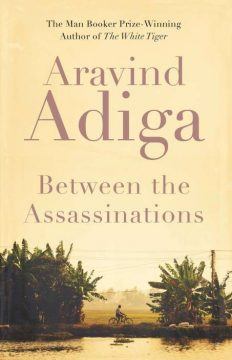 I shall start with the third, titled Between the Assassinations by Aravind Adiga, which is probably the furthest of the three in terms of dissonance from the life in Malgudi. Here we can definitely say: Toto, we are not in Malgudi anymore. The assassinations referred to are those of Indira Gandhi in 1984 and of her son, Rajiv Gandhi, in 1991, but in the book except for merely as a time-marker of those 7 years, they do not play any direct role. Adiga came to be widely noted after he won the Booker Prize for his short novel The White Tiger, a book of stridently raging fury at the crushing inequalities and depravity arising from India’s roaring economic growth and somewhat cardboard characters through which they are played out, a book I did not particularly like. Adiga wrote Between the Assassinations earlier but published it after The White Tiger. Here the fury is less strident, there is more nuance and variety in the characters, and along with aching sympathy there is all-enveloping hopelessness. Here is a typical scene: a lowly cart-rickshaw puller, straining hard going uphill with a heavy load, exhausted by the heat and humiliation and a painful neck, stops his cart in the middle of the busy road, shakes his fist in a futile gesture at the passing, honking traffic and shouts: ‘Don’t you see something is wrong with this world?’
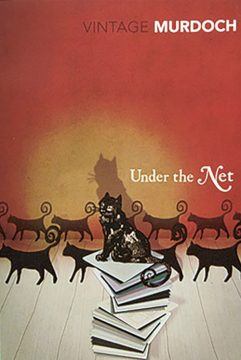 Mother’s friend departed after their weekly get-together for tea, cakes and gossip, but she forgot to take her book. It was a slim hardback with the blue and yellow banded cover of a subscription book club. It lay on the arm of the sofa for ten minutes and then, before anybody noticed, it vanished – relocated to my bedroom. I was fifteen, and this would be the first adult novel I had ever read. Its title was Under the Net by Iris Murdoch. Iris was my “first” – first adult novelist and first woman writer, and she has remained fixed in my affections over the decades. Under the Net was also Murdoch’s first novel, published in 1954. I was so naively charmed that I made a precocious promise to myself to reread it fifteen years later to see if its appeal lasted. I already knew that in the coming years I would not be rereading my previous favourites, my childhood book collections of Just William, Biggles, Billy Bunter and John Carter’s adventures on Mars. Unlike them, Under the Net had mysteries and ideas I did not yet fathom, but would need to discover.