by Ali Minai
Your love stirs the ocean into reckless storms.
At your feet, the clouds drop their pearls.
Dark smoke rises in the sky, a fire burns
Where your love’s lightning strikes the earth.
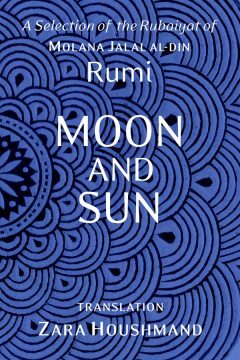 These energetic lines open Moon and Sun: Rumi’s Rubaiyat, Zara Houshmand’s brilliant translation of selected ruba’iyat – quatrains – by Molana Jalaluddin Rumi, and set the tone for an inspiring and exhilarating sojourn through the passions of the peerless Sage of Konya.
It has become almost a cliché to cite Rumi’s status as the most widely read poet in America today. If that is so, it is only because of the many translations of his works into English by poets as distinct as Robert Bly and Coleman Barks. Clearly, all of these translations have something that touches the hearts of 21st century Americans in ways that even modern American poets seldom do. Perhaps it is because this poet who lived thousands of miles away and eight centuries ago has a strikingly modern sensibility – a directness of expression and connection that, couched in appropriate words, can grab a reader across the gulf of centuries. But finding those words also requires a creative act – a re-ignition of the original fire, so to speak. In many cases, translations of Rumi have succeeded by glossing over the complexity of the original, or injecting it with a little modern – even Western – attitude. Most translations have drawn on Rumi’s matchless didactic work, the Masnavi, which is a tapestry of poetic tales embedded within tales, each taking the reader to deep ethical and existential insights. Unlike most other classical Persian poetry, the Masnavi is written in a direct – almost modern – voice. As such, poems from it can be – and have been – translated well by focusing on the stories they tell and the moral conclusions they reach, without worrying too much about replicating Rumi’s poetic diction. The other body of Rumi’s work that has been translated extensively are his ghazals from the Divan-e Shams-e Tabrizi, ranging from A.J. Arberry’s beautiful literal translations to Nader Khalili’s more poetic ones and the impressionistic renditions of Kabir Helminski – all satisfying and lacking in distinctive ways, as must always be the case in translations of this genre. The task undertaken by Zara Houshmand in Moon and Sun is distinct from all these predecessors. Read more »
 Sutcliffe views the concept of “disdain” as central to Scarlatti’s approach: the term, first applied to the composer by Italian musicologist Giorgio Pestelli, connotes a deliberate rejection of convention. Scarlatti is well-versed in, but does not fully adopt, the conventions of the
 One autumn I’m suddenly taller than my mother. The euphoria of wearing her heels and blouses will, for an instant, distract me from the loss of inhabiting the innocence of a child’s body—the hundred scents and stains of tumbling on grass, the anthills and hot powdery breath of brick-walls climbed, the textures of twigs and nodes of branches and wet doll hair and rubber bands, kite paper and tamarind-candy wrappers, the cicada-like sound of pencil sharpeners, the popping of coca cola bottle caps, of cracking pine nuts in the long winter evenings— will blunt and vanish, one by one.

 We are all in some sense equal. Aren’t we? The Declaration of American Independence says that, “We hold these Truths [with a capital ‘T’!] to be self-evident” – number one being “that all Men are created equal.” Immediately, you probably want to amend that. Maybe, not “created”, and surely not only “Men” – and, of course, there’s the painful irony of a group of landed-gentry proclaiming the equality of all men, while also holding (at that point) over 300,000 slaves. But don’t we still believe, all that aside, that all people are, in some sense, equal? Isn’t this a central and orienting principle of our social and political world? What should we say, then, about what equality is for us now?
 Einstein had called nationalism ‘an infantile disease, the measles of mankind’. Many contemporary cosmopolitan liberals are similarly skeptical, contemptuous or dismissive, as its current epidemic rages all around the world particularly in the form of right-wing extremist or populist movements. While I understand the liberal attitude, I think it’ll be irresponsible of us to let the illiberals meanwhile hijack the idea of nationalism for their nefarious purpose. Nationalism is too passionate and historically explosive an issue to be left to their tender mercies. It is important to fight the virulent forms of the disease with an appropriate antidote and try to vaccinate as many as possible particularly in the younger generations.


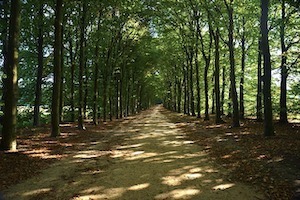 The roof of Notre-Dame de Paris, lost in the fire of April 15, 2019, was nicknamed The Forest because it used to be one. It contained the wood of around 1300 oaks, which would have covered more than 52 acres. They were felled from 1160 to 1170, when they were likely several hundred years old. It has been estimated that there is no similar stand of oak trees anywhere on the planet today.