Dr. Joseph Jurcic specializes in the research of acute myeloid leukemia, radioimmunotherapy with alpha and beta particle-emitting radioisotopes, monoclonal antibody therapy for leukemia, and the molecular monitoring of minimal residual disease. His work focuses on the treatment of acute and chronic leukemias, myeloproliferative neoplasms, and myelodysplastic syndrome. He received the 2001 Louis and Allston Boyer Young Investigator Award for Distinguished Achievement in Biomedical Research from Memorial Sloan-Kettering Cancer Center. Dr. Jurcic is currently Professor of Medicine at Columbia University Medical Center and Director of the Hematologic Malignancies Section of the Division of Hematology/Oncology with over 80 articles and book chapters to his name.
Azra Raza, author of The First Cell: And the Human Costs of Pursuing Cancer to the Last, oncologist and professor of medicine at Columbia University, and 3QD editor, decided to speak to more than 20 leading cancer investigators and ask each of them the same five questions listed below. She videotaped the interviews and over the next months we will be posting them here one at a time each Monday. Please keep in mind that Azra and the rest of us at 3QD neither endorse nor oppose any of the answers given by the researchers as part of this project. Their views are their own. One can browse all previous interviews here.
1. We were treating acute myeloid leukemia (AML) with 7+3 (7 days of the drug cytosine arabinoside and 3 days of daunomycin) in 1977. We are still doing the same in 2019. What is the best way forward to change it by 2028?
2. There are 3.5 million papers on cancer, 135,000 in 2017 alone. There is a staggering disconnect between great scientific insights and translation to improved therapy. What are we doing wrong?
3. The fact that children respond to the same treatment better than adults seems to suggest that the cancer biology is different and also that the host is different. Since most cancers increase with age, even having good therapy may not matter as the host is decrepit. Solution?
4. You have great knowledge and experience in the field. If you were given limitless resources to plan a cure for cancer, what will you do?
5. Offering patients with advanced stage non-curable cancer, palliative but toxic treatments is a service or disservice in the current therapeutic landscape?
 At the heart of French existentialism – and especially the version associated with its most famous representative, Jean Paul Sartre – was the notion of radical freedom. On this view, when we choose, we choose our values and thus what kind of person we are going to be. Nothing can prescribe to us what we ought to value, and the responsibility of freedom is to accept this fact of the human condition without falling into the ‘bad faith’ which would deny it. The moment of existentialism may have passed, but the view that we are radical choosers of our values persists in many quarters, and so I want to consider how well this idea holds up, and what an alternative to it might look like.
 Facebook, Amazon, Apple, Microsoft, and Google, often referred to as Big Tech, know more about you than your closest friends and family. They know who you are talking to and what you are talking about, what you are buying or are thinking of buying, how much money you have, and what your fears and desires are. What a few years ago may have sounded like a dystopic vision, is today a reality of our online life (our ‘onlife’). In this setting, even Facebook’s plans of introducing their own currency, Libra, does not seem out of the ordinary.
 A long time ago, on a mountainside in Liechtenstein, I tuned my transistor radio to the Deutschlandfunk, one of neighboring Germany’s state radio stations whose broadcast range leaked into that tiny country. This is what I heard:
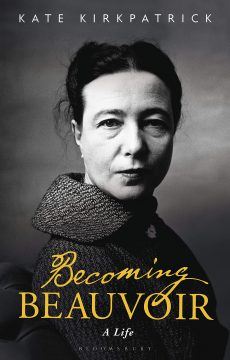 Biographies frequently provide us with insights into individual characters in a way that autobiographies might not: the third person narrator offers the prospect of greater ‘objectivity’ when evaluating and narrating information and events and circumstances. And so it is with Paul Avrich and Karen Avrich’s Sasha and Emma: The Anarchist Odyssey of Alexander Berkman and Emma Goldman,and Katie Kirkpatrick’s Becoming Beauvoir: A Life.These two books provide a wealth of knowledge on the political and philosophical thinking that engaged the brilliant minds of two significant women of the twentieth century: Emma Goldman and Simone Beauvoir.
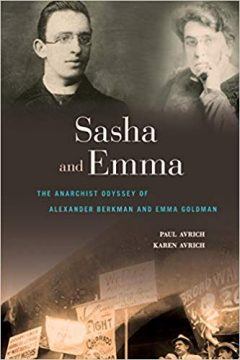 The life trajectories of the two women could not have been more different: Goldman was a Jewish Russian émigré to the United States; she learned her politics through experience and in that process clarified her political thinking on anarchism, and her life was lived humbly. Beauvoir on the other hand, was from a bourgeois Catholic family and benefited from a formal education and she lived life relatively comfortably. However, despite their divergent lifestyles and politics, similarities can be drawn between their thinking on women, love and freedom.
 Suppose you had some undeniable proof of the Everettian or Many-Worlds Interpretation (MWI) of quantum mechanics. You would know, then, that there are very many, uncountably many, parallel worlds and that in very many of these there are many, many nearly identical versions of you – as well as many less-closely related “you’s” in still other worlds. Would this change the way you think about yourself and your life? How? Would you take the decisions that you make more or less seriously?
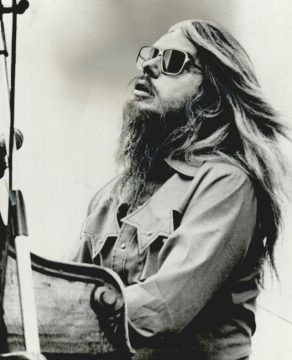 He released 33 albums and recorded over 400 of songs, earning two Grammys among seven nominations. Yet you probably don’t know who Leon Russell was. For some people he’s a vaguely familiar name they have trouble putting a face or a tune to. Many more have never even heard of him. Because despite his prodigious output, Russell also had a way of being there without letting you know. He was the front man whose real impact came behind the scenes. He was very present, but just out of sight.


 Despite Vonnegut’s strong counsel to babies entering the world, kindness seems to be in short supply. Little wonder. Our news media portray to us a world of power politics, corporate greed, murders, and cruel policies which are anything but kind. Our popular forms of entertainment, much more often than not, are stories about battles that shock and thrill us and gratify our lust for bloody vengeance, leaving no room for wimpy, kind sentiments. Success is advertised to us as requiring harsh discipline, dedication, and focus, and kindness, it appears, need not apply. Even though we all like to give and receive kindnesses, they seem to play no role in our political, social, and cultural economies.
 In a
In a 

 A few tall, dreamy-eyed Sikh men were on my plane to Lahore.