by Thomas Larson
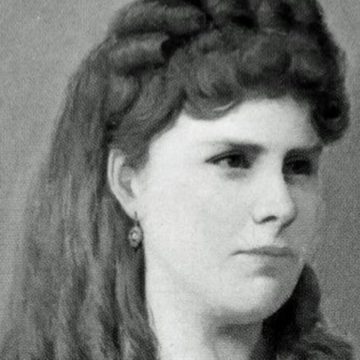
In 1874, Thomas Hardy married Emma Gifford, a woman who never let her novelist husband forget that she was born of a higher class than he, ever his superior in taste and breeding. After her death he got back at her—poetically—in a big way. And she—from the grave—at him.
The pair began a premarital affair, fervent and soulful, as romantic and intellectual companions; not long after, they were quarantined in thirty-eight years of a childless and mutually regrettable marriage. When Emma died of a bad heart and impacted gallstones (she wrote treacly poems, many published, and suffered from delusions of grandeur), Hardy at sixty-two composed a loose sequence of verse, “Poems of 1912-1913.” These twenty-one rhyming, pithy elegies, among the finest in English, conjure the ghost of his first wife as the means of grieving his loss in a fatalistic anti-theism that feels downright religious.
For Hardy, as Claire Tomlin writes in her biography, there are three Emma’s: “Sometimes she appears as a ghost, sometimes as the elderly woman who liked parties and hats; more often as the girl of long ago, wearing an ‘air-blue gown,’ or with her ‘bright hair flapping free.’” Hardy names her (“woman much missed”), recalls their slow-dissolving marriage (“scars of the old flame”), owns up to their mutual failures (“things were not lastly as firstly well / with us”), and measures her apparitional lingering, postmortem, in places where she shadows him (“how you call to me, call to me, / Saying that you are not as you were”). He resurrects her girlish form, the woman he began courting long ago, (“fair-eyed and white shouldered, broad-browed and brown-tressed”). Read more »
 But Och! I backward cast my e’e,
 Bill: Can you believe these Republicans?! Just four years after swearing up and down that no nominee for the Supreme Court should ever be approved in an election year for the president, and promising on their mothers’ graves that they would never do such a thing, here they are doing exactly that!
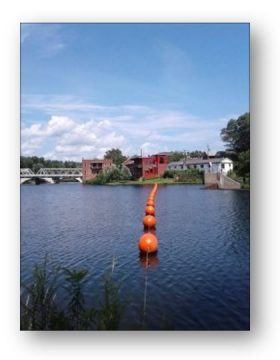
 Sughra Raza. Autumn Water. Chittenden, September 2020.
 Autumn is brilliant. One of the things I looked forward to when I moved to the Midwest from the desert southwest was the experience of a year with four seasons. I did not anticipate how very beautiful autumn could be, and even after 40 years in the Midwest, I can’t get enough of this season. I can’t spend enough time outside in the wonderfully crisp air, under the low-angle sunlight, stopping to drink in the deep burnished golds, the lemony yellows, the gloriously variegated reds and oranges.

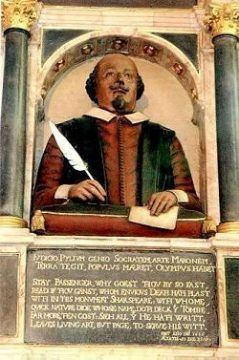 It’s dawned on me, looking at recent (and not so recent) commentary on Shakespeare, that a wedge is being driven between the Bard and the culture in which he lived. Although I haven’t actually heard the following syllogism, it seems to be lurking behind much current criticism:


![Shakespeare & Company, Paris. [Wikipedia]](https://3quarksdaily.com/wp-content/uploads/2020/10/SandC.jpg)