Optimism about agents: How neuroscience illuminates, not threatens, conscious and free agency

by Robyn Repko Waller

The case for the illusion of conscious agency from neuroscience is far from a straightforward conclusion.
Image from John Hain from Pixabay

Last month I introduced a curious disconnect in public perception of neurotechnology. Whereas reports of brain-computer interfaces (BCI) inspire celebration of expanding agency, the public seem wary that neuroimaging exposes the illusion of conscious agency. The curiosity being that both use neurotechnology to decode motor intentions from the same brain regions of interest. If one threatens our conscious control as human agents, doesn’t the other? If one is a celebration of human agential control, isn’t the other?

That is, I suggested there that, to the contrary, these like research programs ought to be treated alike. Either both applications of neurotechnology deal in diminished agency or, alternatively, neither does. I ended that discussion with a promissory note to defend my insistence that such research doesn’t threaten our control as agents. Here I’ll briefly outline the case, as it’s made, for the illusion of conscious will from neuroscience. Then I’ll argue why we ought to strike a more optimistic note about our scientific understanding of humans as acting consciously and freely (elsewhere I’ve laid out more detailed discussions of science of free will).

I’ve elaborated frequently in this column about the sense of agency and free will that most of us believe we enjoy. I’ll rehearse those important notions again here. The narrative of human agency is not simply that we act in goal-directed ways, actively affecting change beyond the impinging of happenings to us. Humans (and perhaps other complex animals) don’t just forage about locating resources or evading predators, or so we contend. It seems we exercise a much more meaningful kind of agency. That is, free will is not just that I control my bodily movements, but that I exercise meaningful control over what I decide to do.  Read more »

Lots of Things Exist, but You and I are Not Among Them

by Charlie Huenemann

MatiasEnElMundo / Getty Images

Of course, it pays to be cautious when you read philosophers writing about what exists. They are slippery, weaving in and out between “in one sense” and “in another” like clever eels wearing togas. The fact that we can talk about what doesn’t exist has long been a problem for philosophers: for what are we talking about? Surely what doesn’t exist must exist in some sense!

So, of course, in one sense just about anything we can talk about exists: it exists even just as a concept, or a figment, or a thin abstraction, or some ghostly possible being. But, in another sense, when we really get down to it, and wrestle to the ground the protean stuff that really does exist — the stuff that even God would be forced to recognize as existing (that is, if God really did exist) — well, there’s not as much of it. We can talk about more than there is.

Good thing, too, as I think that most of the things we concern ourselves with — including ourselves — don’t really exist. Bruises, cancers, headaches, memes, bars of gold, economies, jobs, gods, angels, souls, friends, enemies, alliances, and wars: none of these things exist. Not really, not ultimately, not as God sees the world (assuming, again….). All of those things depend crucially on cognitive systems which construct models satisfying their experience, and which project those models onto the so-called “world”, which, whatever it is, does not contain the elements postulated by those models. And — you probably guessed it — cognitive systems don’t really exist either. Now comes the part where I try to explain myself. Read more »

My Cancer Patients

by Carol A Westbrook

When I finished my residency in 1980, I chose Medical Oncology as my specialty. I would treat patients with cancer.



I am often asked why I chose oncology. Many people fear cancer, and do not even like talking about it. How can you deal with all the pain and death,  I am asked.

My answer is straightforward–it’s the patients. I enjoy working with cancer patients. They are some of the bravest people you will ever meet. And they are honest. There are no malingerers in cancer. When a cancer patient complains about a stomachache, headache, nausea, or worsening pain, you can be sure it’s real. It is so gratifying to me, as a doctor, to provide a patient some relief, some hope, and even, sometimes, a cure. And they all have a story to tell, if you take the time to listen.

And we had the time, back in those days. Medicine was not as rushed as it is today, in the race to get patients through the clinic visit quickly, as it is today. The clinic visits were often a half hour or more, because we oncologists took over the role as their internists, managing their diabetes, hypertension, depression, and just about any other problem that today would get referred to their primary care physician or a specialist. Read more »

Monday, June 28, 2021

The Paradox of Individualism

by Martin Butler

Individualism has been blamed for the break up of communities, personal alienation and rampant western consumerism. At the same time, with its focus on liberty and human rights, it is lauded as the crowning glory of western culture. How do we come to terms with this paradox?

Individualism feels natural to the modern western mind. We balk at the idea of living according to the preconceptions of tradition, religion or authoritarian elites. Individualism is promoted in diverse lifestyles, chosen identities, family structures and types of relationships, in everything from artistic and popular taste to our belief systems and ways of making money. This trend has been turbo-charged by the Internet, as now we all have a mouthpiece through which to proclaim our choices and opinions. The philosopher Charles Taylor recognises that modern western culture is not uniform but identifies three ways in which it embraces individualism: “it prizes autonomy; it gives an important place to self-exploration, in particular of feelings; and its visions of the good life generally involve personal commitment.”[1] He also points out that the political expression of this individualism comes in the modern focus on rights.

On the other hand, individuals need society, but there is a sense in which individualism is anti-social and works against community. Historically, societies have placed limits on autonomy and rights, on personal commitments and even self-exploration. Liberalism was supposed to be the solution through building a society on the acknowledgment of the value of individualism, and so was designed to cope with conflict and difference – this, after all, is the essence of Mill’s harm principle. The modern thinker who has gone furthest in exploring the consequences of full-blown individualism, however, is Robert Nozick. Starting from the simple premise that individuals are autonomous beings with rights, Nozick struggles to form anything we would recognise as a fully functioning society, famously concluding that “Taxation of earnings from labor is on a par with forced labour”.[2] So he avoids the paradox simply by downplaying the social nature of human existence and embracing the individualistic.  His insistence on individual rights is so strong that the group can make next to no claims on anyone without their explicit consent. His minimal state does no more than protect these basic rights. Read more »

Monday Poem

Lolla Rossa

in a field behind our house, Lolla Rossa,
transfigured in morning light
becomes

becomes
the instant a groundhog
just on haunches drops
and scuttles under the shed

becomes
the light that shaped her

becomes
particles, waves or both
which transcendentally
show themselves to us here
in this room, and there too
fifty feet down the slope

….. present themselves:

lettuce, whose ruby leaves,
tight, gathered, convoluted at mortal edges
echo the muscle songs of our closest star
as dawn trumpets blow to raise her
….. —Miles Davis from a corner
of this universal room
spinning past the iris of a laser
from the darkness of a CD tray
as coral clouds collect to praise her

Lolla Rossa un-transfigured now
as a nimbus glides from play to pause
and grays her

by Jim Culleny
10/20/12

Absent Absences And Tool-Breaking: On Language Inclusivity

by Jochen Szangolies

Figure 1: Sometimes, tools must be broken to unveil what is absent. Image credit: Peregrin.st, CC BY-SA 4.0, via Wikimedia Commons.

It’s getting late, and your friends are leaving; however, you decide to linger for a bit at the bar, enjoying a last drink, perhaps quietly observing the people around you. As your gaze sweeps the room, it suddenly locks onto another’s, and your idle attention snaps into focus. You feel a strange fluttering sensation in your stomach intensifying as they hold your gaze, and your tentative smile is returned. Emboldened by the smile and the effect of the drinks before this ‘last’ one that will not remain the last, you move over and strike up a conversation. You end up leaving the bar together.

The following months are love and bliss. The harmony is effortless and immediate. Getting to know each other becomes intimacy, becomes familiarity. You move in together, pick out wallpaper and dishware, begin the work of crafting a life together.

But in the end, it doesn’t last. Small irritations become fault lines, become trenches. The mood sours; perhaps you suspect there may be someone else involved. Otherwise, how to explain this sudden coldness? The turning away with downcast eyes?

Yet when they leave you, it hurts more than you thought it would. It hurts for a long time, too, and although the wound eventually scabs over, then scars, it leaves a tender spot that will be with you for the rest of your life, occasional flare-ups indicating a change in cosmic weather you don’t quite understand. You lie awake at night sometimes, wondering how things might be if you still were together—or even, if you’d never met them. Would you be happier? Or would there be something intangible, yet profound, missing in your life? Read more »

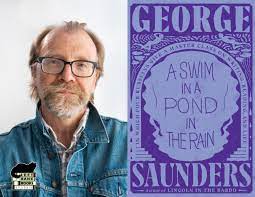
On George Saunders’ “A Swim in a Pond in the Rain”

by Emrys Westacott

George Saunders’ recent book, A Swim in a Pond in the Rain, is the most enjoyable and enlightening book on literature I have ever read.


Saunders’ collections of short stories and his 2017 Booker Prize winning novel Lincoln in the Bardo have earned him numerous awards and much acclaim. He has taught creative writing at Syracuse University for many years, and his latest book is largely the fruit of his work in the classroom. Yet it will delight and instruct not just writers and writing teachers but anyone who loves literature. And it demonstrates persuasively how literature, intelligently read and reflected upon, can offer forms of wisdom that defy reduction to precisely articulated knowledge claims.

The book contains the text of seven famous short stories by nineteenth century Russian authors: three by Chekhov, two by Tolstoy, one by Turgenev, and one by Gogol. Each short story is followed by Saunders’ searching discussion of it, at the end of which one feels that one has a greatly enhanced understanding of not just how the story is constructed–how it works as art–but also of its meaning and purpose. These essays thus illustrate very effectively how interrogating a text from the perspective of a writer can deepen our appreciation of it as readers. Read more »

Hail, the one-eyed King: 30 years after the contested Harvard Medical Practice Study on Medical Errors

by Godfrey Onime

Scissors on Chest X-Ray

A few months ago, I walked into a patient’s hospital room, introduced myself, and sat on a chair next to her bed. After a quick review of her condition, I stood to examine her. The woman stopped me. 

“No offense, Doc,” she said, “but did you wash your hands?” 

I was shocked by the seemingly simple question. No patient had ever before challenged me in this direct manner. I explained that I had indeed used the disinfectant solution by her door before entering. But I proceeded to wash my hands at the sink in her room anyway, making a show of using ample soap and scrubbing as high up as my elbows. Then, I examined her. 

Concerning her challenge, the woman explained the source of her empowerment. She’d learned that according to a governmental report, medical errors kill nearly 100,000 Americans per year–perhaps a low estimate. She also understood that a large proportion of the deaths are related to hospital-acquired infections, which nurses and doctors can introduce by not washing their hands before touching patients. 

I was familiar with the report. It is the now-famous Institute of Medicine’s (IOM) 1999 publication, To Err is Human. It attributed the dismaying figures of 48,000 to 98,000 deaths per year to medical errors. That number would translate to a Titanic cruise ship crammed full of people crashing into an iceberg every one to two weeks, killing everyone on board. The press ran with the numbers—statistics that are still widely cited today. But the report also drew intense criticisms, notably concerning the research from which those figures were gleaned, particularly the estimate of 98,000 deaths. Read more »

Among School Children

by Joseph Shieber

Yeats composed his poem, “Among School Children”, after visiting St. Otteran’s School in Waterford in February, 1926, when Yeats was in his early 60s. It is probably best known for the couplet that concludes it: “O body swayed to music, O brightening glance,/ How can we know the dancer from the dance?” (Here is Helen Vendler leading a class on the poem at the Bok Center for Teaching and Learning, Harvard University, in 2007.)

Read in its entirety, one of the major themes of its eight stanzas is the divergence between image and reality, and how humans suffer from attempting to privilege ideas over reality. In a note he wrote for himself in March, 1926,  while composing the poem, Yeats describes the theme of the poem this way: “School children, and the thought that life will waste them, perhaps that no possible life can fulfill their own dreams or even their teacher’s hope.” 

Despite the suggestion of Yeats’s own note, the poem doesn’t really deal with the dashed hopes of the students themselves. Instead, Yeats’s focus in the poem is on the illusions of the childrens’ mothers — and of the nuns who are their teachers. Read more »

FILM REVIEW: ‘First Date’? Swipe Left.

by Alexander C. Kafka

A shy high-school student asks a girl out. Desperate for some wheels, he buys a sorry ’65 Chrysler sedan and, with it, a heap of trouble. 

That’s not a bad premise for a noir action comedy, but the new release First Date squanders the concept from script through edit in a preposterous, humorless, bloody, and nihilistic mess of a movie.

For their feature debut, the writer-director duo Manual Crosby and Darren Knapp were clearly trying to concoct a spicy blend of Quentin Tarantino, the Coen Brothers, and Guy Ritchie. But First Date has no originality, wit, or directorial flair, only derivative burnt scrapings of violence and meanness. Despite one half-hearted, swiftly corroded moment of civility, the screenplay is three-quarters F-bombs, one-quarter cynical shootings and beatings. 

The production has an undeniable energy and the unfertilized seeds of its crowded characterizations might have been more ambitiously nurtured. The dynamic between the passive hero Mike (Tyson Brown) and Kelsey (Shelby Duclos), the kickboxing dynamo he desires, is an intriguing gender inversion of the traditional. A misfit crew of baddies also discuss Steinbeck as a book group. And there’s a droll coffee-table meme. 

But such promising touches wither under the screenwriters’ sadistic hand, as does the unlikely introduction of an older couple with distinct memories of the junker car. Mike’s passivity, rather than a challenge to overcome, becomes worrisomely defining and dramatically flat. The criminal gang’s constant foul-mouthed blathering, within minutes, becomes merely grating. Michael’s parents are oblivious, Kelsey’s are crass and unfeeling, and a couple sports-car-obsessed neighborhood jocks are insipid teen-farce throwbacks with nothing to say. Only Nicole Berry, as a poker-faced sheriff’s deputy, has any real hint of quirky depth.

Direction is halting toward the beginning but finds its momentum by a tense standoff scene, and sedate Hawaiian-guitar riffs give the score an unexpected, somewhat demented vibe. But ultimately, First Date is just bleak. As social commentary, it’s numb, and as entertainment, it’s numbing. 

Beyond Subjectivity and Objectivity in Wine Tasting

by Dwight Furrow

It seems as if everyone in the wine industry proclaims that wine tasting is subjective. Wine educators encourage consumers to trust their own palates. “There is no right or wrong when tasting wine,” I heard a salesperson say recently. “Don’t put much stock in what the critics say,” said a prominent winemaker to a large audience when discussing the aromas to be found in a wine. The point is endlessly promoted by wine writers. Wine tasting is wholly subjective. There is no right answer to what a wine tastes like and no standards of correctness for judging wine quality.

But no one in the wine industry actually believes this. Everyone from consumers and retail salespersons to wine critics and winemakers must distinguish good wine from bad wine and communicate that distinction to others. Ask any winemaker why she controls fermentation temperatures, and she will respond that doing so makes better wine. If wine quality were wholly subjective, there would be no reason to listen to anyone about wine quality. Wine education would be an oxymoron; quality control an exercise in futility; wine criticism just empty talk; price differentials based on nothing but marketing.

So what’s going on here? Why the self-deceptive denials and sotto voce acceptance that wine quality is a meaningful concept. We could speculate about why we’re so enamored with subjectivity—freedom from constraint in matters of taste I suppose. But it’s been going on since the 16th century, if we can blame Descartes. Read more »

Monday, June 21, 2021

The Founders Fight: Adams Goes Home

by Michael Liss

Take mankind as they are, and what are they governed by? Their passions. There may be in every government a few choice spirits, who may act from more worthy motives. One great error is that we suppose mankind more honest than they are. Our prevailing passions are ambition and interest…

–Alexander Hamilton, 1787.

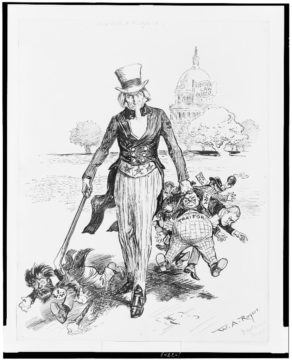
Rogers, W.A. (1981), Now for a round-up (Library of Congress)

March 4, 1800. John Adams, Second President of the United States (and first President to be defeated for reelection) was leaving Washington on the 4:00 a.m. stagecoach to Baltimore, the first stop on his way back home to his beloved home and his wife Abigail. He would not be in attendance when, later that day, his successor (and former Vice President), Thomas Jefferson, would take the Oath of Office and deliver his Inaugural Address.

It was considered by his contemporaries (and most of us would agree) a sour note to end a Presidency. As Washington had voluntarily given up the office when he could have been President-for-Life, a peaceful transition of power was a demonstration of continuity and the stability of a young nation’s experiment in democracy. Adams had lost, fairly so under the rules of the day, and many felt he needed to express public acceptance, particularly at a time when the verdict was not merely a change of person, but also of political philosophy.

There are many explanations for Adams’ behavior, one of which is that Jefferson might have made it known that Adams would not be welcome, but the one that fits best is that, in the absence of a real tradition, Adams was following his heart. He’d had enough of Philadelphia and the new swamp that was Washington, of politics and political infighting, of being judged too harshly for his failures and praised too little for his accomplishments. Like every President since who has lost, the sense of rejection was unavoidable. In Adams’ case, more so because Jefferson and he had once been close, and because some in Adams’ old party, the Federalists, had pointedly withheld support—Alexander Hamilton foremost amongst them, but even some of his old friends. It was time for him to leave. Read more »

On Progress As Human Destiny

by Usha Alexander

[This is the tenth in a series of essays, On Climate Truth and Fiction, in which I raise questions about environmental distress, the human experience, and storytelling. All the articles in this series can be read here.]

On February 18, 2021, NASA landed Perseverance rover on the surface of Mars. Perseverance is the latest of some twenty probes that NASA has sent to bring back detailed information about our neighboring planet, beginning with the Mariner spacecraft fly-by in 1965, which took the first closeup photograph. Though blurry by today’s standards, those grainy images helped ignite widespread wonder and fantasy about space exploration, not long before Star Trek also debuted on television. By the 1970s, science-fiction storytelling was moving from the margins of pop-culture into the mainstream in film and television—and so followed generations of kids, like myself, who grew up expecting off-world adventurism and alien encounters almost as much as we anticipated the invention of video-phones and pocket computers and household robots, as our conceptual bounds for the human story were pushed ever farther outward.

And so much of our expectation has come true. Smartphones and Zoom calls and Roombas are just the most mundane examples of how our techno-fantasized future has manifested in daily life. There’s promise of even more to come, as cultural forces continuously work to realize not only our imagined technotopia of flying cars and jetpacks, but even to seek out those elusive alien encounters. Perseverance rover is, in fact, a robotic astrobiologist: its purpose on Mars is to seek out direct signs of alien life—microbial fossils, if not living microbes themselves. But even should the Martians disappoint us by their absence, information gathered by Perseverance is still intended to help us make that next “giant leap for mankind”: human colonization of Mars. What was until quite recently still generally regarded an outlandish notion seems now widely accepted as the obvious next chapter in our human Manifest Destiny. Indeed, the more we know about the unsuitability of that cold, airless, radiation-beleaguered rock, the more we seem inspired to conquer it. Read more »

A Fictional Place For Real Encounters

by Rafaël Newman

It’s been 40 years this past month since the election of François Mitterrand as President of France. Today, June 21, is the day chosen by his first Minister of Culture for the Fête de la Musique: what has come to be known as “World Music Day” in the English-speaking countries that have since, along with scores of others, enthusiastically adopted the annual festival.

Mitterrand was the first Socialist in the history of the Fifth Republic to attain the office of president, and his term, historic as well for its unprecedented (and still unrivalled) duration, was characterized among other things by grand gestures of support for culture, both classical and popular, focused not only on Paris but increasingly on the cities and towns of the traditionally underserved French provinces. Following a nation-wide study of amateur musicianship commissioned by Culture Minister Jack Lang, which found that one out of two young people in France play a musical instrument, Mitterrand’s government in 1982 initiated the annual Fête de la Musique, to be held on the day of the summer solstice, and to feature multiple, simultaneous public performances by musicians, both amateur and professional, playing for crowds of varying dimensions, from busker’s circle to stadium-sized audience.

Although Mitterrand’s cultural policy was in some respects a continuation of his predecessor’s efforts at modernization and opening, Giscard’s patrician air had lent his presidency the cast of a bygone era, and it was left to Mitterrand, the former Vichy functionary and perennial also-ran, to reap the benefits of a sea change in French public affairs, symbolized in part by the Fête, an annual celebration of a vital, and vitally homespun, national creativity. The Fête was thus effectively part of an image campaign: a rebranding, or, less cynically and more in keeping with the cultural theory of the era, a re-imagining of the French community, and a libidinous recommitment to its revolutionary pillars of liberté, égalité, and fraternité. Read more »

Is this a Dagger and Fork I See Before Me: Menu Items from Shakespeare’s Diner

by Akim Reinhardt, Executive Chef (Marilyn Reinhardt, Megan Golden, Sous Chefs)

Truly, Thou Art Damned Like an Ill-Roasted Egg: Breakfast
All the World’s a Cage Free Omelet 10.99
Get Thee to a Buttery Croissant 8.99
Brevity is the Soul of Grits 5.99
If Muesli Be the Food of Love, Play On 5.99

What a Piece of Work Is Sandwich
Oh That This Too Too Solid Patty Melt 10.99
Eh Tuna Salad, Brute? 8.99
Cry Ham Sandwich and Let Slip the Dijon of War 10.99
Love Is a Smoked Brisket Sandwich Made with the Fume of Sighs 12.99

Better Three Hours Too Soon than a Minute Too Late: Appetizers
Now is the Winter Squash of our Grilled Content 5.99
Neither a Butter Beans Nor Lentils Be  6.99
Hell Is Empty and All the Deviled Eggs Are Here 3/5.99
Now Cracked Pepper a Noble Heart of Artichokes 7.99  

Salad Days
Romaine, Romaine! Wherefore art thou Romaine? 5.99
Two Beets (Red and Golden) or Not Two Beets (Just Red), That is the Salad 9.99
I Come to Eat Caesar Salad Raw, Not to Braise It 8.99
A Woman Would Run Through Fire andWater for Such a Kind Heart of Palm Salad
   11.99 Read more »

Framing Critical Race Theory: Ideology, Schooling And The Production Of Ignorance

by Eric J. Weiner

White people go around, it seems to me, with a very carefully suppressed terror of Black people—a tremendous uneasiness. They don’t know what the Black face hides. They’re sure it’s hiding something. What it’s hiding is American history. What it’s hiding is what white people know they have done, and what they like doing. White people know very well one thing; it’s the only thing they have to know. They know this; everything else, they’ll say, is a lie. They know they would not like to be Black here. They know that, and they’re telling me lies. They’re telling me and my children nothing but lies. —James Baldwin, 1979

Photo by Aaron Burden on Unsplash

What and how the Nation teaches its children says a lot about the political principles for which it stands. Through a complex mechanics of curriculum, pedagogy, assessment, discourse, and discipline, public school systems have always operated as cultural and ideological state apparatuses. This means that they help to reproduce the dominant ideological and cultural logic of the nation-state of which they are an integral part. The mechanics of public education change as the ideological and cultural morphology of the state changes. Yet, schools are also sites of struggle over the Nation’s dominant ideological and cultural interests. As Henry Giroux has shown, there is always resistance at the curricular, pedagogical, and discursive levels to the reproductive energies of the state. Teachers, students, parents, and other stake-holders are always, from one side of the ideological spectrum to the other, pushing back against the reproductive mechanics of the school. One articulation of resistance that has become a source of outrage and concern in our current times for many liberals and conservatives is the move by some states, districts and schools to use Critical Race Theory (CRT) to reframe what and how American history is taught.

CRT, explains Stephen Sawchuk, Associate Editor of Education Week, “is an academic concept that is more than 40 years old. The core idea is that racism is a social construct, and that it is not merely the product of individual bias or prejudice, but also something embedded in legal systems and policies.” Within the context of schooling, CRT researchers and scholars “look at how policies and practices in K-12 education contribute to persistent racial inequalities in education, and advocate for ways to change them.” Researchers working within the framework of CRT over the past 40 years have shown, qualitatively and quantitatively, how systemic racism in the areas of housing, finance, law, healthcare, and education has disenfranchised, marginalized, oppressed, and dehumanized people of color from the Nation’s inception and continue today. Read more »