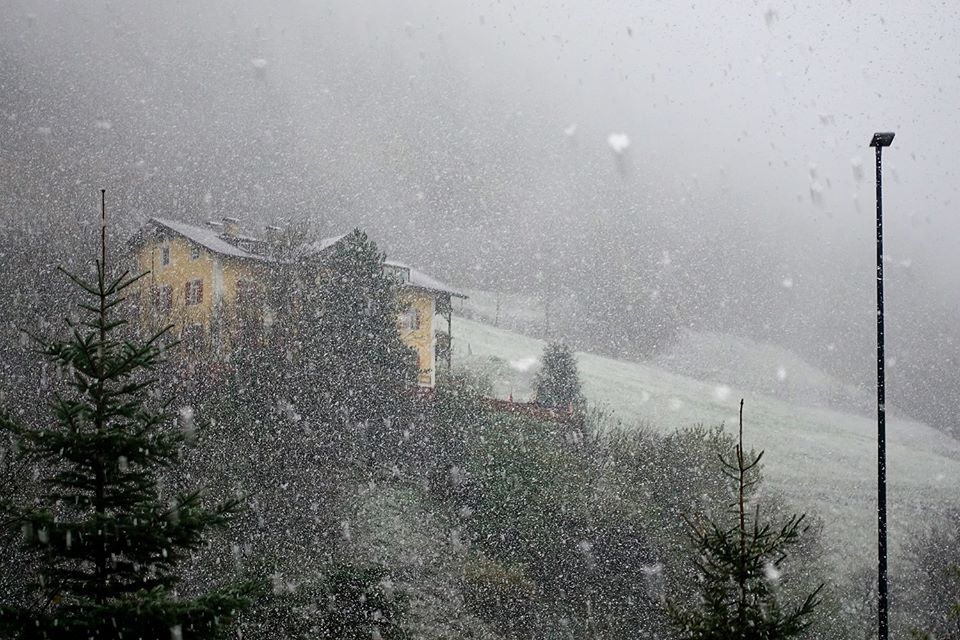
Snowfall in Franzensfeste, South Tyrol. Photo taken in November of 2019.

Snowfall in Franzensfeste, South Tyrol. Photo taken in November of 2019.
by Bill Benzon
About a month ago Tyler Cowen posed the following question at Marginal Revolution, a blog he runs with along with his collegue Alex Tabarrok: Why has classical music declined? If you do a general web-search on that question you’ll see that it’s a popular topic. The ensuing discussion has had 210 remarks so far. That’s a lot, especially when you consider that Marginal Revolution centers on economics and closed allied social sciences, though Cowen does comment on the arts as well. Some responses are longish, somewhat detailed, and knowledgeable. Most are relatively brief. On the whole the quality of the discussion is high, but scattered, which is to be expected on the web.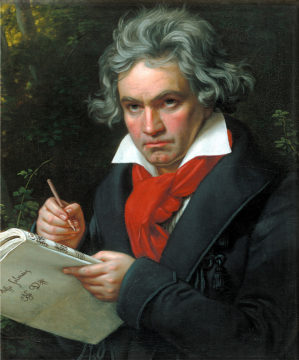
Cowen posed the question in response to a request from one of his readers, Rahul, who had asked:
In general perception, why are there no achievements in classical music that rival a Mozart, Bach, Beethoven etc. that were created in say the last 50 years?
Cowen offered several observations of his own. Here’s the first:
The advent of musical recording favored musical forms that allow for the direct communication of personality. Mozart is mediated by sheet music, but the Rolling Stones are on record and the radio and now streaming. You actually get “Mick Jagger,” and most listeners prefer this to a bunch of quarter notes. So a lot of energy left the forms of music that are communicated through more abstract means, such as musical notation, and leapt into personality-specific musics.
Yikes! From Mozart to the Rolling Stones, that’s quite a lot of musical territory – one reason, perhaps, that the discussion was scattered.
In this piece I treat the discussion as a collection of dots. I draw lines between some of them and color in some of the shapes that emerge. Read more »
by Bill Murray

Ukraine is surrounded by 100,000-plus miserable, freezing, foot-stamping Russian soldiers who are Chekov’s gun on the table in Act One of our new post-Cold War epic. We’ve moved from “surely he wouldn’t?” to “he’s really going to, isn’t he?” It’s the moment when Wile E. Coyote has run off the cliff but not yet begun to fall.
Two years ago Covid crowded out every thing but the most immediate, every body but family. Shocked by the viral invader’s audacity, we scrambled around in a new, unfamiliar world. Everything was frightening. We had precious little time to reflect.
Now comes the malign intent of a real-life invader. Unlike Covid, Ukraine isn’t exactly appearing out of nowhere. Russia has been moving toward military aggression for months. The US president has had time to commit high profile gaffes about any U.S. response. Russian landing craft have moved clear around Europe from the Baltic Sea to threaten Ukraine in the Black Sea. We’ve had ample opportunity to reflect.
So far the west has performed a pretty nifty feat – defying physics. Specifically Newton’s third law, the one about for every action, there is an equal and opposite reaction. Only now, at last, comes a grudging rumble from the big American reaction machine. Read more »
by Pranab Bardhan
All of the articles in this series can be found here.
 The Naxalite phase in Bengal was a short, tragic chapter in politics, but in Bengal’s cultural-emotional life its implications were deeper, and reflected in its literature (and films)—most poignantly yet forcefully captured by the writer Mahshweta Devi, one of Bengal’s most powerful political novelists. Again and again in the 20th century some of Bengali youth have been fascinated by the romanticism of revolutionary violence–as was the case in the early decades in the freedom struggle against the British (I have earlier mentioned about my maternal uncle caught in its vortex), then again in the 1940’s when the sharecroppers’ movement (called tebhaga) was soon followed by a period of communist insurgency in 1948-50, and then in the Naxalite movement of the late 60’s and early 70’s.
In the early literature Tagore often engaged with this theme (something already familiar in 19th-century Russian literary imagination). By temperament and political judgment he was opposed to revolutionary violence and the unthinking passions associated with it, and yet he had some soft corner for the young people involved. This theme is dominant, for example, in his novel Char Adhyay (‘Four Chapters’), and in its preface he writes about his once-close friend Brahmabandhab Upadhyay, who parting company with Tagore joined the revolutionary movement. In this preface Tagore recalls the brief touching moment one evening when he came back after some years as a disillusioned man to see Tagore. In much of the profuse literature generated by the Naxalite period, while the repressive state is in the background, there is a pining over the wastage of the lives of so many idealistic youths for a brave social-justice cause–a cause that was in my judgment an insufficiently thought-out one. Read more »
by Scott F. Aikin and Robert B. Talisse

Academic journal publishing employs a system of anonymous peer review. Work is submitted anonymously to a journal, which then arranges for it to be reviewed by other experts in the field, who also remain anonymous. The reviewers compose a report that itemizes the submission’s merits and flaws, and eventually recommending publication, rejection, or revision-and-resubmission. The reports are shared with the submitting academic, along with a final judgment about whether the work will be published.
Every academic has stories about how this process can go haywire. Many of these stories have to do with that one reviewer, the one who seemed hell-bent on not only misunderstanding but willfully resisting the point of an essay, the one who wrote an off-the-rails, and just nasty, rebuke of the submission. The anonymous peer review process at academic journals, it seems, encourages this kind of behavior. Not only does the reviewer not know who the author is, but the author will not know who the reviewer is. And all the intuitions shared about how anonymity on the internet produces trolls bear on temptations too many reviewers give in to.
Most journal reviewing, in the humanities at least, is done without compensation. It is a service to the profession, added on to one’s teaching, university service, and research responsibilities. And it shows up out of the blue, with a short invitation from a journal editor and maybe an abstract. It’s often onerous, and too often simply annoying. In the climate of publish or perish, many essays go out to the journals before they are ready, and in fields with fast-moving controversies, they must or else be untimely. So reviewers are faced with essays that are additions to their already heavy workloads that could have used more time. And the inclination to take one’s frustrations out on the author is just too great. Add to all of this the simple but pathological delight of punching those who cannot defend themselves or hit back. We have been on the helpless receiving end of such pummeling. Many times. Read more »
by Ashutosh Jogalekar

From the age of eleven to the age of fifteen or so, my consummate interest in life was collecting insects and studying their behavior. In the single-minded pursuit of this activity I chose to ignore every ignominy, ranging from being chased by stray dogs and irate neighbors to enduring taunts hurled by my peers and disciplinary action meted out by teachers. Suffice it to say that I would have been the last boy to be asked on a date. The best thing was that none of this mattered in the least.
I don’t remember how it began, but I do know how it progressed. I vaguely recall a book, one of those craft books that taught kids how to build terrariums and enclosures. What I do remember well is that once the hobby took hold of my mind, it changed the way I saw the world. A new universe opened up. What might look ordinary to others – a patch of dusty brush by the side of a busy highway, the outskirts of a field where everyone else except me was playing soccer, and most notably, the hill close to our house which was a venue for vigorous workouts and hikes by seniors trying to stay fit – now teemed with insect life for me. That is what science does to your mind; it hijacks it, making you see things which everyone sees but notice things that very few do. Read more »
by Jonathan Kujawa
2, 3, 6.
There is one of these numbers for each pair of numbers m and n. The 2 is from when m and n both equal 1, the 3 was when m equals 2 and n equals 1, and the 6 was from when m and n both equal 2. The 6 took several days and was about the limit of what we could compute by hand.
By analogy from similar calculations in other situations, it was our belief that there should be a reasonable formula that could compute these numbers just given m and n. But that was faith and intuition, not science — and definitely not math! Despite the Law of Small Numbers, mathematicians are firm believers that coincidences rarely happen. Given data, there should be an understandable order and pattern. Certainly 2000+ years of mathematics support this optimism.
In my work with Brian and Dan, we ended up proving that the above list of numbers is given by the formula (where r is the smaller of m and n):
(m+n)*r – r² + r.
If you would like to see the details, see formula (1.1.2) in this paper. We never had more than those three numbers for data, but through a combination of theoretical considerations and plain ol’ guessing, we were able to figure out the pattern.
In trying to solve other research questions you sometimes have the opposite problem. You can generate lots of data, even huge amounts of data, but it is hard to see the forest for the trees. Read more »
by Brooks Riley
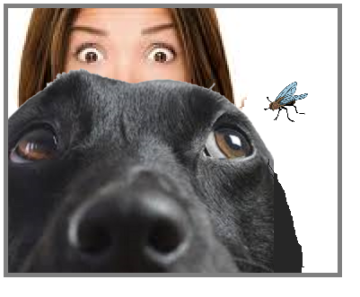 Not long ago, having steeled myself for the read-through of yet another dry but informative assessment of the body’s immune response to Covid 19 and her variant offspring, I was pleasantly surprised to find myself being dragged into a barbaric tale of murder and mayhem, full of gory details and dire strategies.
This was not a thriller, or the reenactment of a famous battle, but rather as entertaining an article about Covid 19 as one could hope to find in these dark days, couched in the rhetoric of anthropomorphism. Katherine J. Wu, a staff writer at The Atlantic, as part of her ongoing coverage of the pandemic, casts the lowly T-cell in the role of ruthless mercenary on a murderous rampage through the body on behalf of the immune system, investing him (her, they or it?) with intent to kill all viral interlopers, which is exactly what a T-cell should be doing.
Just listen to this: When these immunological assassins happen upon a cell that’s been hijacked by a virus, their first instinct is to butcher. The killer T punches holes in the compromised cell and pumps in toxins to destroy it from the inside out. The cell shrinks and collapses; its perforated surface erupts in bubbles and boils, which slough away until little is left but fragmentary mush. The cell dies spectacularly, horrifically—but so, too, do the virus particles inside, and the killer T moves on, eager to murder again.
Has science writing ever produced such a graphic description of a biological killing spree? Conversely, what crime writer would endow his heroes with such unflinching maleficent intent? It’s a stunning piece of writing, but it also serves a hidden purpose: The reader will not forget this diabolical sequence—or the functions of a T-cell. How a T-cell attacks a virus will burn forever in the imagination, along with other memorable entertainments. Read more »
by Nicola Sayers
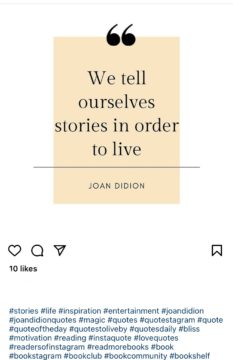 We tell ourselves stories in order to live.
I don’t know where I first came across this sentence. I was in my early twenties, so it can’t have been on Instagram, although I’ve since seen it there so many times that this is now how it appears in my mind’s eye: boxy black print, hovering in mid-square. My young notebooks are less polished: in those the sentence is scribbled over and over in messy, heartfelt handwriting, a kind of incantation to writerly promise. But there, too, it stands alone. Surrounded by white space, free-floating, as though it does its best work all by itself.
But it wasn’t, of course, written to stand alone. It is the first sentence in Joan Didion’s iconic 1979 essay The White Album, an essay which goes on to examine exactly the moments when the stories we tell ourselves no longer work or, worse, when no stories present themselves to us at all, when we can’t make sense of any of it. It is an essay about California in the 1960s and, not unrelatedly, about her own mental health struggles (as is often the case in Didion’s writing, her state of mind is not examined as its own particular thing, but taken instead as a clue to the state of the world). It is an essay about disorder, about fragmentation, about falling apart. If, in 1976, Didion stated in ‘Why I write’ that ‘I write entirely to find out what I’m thinking, what I’m looking at, what I see and what it means’, in her 1979 essay (parts of which had been previously published) she concludes that – at least when it comes to the events of the sixties, and her experiences of them – ‘writing has not yet helped me to see what it means.’
I did not know any of this, though, when I first came across that sentence. In truth, I didn’t even know who Joan Didion was. It was a number of years before I would come to read the essay to which the sentence belongs, and I confess that I was initially disappointed. Read more »
by Ethan Seavey
I haven’t had a moment for words in weeks. I’ve been drowning myself in the minutia that sums into minutes. I take a nap. 30 second videos and 30 minute episodes on a screen my eyes strain to see. I spend half an hour making food and another eating it.
I feel the conflict within myself. I feel my body begging for satisfaction, for a good night’s rest and a home-cooked meal and a dozen eggs every three days and a good bowel movement. I treat the body like a puppy. I turn on Netflix and put my mind on autopilot: then bathe the body, cook for the body, bring the body to water, tuck the body into sleep. I treat it to plenty of walks and treats and it is happy.
But the mind suffers. It has to take care of the body and the person, Ethan, who needs to email this person and text that person. The brain must schedule this, and sign that. Plan and plan and plan for the future and block out the past and all the while the brain is itching for the phone.
The cure-all is scrolling. To watch more content online and be totally full of information and stimulus. The brain has no need to think for itself, to relieve the stresses causing my anxieties.
The soul, it’s the least important. It brings me security during the day to say I’m a writer and it relieves me at night to tell myself that I’m too tired to write today. The soul understands that I’m fighting a war here. The soul understands that it’s mostly a source of pain these days, and that to turn it off is easier. My soul’s really only satisfied as I sleep, as I dream of touching love’s skin and feeling safe, like I’ll never roll off the bed. Read more »
by Brooks Riley
by David Oates
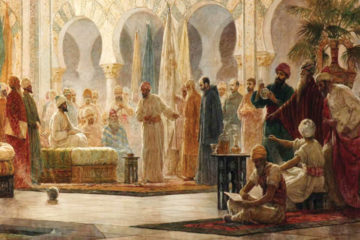
In the short month since the first installment of this exploration, the news has returned to our theme. A few days ago (at this writing) a new squabble broke out over America’s supposed “Judeo-Christian heritage,” this time in Boston itself, seedbed of our original revolution. It seems the city government has rejected a request to fly a “Christian flag” outside the city hall. The reasoning offered for this request (if repetition of cliches based on historical fantasy can be called “reasoning”) was that it sought to “enhance understanding of our Judeo-Christian moral heritage.”
I would suggest that the cultural conservatives who try to rebrand America as a “Judeo-Christian” culture are not, in fact, conservative – since our founders were explicitly not interested in revealed religion as a basis for the new country. As Part I of this essay showed (if briefly!), the Founders looked to reason; they trusted the testimony of experience; they studied the ancient republics and democracies. There is no democracy in the Bible. That founding value came from elsewhere.
So these “cultural conservatives” are better described as reactionary fantasists. It’s the usual thing in backward politics – pining for an imaginary past. Read more »
by Tim Sommers

When I was 15 years old I volunteered at a paleontological dig in Barnhart, Missouri. A car dealership expanding its parking lot had discovered a treasure trove of mastodon bones in the empty lot right next door. Mastodons are woolly mammoths’ smaller, less glamorous, cousins. Furry elephants, basically. They roamed the Americas until about 10,000 years ago. And Jefferson County, Missouri has more than its fair share of mastodon bones. It’s because of the clay. It seals them in airtight. And so we pulled out bones not fossils. We had to coat them with plastic soon after we exposed them to the air, before the decay set in, otherwise they crumbled like vampires exposed to the sun. But slower.
Most of us were amateurs. And we bent some rules. We dug under part of the road, propping up the black-top with bits of wood. Something I wouldn’t have thought possible if I hadn’t seen it. One day a semitruck rode over the propped-up bit of road while a guy was so far under you could only see his feet. He came out pale and shaky and that was the end of that.
It was a nerd’s paradise. For example, we held a 24-hour dance marathon to raise money for carbon-dating.
And I learned a lot. The most important thing I learned was that working at an excavation is a horrible job. Horrible.
It was slow and hot. Or slow and cold. So, slow. And wet. Mostly you dug up useless fragments of bone. If you found anything interesting, someone more experienced took over immediately. The holes – clay pits, really – filled up with water when it rained and had to be bailed out. Once I left there, I never thought about digging anything up ever again. Read more »
by Christopher Horner
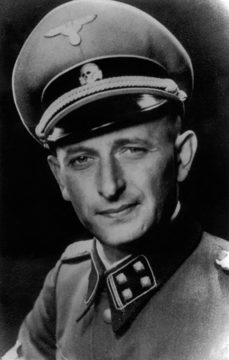
Adolf Eichmann was hanged in Jerusalem on June 1st 1962, a little after midnight. He had been found guilty by an Israeli court of ‘crimes against the Jewish people’ and ‘crimes against humanity’. One of the reasons he is still remembered – apart from the sheer scale of the crimes committed by him – is the he became the subject of a famous book: Eichmann in Jerusalem, by Hannah Arendt. It is a troubling and controversial text, but, I think, one that holds a good deal of interest for us today. For it hs something to say about the modern subject and the way we live today. Eichmann’s significance takes us to the heart of Arendt’s central concern – the very possibility of living together politically in the contemporary world. This is an issue of obvious concern to all of us.
The Banality of Evil
Arendt’s term for what she saw and heard in Eichmann has become famous: ‘The banality of evil’: Arendt’s identification of Eichmann as a somehow thoughtless man, one who replaced reflection on the murder he was committing by clichés and formulae has become famous, so much so that it too risks joining the army of clichés, another formula to replace thought. Yet the question remains: what was it about Eichmann that she saw as significant? What Arendt saw in Eichmann was something that remains present and troubling today. This was the abdication from genuine thinking and judging that she named, an absence that accompanied him through his role in the central crime of the Twentieth Century. The high-ranking Nazi, an agent of genocide was just a colourless bureaucrat. And the manner in which this functionary did evil was as far from the demonic or sadistic as one could imagine –it was banal indeed. Arendt did not claim that evil is a banal concept, but that those who sit in offices and bring it about it are just that: not monsters but ordinary people who do not think. This banality, or ordinariness, is the disturbing reality that makes Eichmann a kind of negative exemplar, a representative figure for our times. The trial gave Arendt the opportunity to encounter the phenomenon right in front of her eyes. Read more »

Taken from my window an hour ago.
by Peter Wells
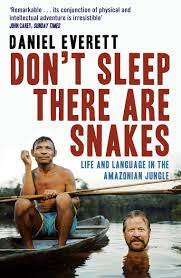 Daniel Everett’s 2008 book, Don’t Sleep, There are Snakes (Life and Language in the Amazonian Jungle), threw what seemed to be a pebble into the world of linguistics – but it is a pebble whose ripples have continued to expand. This might be thought surprising, in view of its curious construction. It contains a detailed description of the writer’s encounters with a small, remote Amazonian tribe, whom he calls the Pirahã (pronounced something like ‘Pidahañ’), but who apparently call themselves the Hi’aiti’ihi, roughly translated as “the straight ones.” They live beside the Maici River, a tributary of a tributary of the Amazon, which is nonetheless two hundred metres wide at its mouth.
Everett includes a harrowing description of a desperate journey to save the lives of his wife and daughter when they became seriously ill, and other incidents when his own life was in danger. He lovingly describes the sights and sounds of the rivers. He relates many anecdotes illustrating the culture of the Hi’aiti’ihi, and the relationships between them and the neighbouring populations. He draws lively thumbnail sketches of memorable characters he met.
He mentions, somewhat incidentally, his unsettled childhood and youth, with an allegedly alcoholic father. He reports that as a teenager he fell in love with, and married, the daughter of a local evangelical pastor, and turned his life around. He became a fervent Christian, and with his wife studied linguistics at the Summer Institute of Linguistics (now SIL International), a Christian non-profit organisation, whose main purpose is to translate the Bible into all the world’s languages. Read more »
by Pranab Bardhan
All of the articles in this series can be found here.
Sometime before Ashok Rudra and I started on our large-scale data collection, I was already doing some theoretical and conceptual work on agrarian relations. My first, mainly theoretical, paper on share-cropping (jointly with TN) came out in American Economic Review in 1971. That paper was unsatisfactory and had quite a few loose strands, but it was one of the first papers to look theoretically into an economic-institutional arrangement of a developing country at the micro-level. This was a time when development economics was preoccupied with macro-issues like the structural transformation of the whole economy involving transition from agriculture to industrialization or problems of its aggregate interaction with more developed economies.
In a short trip abroad I presented my work on share-cropping in a seminar at Yale where my friend, Martin Weitzman who was teaching there, was present. He later told me that it made him start thinking of a more general context, that of sharing profits or revenues with workers in a modern firm that might resolve some macro-economic problems like unemployment—he later came out with a book on this titled The Share Economy.
Joe Stiglitz by that time had also moved to Yale, and asked me to stay overnight with him after my talk. That night at his home kitchen, as he was washing the dishes after our dinner, we kept on talking on various aspects of share-cropping. I told him that to me share-cropping was clearly an inefficient institution in agriculture, and yet it had been around for millennia in different parts of the world. We were both wondering why. Joe started looking at it from his point of view of imperfect information (the landlord unable to monitor how much effort the peasant put in). That led to his chain of thinking which ultimately produced his classic paper on share-cropping in 1974. Read more »
by David J. Lobina
(This is Part 2 of a brand new series of post, this time about the relationship between language and thought; Part 1 is here)
 A provocative title, perhaps, and perhaps also counterintuitive. One thinks in the language one speaks, everybody knows that. Why would anyone ask bilingual speakers which language they think in (or dream in) otherwise?
I suspect that what people usually have in mind when they ask such questions is related to the phenomenon of inner speech, the experience of internally speaking to ourselves, which may well be ubiquitous in adults (but probably not in children), though not entirely universal. I certainly think that inner speech plays a role in thinking, but not as central a role as most people seem to think (I will come back to this on a later post, probably in Part 4 of this series, where I will also discuss how writers of fiction use the narrative technique of “interior monologue” to outline some of the mental processes of a given character (thinking, feeling, etc.) – but mostly to argue that authors generally go about it the wrong way!).
The point I want to make in this post is that no-one thinks in any natural language; not in English, or Italian, or whatever, but in a language of thought, an abstract, unconscious and moreover inaccessible, conceptual representational system of the mind. Or at least I intend to provide some of the evidence, anecdotal and otherwise, that suggests that this is indeed the state of affairs. Read more »
by Hari Balasubramanian
 The slim, green book Natural History of Western Massachusetts is one of my favorites. Compressed into its hundred odd pages are articles and visuals that describe the essential natural features of the Amherst region, where I’ve lived since 2008. I turn to it every time something outdoors piques my interest — a new tree, bird or mammal, a geological feature.
One section that I particularly enjoy is the ‘Nature Calendar’ at the end. The calendar gives predictions on what to expect in each phase of a month; there’s approximately one prediction for every 3-day period. In early November, for example, it says “dandelions may still be blooming in protected areas”, and indeed some wildflowers do retain their bright colors despite freezing fall temperatures. It also says for the same month that “flocks of cedar-waxwings may be migrating through the region”. This was such a specific claim, but it is accurate: I was startled to see a flock of nearly a hundred waxwings swirling around bare trees on a rocky mountaintop this November.
The scientific analysis of such seasonal patterns is called phenology. Wikipedia defines it as “the study of periodic events in biological life cycles and how these are influenced by seasonal and interannual variations, as well as habitat factors (such as elevation)”. It’s a clunky, textbook kind of definition but the gist is clear enough. I find myself drawn to phenology for many reasons. Read more »
 Whitfield Lovell. Kin XLV (Das Lied von der Erde), 2011.