Editor’s Note: Frans de Waal’s new book, Different: Gender Through the Eyes of a Primatologist, has generated some controversy and misunderstanding. He will address these issues in a series of short essays which will be published at 3QD and can all be seen in one place here. More comments on these essays can also be seen at Frans de Waal’s Facebook page.
by Frans de Waal
Since men lack a nurturing instinct, we can’t expect them to take care of kids. It would be “unnatural.”
This false appeal to biology is often heard in defense of traditional gender roles. Thus, Fox News’ Tucker Carlson mocked the paternity leave of U.S. Secretary of Transportation Pete Buttigieg as a way of “trying to figure out how to breastfeed.”
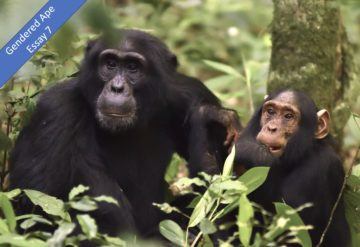
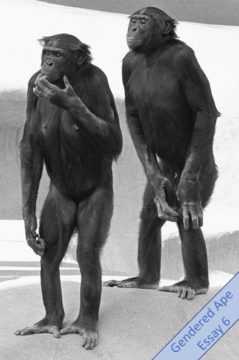
At first sight, the behavior of other primates supports the assertion that caretaking is not for males. Male apes may offer protection to mothers and young, but that’s all. Raising offspring is a female job. The maternal load is so heavy that bonobos and chimpanzees get pregnant only every five or six years. They cannot handle more progeny. Mothers carry the youngest on their belly, a juvenile on their back, while an older one follows them through the forest. Young apes remain dependent for up to a decade, and mothers receive no assistance to speak of.
But oddly (or perhaps not so oddly if we assume that the genders are psychologically more similar than different), males are perfectly capable of childcare. They have a remarkably well-developed caring “potential”. We sometimes get a glimpse of this potential after a mother’s death, when there is all of a sudden an orphan whimpering for attention. Read more »
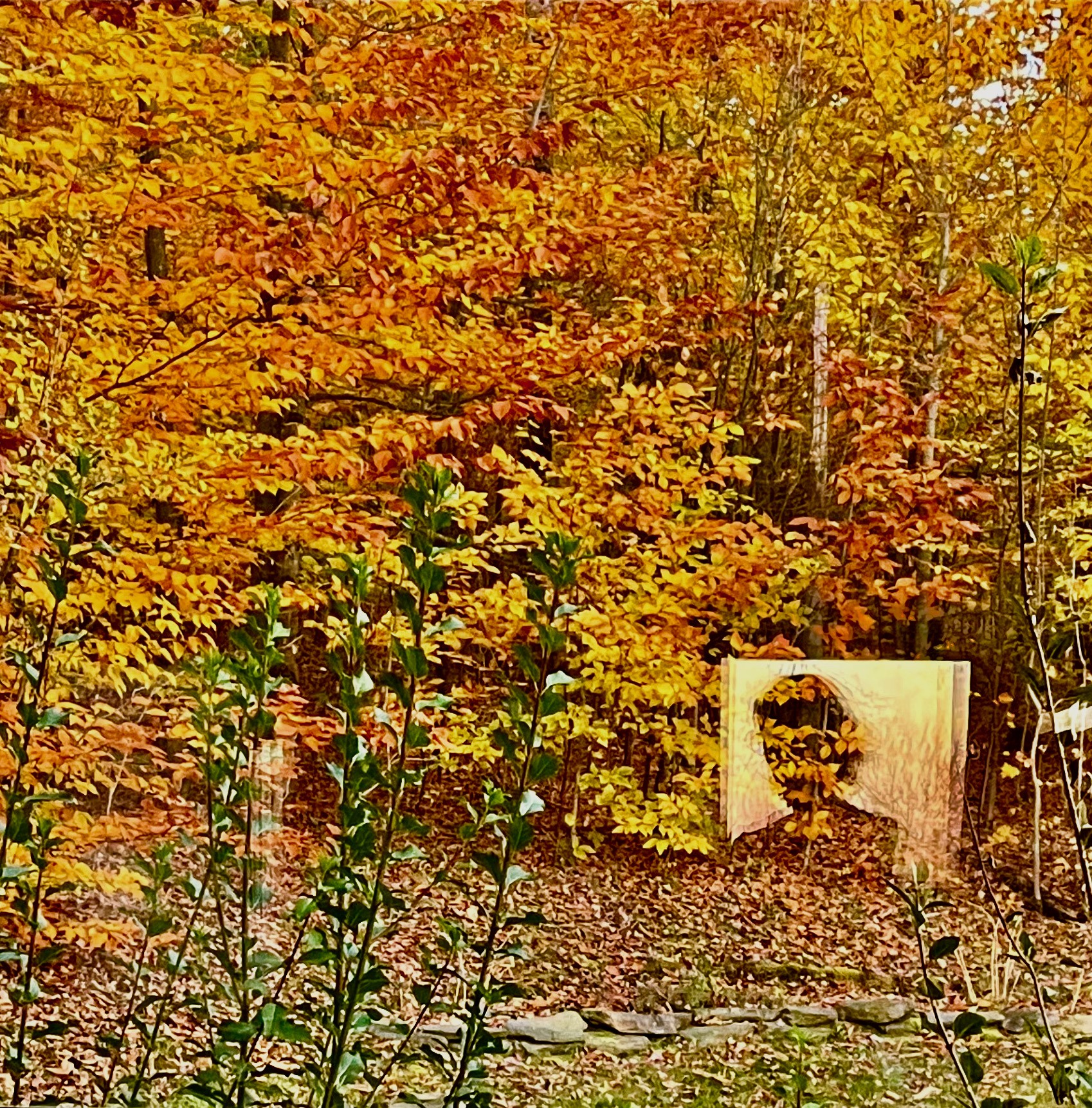 Sughra Raza. Shadow Self-Portrait in a Reflection of a Window in a Window.
  A couple of years ago I briefly became famous for hating Vancouver. By “famous” I mean that a hundred thousand people or so read

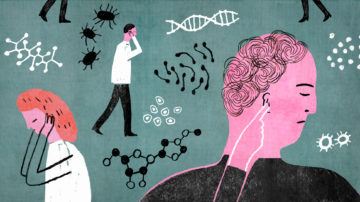
 It was announced last week that scientists have integrated neurons from human brains into infant rat brains, resulting in new insights about how our brain cells grow and connect, and some hope of a deeper understanding of neural disorders.
  Visualize a purple dog, the exercise said. Imagine it in great detail; picture it approaching you in a friendly way. So I did. I thought of a spaniel: long silky ears, beautiful coat, all a nice lilac color. Pale purple whiskers. The dog was friendly but not effusive. I’m not a dog person, but I wouldn’t have minded meeting this dog. All right, now what? The exercise went on to say something along the lines of “Wonderful! If you can visualize that purple dog, can’t you imagine your own life as being full of amazing possibilities?”

 The Fate of the Animals: On Horses, the Apocalypse, and Painting as Prophesy (Three Paintings Trilogy), by Morgan Meis, Slant
 Scheduled departure at Dulles came and went as we waited for the last passenger to board. Although the non-smoking section in the rear cabin was full, the smoking section where I sat was half empty. Death by asphyxiation on the flight to Paris was a distinct possibility but with three empty, adjacent seats in the centre nave there was some chance that my obituary might read, “She died peacefully, in recumbent sleep.”
 Indifference is an attitude first theorised as a philosophical stance by ancient Greek Stoic philosophers from the 3rd century BC. It was conceived as the right attitude to cultivate in reaction to indifferent things. What was surprising were the things the Stoics considered to be indifferent and hence require us to be indifferent to. Not your usual ‘whether the number of hairs on your head is odd or pair’, or the number of billions of stars in the galaxy, or even what colour underwear your boss wears – though in some circumstances, the latter can start becoming titillating. And titillation is of course what it’s all about. It’s the tickle that spurs the Stoic to resist it. Resisting what exactly? Feeling, uncontrolled gratification, heart-melting, giving in, touching, kiss-&-make-up-ing.