The Rehearsal: Can realistic simulations transform us?

by Robyn Repko Waller

Photo by Chris Lawton on Unsplash

Cringy. Real. Surreal. Socially Suspect. A lot can (and has been) said about Nathan Fielder’s HBO docu-comedy The Rehearsal. Are the clients actors? Are the actors acting? Is Fielder an actor or  client? Script becomes life and life becomes script in a recursive dream (nightmare?) of which one cannot help but be an onlooker. [Season 1 spoilers ahead.]

The initial premise seems wholesome if it was not so intrusive. Help folks live out their fraught future endeavors with a host of trained actors, replica sets, and practically limitless rewinds. ‘Immersive’ doesn’t do The Rehearsal justice. Fielder, the former magician, spins realism. Fielder and HBO seem to spare little expense to engineer clients’ test scenarios — the full-scale bustling bar down to the torn chairs and spices and patrons, an Oregon farmhouse homestead with the dream garden and steady supply of child actors. Creator of worlds of possibility. Worlds of possibility for action and transformation.

But can being embedded in a rich social simulation transform us? Prepare us for a changed future self? Plenty of shows and movies exploit the intrigue of transformation to capture viewers, but few are philosophical enough to explore the conditions for transformation, for shaping the self. Read more »


Darkness Visible

by Christopher Horner

Port Sunlight was a model village constricted in the Wirral, in the Liverpool area, by the Lever brothers, and especially under the inspiration of William Lever, later lord Leverhulme. Their fortune was based on the manufacture of soap, and the village was built next to the factory in the  Victorian/Edwardian era, for the employees and their families. It’s certainly a remarkable place, with different houses designed by various architects, parks, allotments, everything an Edwardian working class person might want. An enlightened employer, Lever was still a paternalist: he claimed his village was a an exercise in profit sharing, because “It would not do you much good if you send it down your throats in the form of bottles of whisky, bags of sweets, or fat geese at Christmas. On the other hand, if you leave the money with me, I shall use it to provide for you everything that makes life pleasant – nice houses, comfortable homes, and healthy recreation.” Overseers had the right to visit any house at any time to check for ‘cleanliness’ and that the rules about who could live in which house were observed (men and women could only share accommodation if they were in the same family). Still, by the stands of the day it was quite progressive – schools, art gallery, recreation of all sorts for the employees were important. Read more »

A Bit of Berthold Laufer

by Eric Bies

In 1930, the German anthropologist Berthold Laufer published a monograph on the phenomenon of people eating dirt.
A sinologist by training, Laufer’s study—“the evaluation of the whole question of geophagy”—begins with a trip through Ancient China, where for hundreds of years Han, T’ang, and Sung soil disappeared down eager gullets. From there, the globe: he tours Malaysia, Polynesia, Melanesia, Australia, India, Burma, Siam, Central Asia, and Siberia, stopping off among Persians and Arabs before continuing on to Africa, Europe, North America, Mexico, Central America, and South America. His conclusion? People all over have eaten dirt for a very long time … And yet rarely does one find a Malaysian or an Indian, a Siberian or an Arab, an African or a Mexican swallowing down the plucked clod raw. Almost always water is added to the earth first: in the Yun-ho Mountains, white clay “is mixed with water and beaten on a stone” before it is eaten; in the Philippines, “it is a common thing to mix the earth taken from the nests of ‘white ants’ with water”; in Nishapur, where Omar Khayyam penned his Rubáiyát, the clay is softened with “rose-water and a little camphor,” then shaped into loaves.

Of course, few have particularly prized the practice Laufer describes in all its inventive renditions: as when the occupants of Leningrad remained under unremitting siege for 872 days and turned, in the interest of evading death by starvation, to their suppers of book glue and snow, so the chronically hungry everywhere and forever have tended to eye the lumps of mud out back with all the despairing expediency of a cratered gut.

Even now it remains common practice in the poorer parts of places like the Subsaharan to attempt to recuperate certain vital minerals as iron, calcium, and zinc, including incidental traces of vitamins B and C, through a sometime diet of dirt. Read more »

Prized and Feral

by Ethan Seavey

My grandmother’s bird of choice is the rooster. She was raised in rural Kentucky and now lives in rural Wisconsin. She collects all sorts of roosters (and, by extension, some hens): wall art, printed dish towels, ceramic statues as small as a pinky and as large as a lamp, coin bowls and blankets and something nostalgic in each one.

If you don’t mind stepping briefly into her condo, we can see what it’s like. Eyes everywhere. Thoughtless, energetic eyes. Suspicion and preparedness. A rooster’s eye is life because it is anxiously awake, unsure why, but it is safe because it is always aware of sources of suspicion; suspicion, of course, comes from an abundance of anxiety. So those eyes don’t think much about what they’re watching. I’m sure you’ll find it hard to find hundreds of rooster eyes in your peripheral vision, but you’ll get used to it. If you feel overwhelmed, you can look outside her large windows, you can see the small and glassy lake with sailboats gliding over its surface like razors through taut fabric.

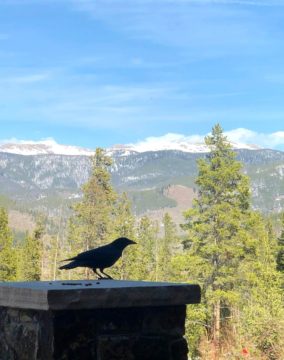
My mother’s bird of choice is the crow. She unconsciously developed an uncanny connection with them. It started during our group quarantine, after the onset of the pandemic. We spent April through May isolated in our ski cabin. We had no friends there so we could not be tempted to socialize. We could social distance easily, with the majority of the houses nearby sitting empty, their owners waiting for the ski resort to reopen. Read more »

Monday, October 24, 2022

The Gendered Ape, Essay 7: Males Are Better Caretakers Than You’d Think

Editor’s Note: Frans de Waal’s new book, Different: Gender Through the Eyes of a Primatologist, has generated some controversy and misunderstanding. He will address these issues in a series of short essays which will be published at 3QD and can all be seen in one place here. More comments on these essays can also be seen at Frans de Waal’s Facebook page.

by Frans de Waal

When young chimpanzees in a wild population lost their mothers, some were adopted by their big brothers. Holland, a seven-year old (pre-pubertal) male was taken care of and protected by his seventeen-year-old (late adolescent) brother, Buckner. Photograph by Kevin Lee.

Since men lack a nurturing instinct, we can’t expect them to take care of kids. It would be “unnatural.”

This false appeal to biology is often heard in defense of traditional gender roles. Thus, Fox News’ Tucker Carlson mocked the paternity leave of U.S. Secretary of Transportation Pete Buttigieg as a way of “trying to figure out how to breastfeed.”

At first sight, the behavior of other primates supports the assertion that caretaking is not for males. Male apes may offer protection to mothers and young, but that’s all. Raising offspring is a female job. The maternal load is so heavy that bonobos and chimpanzees get pregnant only every five or six years. They cannot handle more progeny. Mothers carry the youngest on their belly, a juvenile on their back, while an older one follows them through the forest. Young apes remain dependent for up to a decade, and mothers receive no assistance to speak of.

But oddly (or perhaps not so oddly if we assume that the genders are psychologically more similar than different), males are perfectly capable of childcare. They have a remarkably well-developed caring “potential”. We sometimes get a glimpse of this potential after a mother’s death, when there is all of a sudden an orphan whimpering for attention. Read more »

Apophenia and Extreme Confirmation Bias

by John Allen Paulos

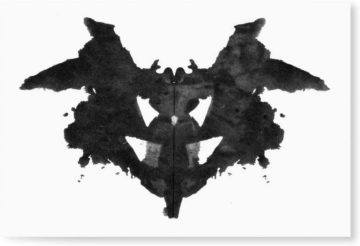
Rorschach Inkblot Test

I recall a party game I once wrote about. The game, described by philosopher Daniel C. Dennett in his book “Consciousness Explained,” is a variant of the familiar childhood game requiring that one try to determine by means of Yes or No questions a secretly chosen number between one and one million. (Twenty questions are sufficient.)

In Dennett’s more interesting and suggestive game, one person is selected from a group of people at a party and asked to leave the room. He (or she) is told that in his absence one of the other partygoers will relate a recent dream to the other attendees. The person selected returns to the party and is then told that, through a sequence of Yes or No questions about the dream, he should try to do two things: reconstruct the dream and identify whose dream it was.

The punch line is that no one has related any dream. When asked, the individual partygoers are instructed to respond either Yes or No to the subject’s questions according to some completely arbitrary rule. Any rule will do, but should be supplemented by a non-contradiction clause so that no answer directly contradicts an earlier answer or contradicts obvious facts. The Yes or No requirement can also be loosened to allow for an occasional Maybe.

Now let me change the scene. Instead of the unlucky partygoer, consider an ardent QAnon member. Instead of the other partygoers let’s substitute people who pretend to be from the news media (to rouse the member’s antagonism) but who agree to be governed by similar arbitrary rules. Finally, rather than having the subject try to reconstruct the dream and identifying the dreamer, let’s examine whatever disgusting scandal the QAnon member believes to be the case and to whom he attributes it.

Clearly this is more a thought experiment than an empirical result, but I would guess that the likely outcome in both cases is that the subject, impelled by his (or her) own obsessions, will often concoct an outlandish dream or gruesome story in response to the random answers he elicits from the partygoers or the “media” people. The situation is a kind of Rorschach test without the inkblots. Read more »

Vancouver I Hardly Knew Ye

by Deanna K. Kreisel (Doctor Waffle Blog)

A couple of years ago I briefly became famous for hating Vancouver. By “famous” I mean that a hundred thousand people or so read an essay I posted on Medium, and for a few weeks it became a part-time job to answer emails from well-wishers, cranks, and haters.[1] (Now, thank God, I am blissfully obscure again and all my emails are from manufacturers of undereye creams and students asking questions that are answered on the syllabus.) By “hating Vancouver” I mean that in the essay I wrote, which was in response to a truly nutso anti-American screed by Wade Davis published in Rolling Stone, I used Vancouver as a test case to refute Davis’s claims of Canadian superiority. It was too easy, in a way: Davis held up my former hometown as an example of income equality and social justice, which is sort of like using the Marquis de Sade’s château as an example of Buddhist lovingkindness. In my response, poor Vancouver—which has many other excellent qualities—was the innocent victim of an essayistic drive-by shooting; my aim was elsewhere, but she got caught in the crossfire.

But lambasting real estate greed and excoriating the hypocrisy of the municipal government are not all I have to say about Vancouver. I would also like to complain about the weather. Just kidding! Well, not kidding: I really do like to complain about the weather, but that is not what this essay is about. This is a love letter to a place I left, a place that I wanted to leave and do not regret leaving and yet miss, deeply and tenderly, every single day. It is also an essay, I suppose, about why my spouse and I decided to leave Canada and relocate to Mississippi, a move that never ceases to amaze anyone who hears about it. I mean, fair enough—without more information, I suppose such a move seems akin to relocating from a Buddhist monastery to the Marquis de Sade’s château. Read more »

Scent of a Bookworm

by Joan Harvey

POZZO: Which of you smells so bad?

ESTRAGON: He has stinking breath and I have stinking feet.

POZZO: I must go.

― Samuel Beckett, Waiting for Godot

There are many perplexing things in the world, but one of the more perplexing, only recently discovered by me, is that a substantial number of people, most of whom I assume to be women, wish to smell like old books. While it is easy to have a passion for, say, invertebrates, or designer sneakers, without necessarily wanting to smell like a pink-faced broad-nosed weevil or a favorite pair of old Nikes, apparently book lovers are different. It appears that for some bookworms, parting with their yellowing bound volumes is so distressing they need a way to carry the reminder with them though the day. And one way to carry around these literary longings is to douse themselves in the scent of books or sometimes whole libraries.

I came across the phrase “excessive bibliophilia” in Wayne Koestenbaum’s book Ultramarine. A newish book, so one without much smell. Koestenbaum was referring to Queen Christina, but I wonder if excessive bibliophilia doesn’t equally apply to those who feel they must smell like old libraries even in the boudoir. Perhaps while reading de Sade’s Philosophy in the Boudoir? After looking into book-themed perfumes I’m surprised there isn’t one with that name. Read more »

Kief, Kiev, Kyiv?

by David J. Lobina

KyivNotKiev

I must say that, for someone who is a sort-of linguist and typically pays attention to the latest linguistic customs, I was quite surprised by the recent, sudden transformation of Kiev into Kyiv in the English-speaking media. Now, I’m not as obsessive about all things language as some of my fellow linguists, who seem to be able to notice every detail and nuance in the way language is used today everywhere they go – on posters in the underground, in the media, by eavesdropping on people’s conversations, etc. (TimeOut used to publish a section called Overheard in London, and I’m sure some of my friends followed it religiously) – but I have been following the Russo-Ukrainian War, as Wikipedia calls it, to some extent since Russia’s annexation of Crimea in 2014, and even more so since Russia’s invasion of mainland Ukraine in February 2022 (236 days and counting, as I start this piece), and whilst I am sure that I was already aware of the use of the word ‘Kyiv’ to refer to the capital of Ukraine, I have nevertheless been taken aback by the fact that it has now become nearly universal in the English-speaking press to use the word ‘Kyiv’ instead of ‘Kiev’, even though employing the latter had been the norm for decades before current events.[1]

I especially mention “the English-speaking media” because the situation is rather different in other languages; this is clearly the case in the publications I follow in Italian and Spanish, where the use of the word ‘Kiev’ remains by far the most common, if not in fact as universal in these languages as ‘Kyiv’ has now become in English. Read more »

Rat Man? Ewww!

by Charlie Huenemann

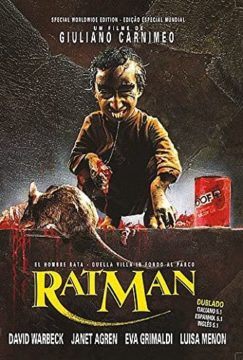
It was announced last week that scientists have integrated neurons from human brains into infant rat brains, resulting in new insights about how our brain cells grow and connect, and some hope of a deeper understanding of neural disorders. Full story here. And while no scientist would admit they are working toward the development of some Rat Man who will escape the lab and wreak havoc on some faraway island or in the subways, it’s impossible not to wonder.

There are some legitimate and difficult ethical questions in this territory, such as whether we should work toward “curing” all conditions labeled as “disorders”, including those conditions that have become woven into people’s lives so thoroughly that they would rather not lose them. Autism, for example, can be a terrible burden in some cases, but in others it serves as a valued feature of one’s individuality, an element in the core of who they are. It’s difficult to follow the precept of doing no harm as we dig deeper into human natures and find it’s not always obvious what counts as a harm. There is a medical/pharmaceutical mindset that likes to pound down any nail sticking up, which is running into the fact that some nails prefer to stick up, thank you very much.

But as we leave those problems to more insightful minds, I would like to turn instead to an illegitimate and silly worry, which we shall call “Ewww”:

Ewww = What if my neurons end up in a rat brain? Would I feel its whiskers twitching, feel hungry for garbage, and find fulfillment by running endlessly inside a little wheel?

As I said, it’s not a legitimate worry, but it’s hard for many of us not to feel a tug in its direction, because many of us are entranced by illusions about consciousness. Read more »

Imagining A Better Life

by Mary Hrovat

Visualize a purple dog, the exercise said. Imagine it in great detail; picture it approaching you in a friendly way. So I did. I thought of a spaniel: long silky ears, beautiful coat, all a nice lilac color. Pale purple whiskers. The dog was friendly but not effusive. I’m not a dog person, but I wouldn’t have minded meeting this dog. All right, now what? The exercise went on to say something along the lines of “Wonderful! If you can visualize that purple dog, can’t you imagine your own life as being full of amazing possibilities?”


At the risk of sounding curmudgeonly, no, I can’t. In fact, I was somewhat offended at the mild condescension of the exercise and the implicit suggestion that imagining a better life is helpful in and of itself. In my experience, it’s not that simple.

As I thought about why this well-meaning exercise bothered me so much, I realized that picturing the purple dog hadn’t actually been that difficult. I pictured a dog with a soft coat that I suspect could easily be dyed purple. (I wouldn’t advise anyone to dye their dog purple, but I can see how it could be done.) It would have been a bit harder to imagine a purple dog with a short oily coat, but I could see it happening by some kind of genetic engineering.

In any case, the main difference between the purple dog and an ordinary dog was cosmetic. Visualizing myself and my life differently, by contrast, often feels more like trying to imagine a dog, with a dog’s chest and throat and mouth and brain, meowing instead of barking. It’s much easier to imagine a purple dog than to imagine that my depression will vanish, after recurring for 40 years, or that I’ll find work in my city that pays enough to live on but also offers interesting mental challenges. Positive change does happen, even within constraints like mine, or worse. But how? Read more »

There is a Crack in Everything : Global Democracy or A Fascist Haunting

by Mindy Clegg

An election official outside and voters outside a voting location in Minneapolis, Minnesota by Lorie Shaull at flickr

The mid-term elections are less than a month away—voting has begun in many places, including here in Georgia with some of the usual struggles already unfolding. In a normal mid-cycle election like this one, control of the house, senate, or both would flip to the minority party—so says common knowledge. This year seems a toss-up. The polls since this summer have kept swinging back and forth between the Democrats hanging onto the house, and expanding their control over the senate, to the GOP taking both, but barely. Ordinarily, the minority party sweeps Congressional elections and that would make perfect sense—the party in power rarely gets it right when they control Congress and the presidency. But this year, the GOP continues its march toward right-wing authoritarianism. The party is wildly out of lockstep with the majority opinions on most of the major issues facing the country. Yet many voters seem poised to hand over control of at least one house in Congress to them. Why? It seems to largely stem from a mistaken belief the GOP has a better set of economic policies (they don’t) and that inflation is thanks to the Democrat’s recent policies (it largely does not seem to be). Far too many people are treating these upcoming elections as normal, ignoring the plethora of red flags being waved in our face. This is not a full-throated defense of the Democrats, whose policies are a mixed bag. I do believe that we face a serious existential crisis that must be averted. The far right-wing represented by the former president have a stranglehold on the Repubilcan party. Despite the very real limitations of the Democratic party, they are better if we wish to maintain a democratic form of government. We should avoid support for the GOP based on their violent, anti-democratic (small d) rhetoric. Read more »

The 500-Dollar Apple

by Mike Bendzela

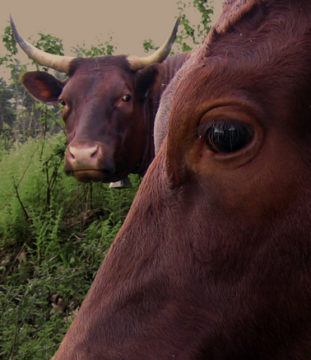
Belle, rear; Hannah, front. Photograph used by permission of Willie McElroy.

Hannah was a wide-horned, burgundy-red American Milking Devon heifer, with bug eyes and such a timid disposition you got the impression of a creature permanently bewildered.  You could not approach her; she would just pace off to a corner of the barnyard pasture and stare at you from a distance. And she seemed never to blink: you swore she knew she was doomed.

Her adopted mother, Belle (full name: Colonial Williamsburg Belle), was just the opposite—outgoing, ornery, bright, also wide-horned and the burgundy red of the breed. We had had Belle a few years before we bought Hannah as a yearling from a Devon breeder. My husband, Don, had visions of hand-milking a small population of cows and selling the milk and the inevitable bull calves to neighbors and hobbyists. Such a prospect caused me to have visions, period.

But Hannah never calved.

We thought something was wrong with her from the time she was a young cow, when she attempted to nurse off Belle. Even though Belle already had her own calf to feed, she indulged the new yearling. Not even the spiked “weaner” that hung from Hannah’s nose like malevolent jewelry dissuaded her from Belle’s teat. She just learned to flip the weaning device up out of the way and twist her head in such fashion as to permit her access to Belle’s swollen bag.

The near-adult cow nursing off the adopted mother in the barnyard got to be something of a scandal. We even had to pen Belle up in the barn with her calf, Abe, to allow him an unmolested meal. Hannah literally had to grow out of it: After a time, she just could not fit her head and horns under the other cow anymore. Read more »

The Frog, the Frog, and the Lizard—Native and Invasive Species on the Salish Sea

by David S. Greer

1And the Lord spake unto Moses, Go unto Pharaoh, and say unto him, Thus saith the Lord, Let my people go, that they may serve me.

2And if thou refuse to let them go, behold, I will smite all thy borders with frogs.

And the river shall bring forth frogs abundantly, which shall go up and come into thine house, and into thy bedchamber, and upon thy bed, and into the house of thy servants, and upon thy people, and into thine ovens, and into thy kneading troughs.

And the frogs shall come up both on thee, and upon thy people, and upon all thy servants.

King James Bible, Exodus 8

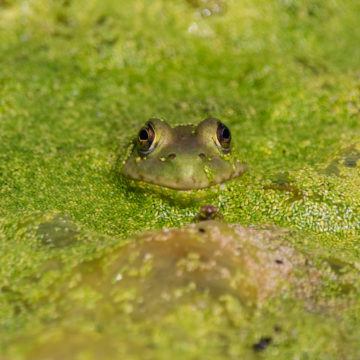
The American bullfrog—a face that only a mother could love? Bruce Tuck photo.

The negative reputation suffered by frogs during Biblical times hasn’t improved much since.  Macbeth’s three witches made a point of tossing into their bubbling cauldron not only toe of frog but also an entire venomous toad (a frog by another name).  In later fairy tales, princesses kissed frogs with reluctance, and only when required to break a spell.  Even today, the ickiness factor of frogs remains high for anyone leery of creepy-crawlies, even though more frogs means fewer spiders.  And most people still wouldn’t welcome a clammy frog in their bed, let alone in their kneading trough.

The American bullfrog (Lithobates catesbeianus), to name but one of the planet’s 5,000-plus frog species, has a face no one but a mother could love.  And when that face originates from just one of 20,000 eggs, the mother can hardly be blamed for failing to even recognize her offspring’s features, a fact that might go a long way towards explaining why American bullfrogs have a fondness for eating their progeny, whether at tadpole stage or in froggy maturity. Life as a carnivorous frog usually means no exceptions for children or cousins or aunts.  Eat or be eaten is the watchword of the frog and not a bad rule to remember for species hoping to survive and evolve to some more advanced form of life.  It has always been thus. Read more »