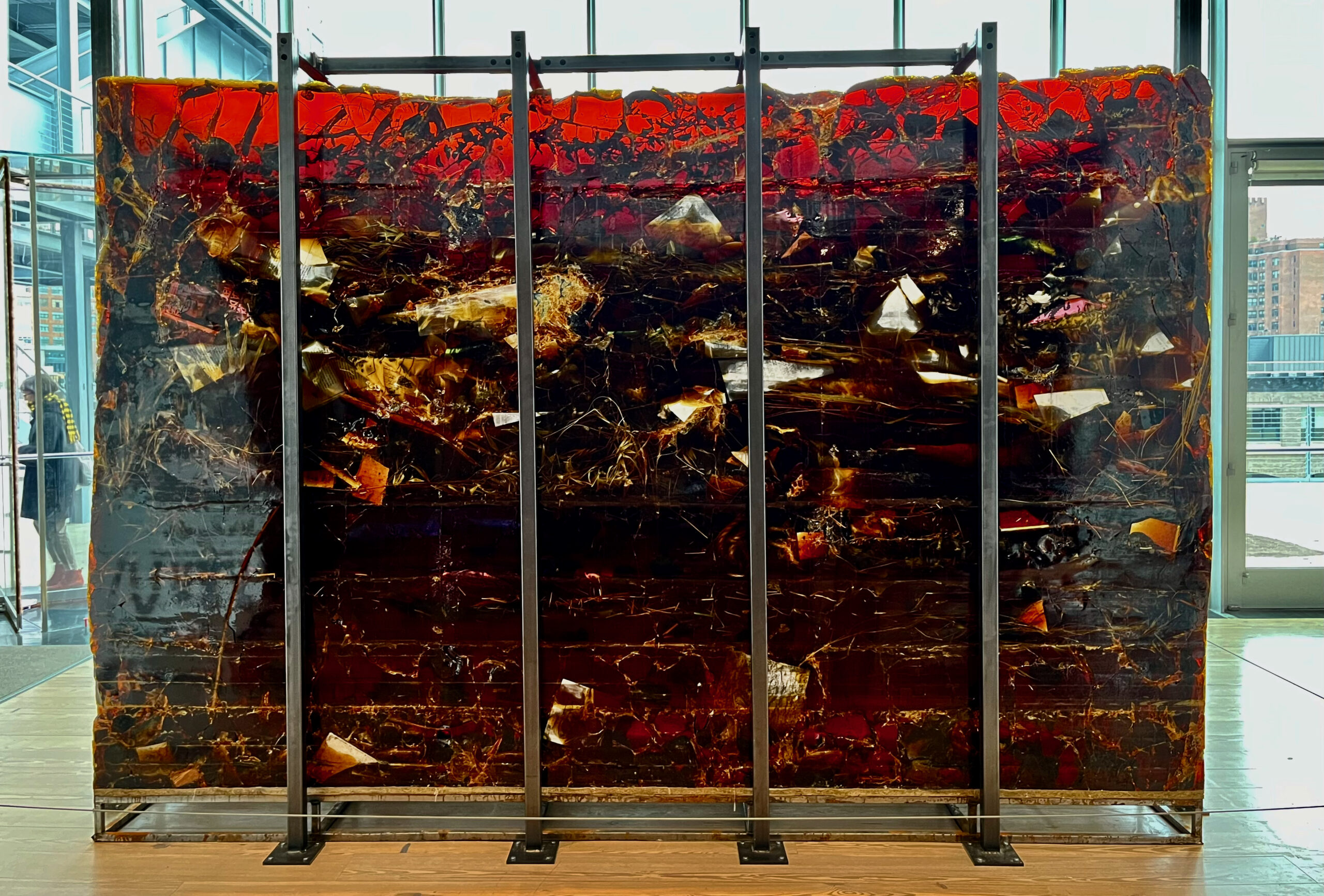
 Eddie Rodolfo Aparicio. White Dove Let US Fly, 2024.
Photo by Sughra Raza.
At the Whitney Biennial.

by Jeroen Bouterse
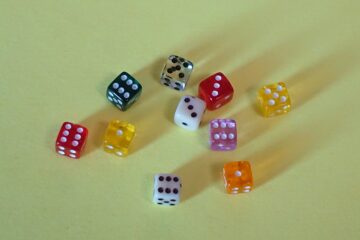 “You are aware”, I ask a pair of students celebrating their fourth successful die roll in a row, “that you are ruining this experiment?” They laugh obligingly. In four pairs, a small group of students is spending a few minutes rolling dice, awarding themselves 12 euros for every 5 or 6 and ‘losing’ 3 euros for every other outcome. I’m trying to set them up for the concept of expected value, first reminding them how to calculate their average winnings over several rounds, and then moving on to show how we calculate the expected average without recourse to experiment. It would be nice, of course, for their experimental average to be recognizably close to this number. Not least since this particular lesson is being observed by the Berlin board of education, and the outcome will determine whether or not I can get a teaching permit as a foreigner.
In case they are reading this, I would like to emphasize that I plan all my lessons with care and forethought; but for this particular one, you can bet I prepared especially well and left nothing to chance. Except for the part I left to chance, that is. To be precise: I had neglected to calculate in advance how likely it was for the experimental average over roughly 80 games to diverge from the expected value by a potentially confusing amount. I relied on my intuition, which informed me that 80 is a large number.
Turns out it’s not that large after all. The probability of at least 50 cents divergence (which would bring the experimental average at least as close to another integer as to the expected value of 2 euros) is, I have now figured out, a whopping 56%. There was only a 0.6% chance for the experimental average to exceed, as it did, 4 euros, but I had also implicitly accepted a 4% chance that the results would have been closest to 0 or even negative. Just imagine the damage that would have caused.
It would not have been the first time for a probability experiment to result in my pleading with my students to trust the math over actual results they have just seen with their own eyes. The Monty Hall problem has been especially awkward at times. Read more »
by Ed Simon

Past the regal bronze lions of Trafalgar Square and Nelson’s towering and triumphant column, up the steps of the National Gallery and behind it’s porticoed, columned, Regency façade, and on the second floor in room 34, the same place where the museum displays William Hogarth’s formal, yet warm, portrait The Graham Children and Joseph Turner’s dramatic Dutch Boats in a Gale, is the most luminescent painting of the British Enlightenment, Joseph Wright of Derby’s 1768 masterpiece An Experiment on a Bird in the Air Pump. Fully six feet tall by eight feet wide, Wright’s composition depicts a wizardly natural philosopher framed in long gray locks and draped in a red coat not dissimilar to a robe, contrasted by flickering candlelight in an eerie chiaroscuro, with his hand atop the perfectly spherical chamber of a vacuum pump, inside of which is a fluttering Australian cockatoo – exotic at the time – right before the pressure of the exhumed air crushes it’s tiny avian lungs. A number of characters witness the scientific presentation; a gentleman in powdered wig and green jacket gives the experiment his rapt attention, two young lovers seem more concerned with each other, an assistant boy at the window closes the bird’s cage while bathed in the light of a full moon, and an elderly man seems to time the demise with an intricate pocket watch.
Demonstrations such as these had been conducted for more than a century by the time Wright put brush to canvas, and during the eighteenth-century they were performed as often by theatrical presenters with a paying audience as they were by scientists, yet the choice of test subjects in these experiments was frequently as cruel as the painter depicted. Robert Boyle, the chemist and philosopher who commissioned the scientist and engineer Robert Hooke to construct England’s first air pump in 1659, records the results of an experiment on a lark, where as oxygen was pumped out of the chamber the bird “began manifestly to droop and appear sick, and very soon after was taken with as violent and irregular convulsions,” so that the animal “threw herself over and over two or three time, and died with her breast upward, her head downwards, and her neck awry.” The dispassionate empiricism of Boyle’s report is in keeping with the mechanistic philosophy which dominated the Royal Society, the scientific organization established by King Charles II’s proclamation shortly after Restoration in 1663, and to which the chemist would donate the vacuum pump. Read more »
by Brooks Riley
by David Winner
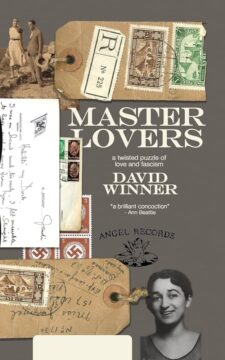
Coming from a Jewish family that arrived in America between the Slave Trade and the Holocaust, I thought that we were ethically in the clear, but researching my family story for Master Lovers, a book about my great-aunt Dorle’s love life in the 1930s, brought me face to face with famously fraught questions about evil and prejudice and the degree to which art and/or historical context can relieve us of its burdens. I thought of Ezra Pound’s and T.S. Eliot’s fascism, of course, Dustin Hoffman, Keven Spacy, and all the other actor/molesters but also Alice Walker’s interrogation of the Talmud, antisemitic or simply pro-Palestinian. And V.S. Naipaul, Indian from Trinidad, whose work (Bend in the River, India: A Wounded Civilization) skewered the post-colonial world.
Dorle Jarmel Soria, a Jewish woman who was a force in mid-century music, integral to both Leonard Bernstein and Maria Callas’s careers, and her husband Dario, who’d fled Rome after the Mussolini/Hitler pact, essentially raised my father. Once, he questioned Dorle about her friend soprano Elizabeth Schwarzkopf’s, close relationship (maybe affair) with Goebbels only to be rebuffed by the claim that “great art” lay “outside of politics.” And learning more about both her family and her lover, John Franklin Carter, whom she nearly married, revealed more dark associations. Ben Affleck convinced Henry Louis Gates not to reveal his enslaved-owning ancestors, but I – unfamous, little to lose – feel driven to out my family. Dorle, who smoked Benson & Hedges, drank gin and tonics, and traveled to Capri well into her nineties always recalled Graham Green’s beloved Aunt Augusta (Travels with my Aunt), but learning more about her made her seem more like Aunt Denver from Beloved, Heathcliff perhaps, someone haunted by their past.
By age thirty, I knew only a few “facts” about my Jewish family: our name did not come from Weiner, we were from somewhere near Poland, a distant relative translated the Declaration of Independence or was it the Constitution into Hebrew or Yiddish. Whereas my mother’s mother, born in Hapsburg Prague, compiled a genealogy going back centuries, my father’s Jewish side was apparently the family who fell to earth. Read more »
by Marie Snyder
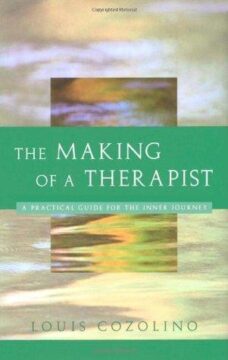
I recently listened to a podcast of Dr. Louis Cozolino, a neuroscientist and psychoanalyst, discussing what he would teach if he were training psychotherapists. The first year would be phenomenology: the power of Carl Rogers’ perspective to train how to develop an alliance through reflective listening while keeping countertransference out of the session. The second year would be physiology: developmental neuroscience and the evolutionary history of brains and bodies. The third year might be called intersectionality: the interpenetration of the spectrum of options that affect clients – brain, mind, family, culture – and a reaction against therapy as a mere opiate to calm the oppressed and exploited. The final year would be on narratives and stories that we live by and on that half second that it takes our brain to construct our experience of the present and feed it back to us.
Cozolino insists that it’s not enough to just sit and listen to people vent. After developing a non-judgmental alliance with the client, therapists need to be “amygdala whisperers,” to be able to down modulate amygdala activation to stop any inhibitory effect on the parietal system that enables problem solving. In other words, they need to soothe anxieties while arousing enough interest for clients to be able to learn new information. Then it’s time to challenge the client’s old system of thinking, slowly and delicately, a little at a time, to help them expand previous conceptualizations of themselves and the world. There’s a necessary plan and a strategy to the sessions. Read more »

Magnolias and blue sky last week in Meran, South Tyrol.
by Rafaël Newman
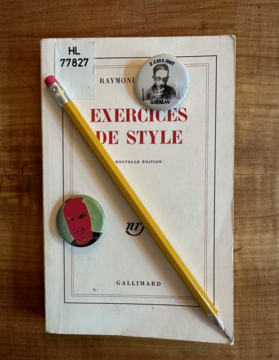 Notational
A Zurich-based translator answers an ad that reminds him of his youth and is sent several lapel pins, or buttons, bearing the likeness of a 20th-century French poet emblazoned with a motto. The creator of these buttons, a Chicago-based teacher, does not charge for his products, but asks only that they be worn. Their recipient is happy to comply.
The two men have not yet met in person; nevertheless, they discover a shared bond in their love of poetry and music, and begin to correspond. The second man eventually sends the first a new shipment of buttons (which he has been manufacturing together with his daughter), this time featuring the masked face of a contemporary Edinburgh-based artist and a new motto, once again free of charge. The first man agrees to wear these as well, especially since they give him the beribboned air of the dandy he once was.
The first man is then moved to distribute both series of buttons to people he meets during his travels, abroad and in his country of residence, on buses and at gatherings, and to photograph himself with these new recipients. He shares the photographs with the second man, as well as with the Edinburgh-based artist, who is, unlike the French writer, still alive. Read more »
by Bill Murray
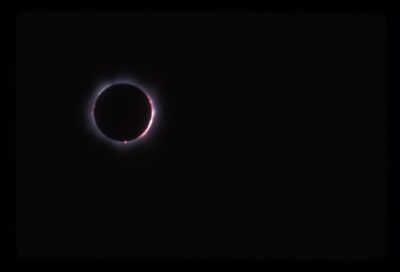
First a note on the April 8th North American eclipse: Many people have seen a partial eclipse of the sun and wondered what all the fuss is about. The sky looks out of whack, things go all shimmery, you can see reflections of the partially occluded sun on leaves, animals act up, the sky darkens, maybe, and then it’s done.
That is a partial eclipse. The experience inside the narrow band of earth where the sun is entirely covered, called “totality,” is nothing like a partial eclipse. Two weeks from today North America experiences the longest path of totality for any eclipse this century.
The band of totality will be about 115 miles wide. Lots of people have the chance to get underneath it. If you’re interested, don’t settle for partial; go and find totality.
The longest totality in the US will be four minutes and 24 seconds. By comparison, the longest totality anywhere in the US for the 2017 eclipse lasted only two minutes and 41 seconds. These may sound like just statistics, but nearly five minutes of totality is a big deal. People pursue even a minute of totality across continents.
Totality is utterly unique. It’s something else entirely. Totality pulses with raw, brute, human-diminishing power. Read more »
by Brooks Riley
Something odd happens when I look at the elder Pieter Bruegel’s paintings: I experience a jolt of vertigo, as though I’d stepped out on a ledge somewhere—not too high up, but high enough to initiate a physical reaction more like titillation than terror. I didn’t notice this right away: For a long time, I was too busy taking in all the business going on in those paintings: the crowds, the tussles and bustle of the marketplace, the hawkers, the wagons, the houses, the animals, and in some of his works a topography rather alien to his own very flat province of North Brabant in the Netherlands. A master of ‘everything everywhere all at once,’ Bruegel knew how to crowd a wooden panel.

In The Fight between Carnival and Lent, faced with a multitude of finely-rendered characters alive with attitude, it’s easy to be distracted from the shot itself—its acute angle, its distance from the action, its extended scope and high horizon achieved through elevation. This is a classic content-over-form dialectic that faces every viewer looking at a painting. What am I seeing? What am I supposed to see? Where am I seeing from?
In this case ‘where am I seeing from’ has everything to do with ‘what am I seeing’’: It’s the high oblique angle that enables the viewer to take in all those individuals spread out over the market square. (An AI command to make each character look up at the painter, might force the viewer to think about where Bruegel is situated as he paints, even if he’s up there only in his imagination. It’s like the fourth wall: you’re unaware of it until a character turns and speaks to you directly.)
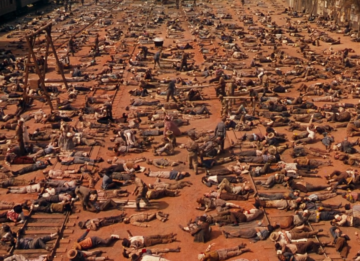 A cinematographer would recognize this as a crane shot, or its replacement, the drone shot. This crane or drone doesn’t move. It defines the POV (point of view) of the painter, and shows how far his perspective can reach and how much he can cram into the in-between, that 2D surface which expands vertically with every higher angle of his POV, as in this crane shot from Gone with the Wind. Read more »
by Jonathan Kujawa

My nieces, Hannah and Sydney, came to visit for the weekend. Since they’re 8 and 9, the delightful Guardian Games in downtown Corvallis was a must-stop. Along with games galore, they have an amazing assortment of puzzles. They have puzzles with micro-sized pieces, puzzles with jumbo-sized pieces, puzzles with only a few pieces, and puzzles with a veritable googolplex of pieces.
The profusion of puzzles reminded me of a recent research paper in applied geometry. The authors are Madeleine Bonsma-Fisher, a mathematician and data scientist at the University of Toronto, and her partner Kent Bonsma-Fisher, a quantum computing and optics researcher.
 Like many of us, they assembled an inordinate number of puzzles during the COVID-19 restrictions. And like many puzzlers, they came to wonder:
How big a table do you really need if you want to assemble a puzzle?
Everyone knows you need extra room on the table to spread out the pieces. But how much extra room? Does the amount of space needed depend on the size of the pieces? Or if the puzzle has more or fewer pieces?
This is a frequent topic of discussion for puzzlers on the internet. A commonly cited rule of thumb is that the table should be twice the area of the finished puzzle.
But rules of thumb aren’t math. Fortunately, close readers of 3QD know of some math that could help here. Read more »

by Nils Peterson
Years ago I was listening to Robert Bly talk about poetry. It was at a conference on form and he was in the process of leaving Whitman and going on to Yeats as part of his own conscious public wrestling, not so much with the Muse as which Muse and where the Muse comes from. He paused for a moment and, to let his batteries charge, said – “Well, what do you think of this Nils?” He’d been talking about the formal aspect of Yeats, the rhythm and the rhyme and the kind of consciousness such usage requires of the reader and the writer. I, startled, could think of nothing else to say than that Yeats writes the kind of poem that you can wake up in the middle of the night and find that you know by heart without ever having made the effort to memorize it. I mentioned having been at a wedding where, unexpectedly, I was asked to recite some poetry. I was able after a minute of two or two with a pencil to come up with a fairly accurate version of “The Folly of Being Comforted.” Bly nodded, and went on his merry way, but I found myself troubled. So, at the end when he asked for comments, I found I had to add this anecdote.
 In the middle ’60s when I first was a new husband, a new teacher, and new father, I met my first indication of the changing consciousness of women in a freshman English class. I was teaching the Yeats poem “A Prayer for My Daughter.” I found it, and in many ways still do a marvelous poem and I spoke of it to my class with great enthusiasm saying that this is what I would wish for my daughter – that she would be “beautiful” but not “too beautiful” and “learned courtesy” for:
Hearts are not had as a gift but hearts are earned
by those that are not entirely beautiful….
I added that I’ve known enough of it in myself to think that,
An intellectual hatred is the worst.
While musing in front of the class, thinking of my own infant daughter’s destiny, it seemed as if I too could pray –
May her bridegroom bring her to a house
Where all’s accustomed, ceremonious…,
having had because of growing up as a chauffeur’s child on a great estate, some illusions about what that would be like.
One of my women students, tough, honest, told me – “You’re wrong. You shouldn’t say wish that on your daughter.” In fact, she went on to say that “I had no right to wish that on my daughter.”
I was set back on my heels, shocked. It had seemed to me the most unexceptionable of fatherly wishes, what, indeed, any father, would want. The class finished with a good argument. And Bly’s evening finished when, shortly after my story, Robert said, “Well, something must be happening here because I feel a lot of anger in my stomach and it’s time for bed.” And yes, the evening all of a sudden had become filled with a strange uncomfortable energy.
But the evening and my story are not quite over. Read more »
by Ashutosh Jogalekar
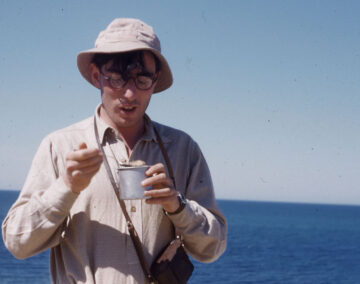
Every once in a while there is a person of consummate achievement in a field, a person who while widely known to workers in that field is virtually unknown outside it and whose achievements should be known much better. One such person in the field of chemistry was Jack Dunitz. Over his long life of 98 years Dunitz inspired chemists across varied branches of chemistry. Many of his papers inspired me when I was in college and graduate school, and if the mark of a good scientific paper is that you find yourself regularly quoting it without even realizing it, then Dunitz’s papers have few rivals.
Two rare qualities in particular made Dunitz stand out: simple thinking that extended across chemistry, and clarity of prose. He was the master of the semi-quantitative argument. Most scientists, especially in this day and age, are specialists who rarely venture outside their narrow areas of expertise. And it is even rarer to find scientists – in any field – who wrote with the clarity that Dunitz did. When he was later asked in an interview what led to his fondness for exceptionally clear prose, his answer was simple: “I was always interested in literature, and therefore in clear expression.” Which is as good a case for coupling scientific with literary training as I can think of.
Dunitz who was born in Glasgow and got his PhD there in 1947 had both the talent and the good fortune to have been trained by three of the best chemists and crystallographers of the 20th century: Linus Pauling, Dorothy Hodgkin and Leopold Ruzicka, all Nobel Laureates. In my personal opinion Dunitz himself could have easily qualified for a kind of lifetime achievement Nobel himself. While being a generalist, Dunitz’s speciality was the science and art of x-ray crystallography, and few could match his acumen in the application of this tool to structural chemistry. Read more »
by Jerry Cayford
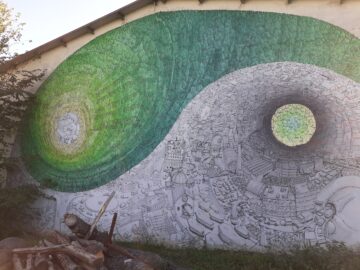
The Vegetarian Fallacy was so dubbed by philosophy grad students in a well-oiled pub debate back in the 1980s. There is a fundamental conflict—so the argument went—between vegetarians and ecologists. The first principle of ecology—everything is connected to everything else (Barry Commoner’s first law)—is incompatible with the hands-off, “live and let live” ideal implicit in ethical vegetarianism. The ecologists took the match by arguing that, pragmatically, animals either have a symbiotic role in human life or else they compete with us for habitat, and those competitions go badly for the animals. In the long run, a moral stricture against eating animals will not benefit animals.
Now, pub debates are notoriously broad, and this one obviously was. A swirl of issues made appearances, tangential ones like pragmatism versus ethics, and central ones like holism versus atomism. In the end—philosophers being relatively convivial drinkers—all came to agree that pragmatism and ethics must be symbiotic as well, and that the practice of vegetarianism (beyond its ethical stance) could be more holistically approached and defended. Details, though, are fuzzy.
A fancy capitalized title like “Vegetarian Fallacy” may seem a bit grandiose, given the humble origins I just recounted. What justifies a grand title is when the bad thinking in a losing argument is also at work far beyond that one dispute. And that is my main thesis. So, although I will elaborate the two sides, it will be only a little bit. I am more interested in the mischief the Vegetarian Fallacy is perpetrating not in the academy but in wider political and cultural realms. Read more »
by Brooks Riley
by Tim Sommers
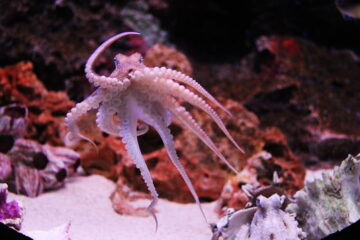
Does your dog feel pain? Or your cat? Surely, nonhuman great apes do. Dolphins feel pain, right? What about octopuses? (That’s right, “octopuses” not “octopi.”)They seem to be surprisingly intelligent and to exhibit pain-like behavior – even though the last common ancestor we shared was a worm 600 million years ago.
Given that all these animals (and us) experience pain, it seems exceedingly unlikely that there would only be a single kind of brain or neurological architecture or synapse that could provide the sole material basis for pain across all the possible beings that can feel pain. Octopuses, for example, have a separate small brain in each tentacle. This implies that pain, and other features of our psychology or mentality, can be “multiply realized.” That is, a single mental kind or property can be “realized,” or implemented (as the computer scientists prefer), in many different ways and supervene on many distinct kinds of physical things.
We don’t have direct access to the phenomenal properties of pain (what it feels like) in octopuses – or in fellow humans for that matter. I can’t feel your pain, in other words, much less my pet octopuses’. So, when we say an octopus feels pain like ours, what can we mean? What makes something an example (or token) of the mental instance (or type) “pain”? The dominant answer to that question in late twentieth century philosophy was called the “functionalism” answer (though many think functionalism goes all the way back to Aristotle).
Functionalism is the theory that what makes something pain does not depend on its internal constitution or phenomenal properties, but rather the role or function it plays in the overall system. Pain might be, for example, a warning or a signal of bodily damage. What does functionalism say about the quest for Artificial General Intelligence (AGI)? Read more »
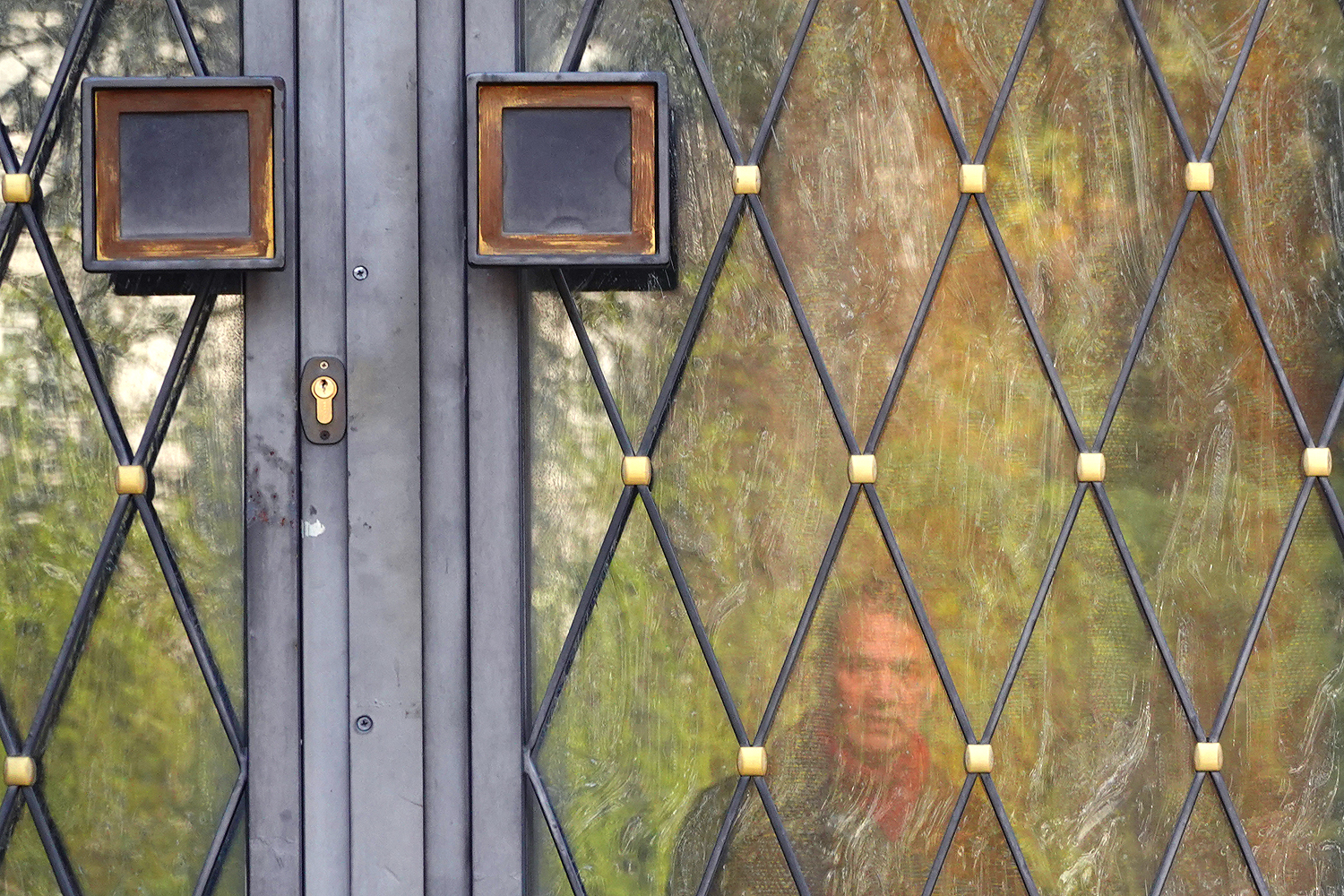
Self portrait by reflection in a glass door in Meran, South Tyrol.
by Ethan Seavey
 I’ve heard owls are signs of a big shift in your life; I also know that I only really look for owls during those times.
Exercise for me is short lived or long lived, short lived to match my attention or long lived to accommodate my frequent breaks for walking, exploring, writing, texting.
I’m running through the gulch and looking at the trees where the owl usually sits in the morning. It’s not morning really anymore. The sun is big in the sky and the owl is nowhere to be seen. I think to see the owl and to prove the shift in my life I’d need to wake up earlier.
After running out of the woods I follow the sidewalk to the water front and walk along that for a while. I see seagulls approach an old man who is bemused that they’ve identified him as a possible food source.
I walk down a pier for a while. It’s meant for fishing but it’s too early in the season for fishing so I don’t see anybody reeling in anything, and I’m looking for marvelous life-changing marlins. I watch a couple kiss on the other side of the pier. They point off into the distance at a warship.
As I run back to the woods, I have the thought that I don’t need to see an animal to decide I’m going through a life shift. That’s when I notice a globe in the water. Read more »
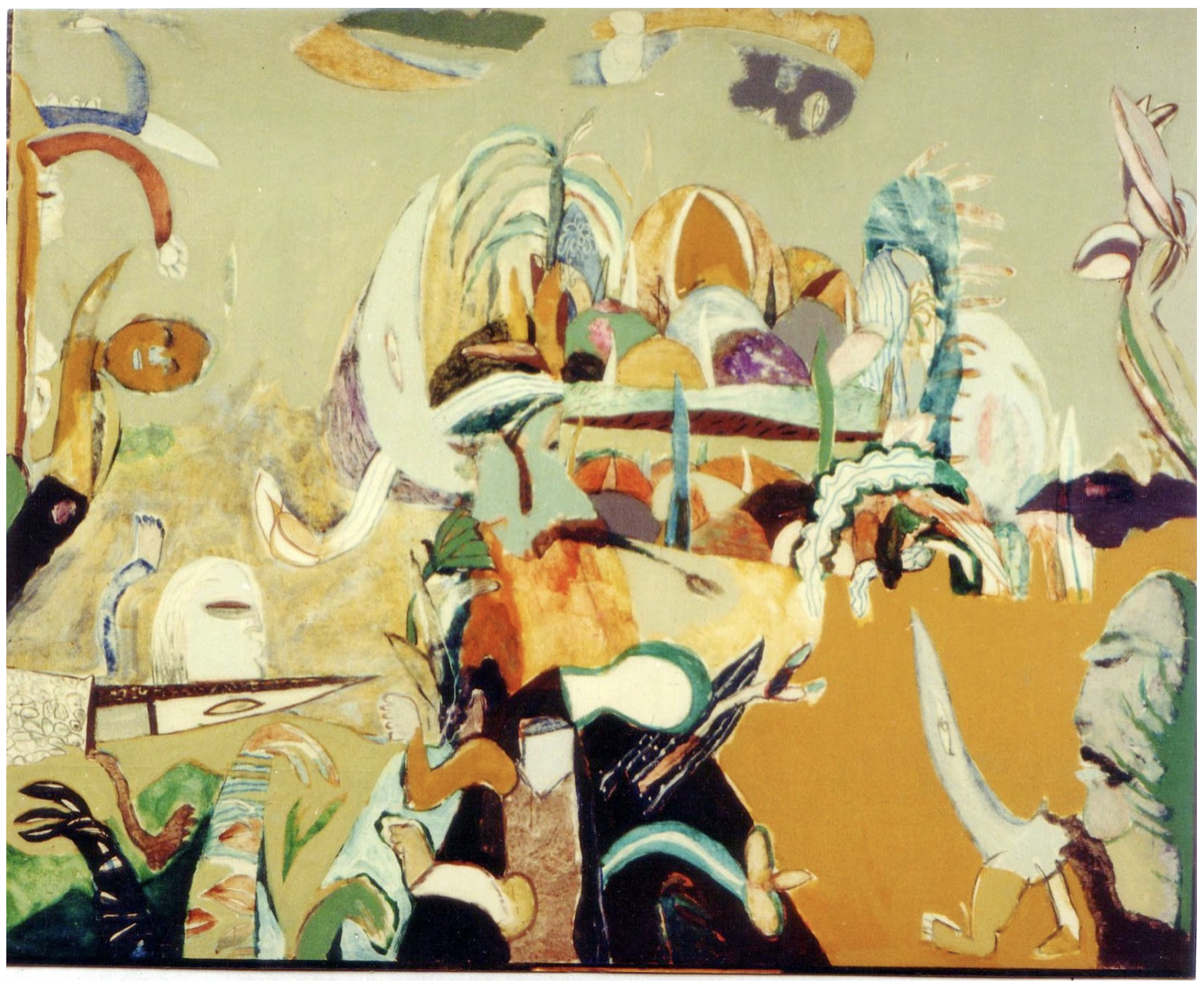 Dilara Begum Jolly. Untitled, ca 2014.