
We Who Play With The World: On the Long Second World War and the origins of the fight to preserve colonialism

by Kevin Lively

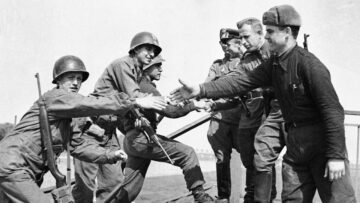
The first line of contact is established between the Allied and Russian armies on the Elbe river near Torgau, Germany on April 25, 1945.

Introduction

This article is part two of a longer series. Check out part one for my framing of the Cold War Military-Keynesianism which characterized the US and USSR economies at the dawn of the space-age.

I’ve opened many questions in my last article and I shan’t be able to close them. Oceans of ink have been spilt trying to satisfactorily answer questions of war and peace; I am not deluded enough to believe that I shall be able to do so. Nonetheless I would humbly submit to your consideration a collection of stories from the perspective of people who found themselves in a rare moment of history, when the old world order had drowned in an orgy of blood and a new one was rising from the ashes. At this inflection point in history, questions of land, power and death were in open debate within global centers of power which were endowed with a freedom of decision-making rarely seen in the long history of international affairs. If you fear, as I do, that this historical precedent bears increasing relevance in today’s geopolitical climate, then we should seek to understand the perspectives of these long dead warlords, the considerations which shaped the world and the consequences which we as a species continue to grapple with.

Topics this large must necessarily be broken into multiple essays. In this one I shall begin with the choices made at the end of WWII to recover from what may as well have a stage rehearsal for the apocalypse. I want to chart how, in quieting some of the guns around the world, US military spending transitioned through its low-point in 1949 into an abrupt reversal — leading to a steady-state war economy at the outset of the Cold War in 1950. The course of events underlying this coincided with an onset of USSR nuclear capability, the “loss of China” to the Chinese Communist Party, and the beginning of the Korean war, all while setting the stage for Vietnam. Here I will only have space to begin this story.

Framing the Narrative

Captain Hindsight is the patron saint of historians and armchair generals alike. After the primary actors are long buried and the security situation so changed as to make classification irrelevant, the internal planning documents which weren’t hastily burned are finally released. The USA in particular used to have a strong commitment to regular declassification of non-technically sensitive material. Internal planning documents from WWII and its immediate aftermath were slowly released within a roughly 30-40 year time horizon, continuing into the 1970s. One can peruse to their hearts content much of the internal records of US administrations up to Carter before the share of still-classified topics begins to balloon out of proportion. Nowadays one is reliant on the occasional leak, either from sites like Wiki leaks, The Intercept or somewhat bizarrely and with increasing frequency, video game servers like War Thunder. Read more »
Monday, December 28, 2009

Losing the Plot: Habits of the Heart (Complete Novel)

by Maniza Naqvi Poppy

Chapter One: The Little Coffee Shop

Chapter Two: The Hotel

Chapter Three: Dreaming Dulles

Chapter Four: Civil War

Chapter Five: Stanley’s Girl

Chapter Six: Hope

“We are just props for validating and furthering their policy! We say no to them and they punch us hard and prove their point with another explosion! Can't you see that?”

“No, jan–I cannot–You have made this a habit–of blaming America for everything!”

“No I have not made it a habit! Isn’t it curious that every time they make a policy statement—quoting D’Touqueville to us—-every time they want to force Pakistan to take a position in their war and Pakistan resists—some sort of a violent event takes place in Pakistan to prove their point? Isn’t that just a little suspect? They are going to increase their troops here—they are going to expand the war into Pakistan—they are going to occupy us—just wait and see!” Zarmeenay had argued, in an urgent tone, her eyes wide and serious as she had packed to leave for Baluchistan. “ We have to stop them Mama.—we have to push back! Amir, Amreekah, Mama! Amir Amreekah!”

“I don’t know Zarmeenay.” Rukhsana had argued with her daughter, “Maybe it’s time we stopped blaming everybody else for all the criminals that have been created right here in Pakistan in the name of religion.’

“Mama! Please—there no such thing as Al Qaeda! There’s no such thing as the Taliban! This is all the same old, same old, overt-covert good old CIA—now breaking up Pakistan—we will have Pushunistan, Baluchistan—Serakiistan—Kashmir, Baluchistan, Karachistan, Sindhistan—just wait. They will do worse to us than what they did to Yugoslavia and the breaking apart of the Soviet Union—just wait—……They will murder all of us!”

“Zarmeenay…”

“Don’t you agree with me Mama, that they killed Benazir Bhutto? They already knew who was her murderer the moment she died? They had decided who to accuse of her murder the day she was murdered? So Benazir is dead, and Baitullah Mesud is dead—But they can’t find Osama Bin Laden in all these ten years of looking for him with all the sophisticated technology that they have?”

“Really! I’m so worried about you darling! Zarmeenay, you are beginning to go too far! I’m scared for you! You talk like this everywhere in public and I’m afraid for you! ” Rukhsana had said to Zarmeenay just before she had left the house.

“Don’t be afraid, Mama. Don’t be afraid! That’s been our main problem we’ve been afraid for too long. It’s too late to be afraid now, we have to take action. We have to save ourselves, our country! You’ll see Mama! I’m right! It’s time to listen to your heart Mama, I’m listening to mine. We have to fight for Pakistan!”

And Zarmeenay had disappeared. Just like that vanished. Now she was dead.

Read more »