
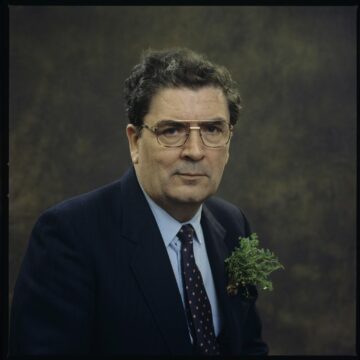
New Troubles In Belfast

by Barbara Fischkin

John Hume, Nobel Prize Laureate
John Hume—who won the Nobel Peace Prize, for his work in Northern Ireland—as I imagine him looking down today from the heavens.

John Hume would not have tweeted. He would have been on Kinnaird Avenue.” —As stated by Sara Morrison in conversation with Jenny Holland

A twenty-first century version of the Northern Irish “Troubles” erupted this month on Kinnaird Avenue in Belfast.  This was not a continuation of the centuries-long war between Catholics and Protestants. It was about race, not religion. The attacker was a Sudanese immigrant. The victim and his main savior were white men born in Northern Ireland. The attacker brutally stabbed his victim, gouging out an eye. The savior ended the attack with a hurley stick, the Irish version of a baseball bat.

The riots that followed—labeled as anti-immigrant which sounds correct to me, if over simplified— involved masked mobs, weaponized bricks, petrol bombs and the ensuing arson, burnt homes, displacements and similar decibels of the fear that has engulfed Ireland for centuries, albeit with different enemies. And then, of course, as happens everywhere riots occur, the police arrived: The Police Service of Northern Ireland, with its riot squads and water cannons.

This happened between June 8 and 11. On June 13, thousands in search of a happier ending, gathered outside City Hall to condemn racism in Northern Ireland.

The above is what I think happened from reading news reports. And social media. Most not from Belfast, itself.

Northern Ireland has long been a place reported on from afar. My husband and I, as American journalists, moved to Ireland to live in both Dublin and Belfast in 1984, as that sectarian violence—religion-based with many eruptions over centuries—was underway. We went on a grant my husband was given from St. John’s University in New York, pushed by Irish-Americans who felt the current “troubles,” were underreported. Despite knowing this, it was shocking to find out that so many other international foreign correspondents reported on Northern Ireland from London. Or from farther away. A New York Times reporter based in London, described how terrified she was to finally spend an overnight—or perhaps more—in Belfast. This was something my husband and I did regularly. Read more »

Monday, March 4, 2024

On War: A St. Patrick’s Day Offering

by Barbara Fischkin

My 1985 photo of the priest who helped me to sneak into Armagh Jail, Father Raymond Murray: Jail chaplain, with former inmate Catherine Moore.

I arrived in Ireland in the mid-1980s to cover the seemingly intractable bloody conflict colloquially known as “The Troubles.” I studied up on materiel: Armalite rifles, homemade fertilizer bombs, the plastic bullets protestors ducked. And on the glossary of local politics: Loyalists were mostly Protestants who wanted to remain British citizens; Republicans were mostly Catholics who yearned for a united Irish nation. I interviewed people on both sides of the conflict but more women than men. I wanted to make their voices heard in the United States.

I was taken by one issue that had already created international headlines—the strip searches of female political prisoners.

But the stories I read did not quote the women who were being strip searched. They quoted politicians and  sociologists instead of the women themselves. The stories said the policy was routine, part of the process of getting inmates out of civilian clothes and into prisoner uniforms. Not true. This was actually a well-conceived British military psychological operation to humiliate the women, a technique intended to “break” the women.

I decided that the only way to write about this was to getting inside the 100-year-old stone walls of Her Majesty’s Prison Armagh—and to talk to the women directly.

But to get in, even to speak to only one woman, I had to lie. I could not say I was a reporter. I had to say I was a cousin, visiting from the states. The Northern Ireland Office, run by dutiful Protestant colonists controlled by the British, kept the press out. Perpetrators of abuse do not like publicity. Now, as St. Patrick’s Day approaches, and two larger wars rage—wars that unlike the one in Ireland threaten us all—my mind keeps racing back to what is better known as “Armagh Jail.” Read more »