
by Barbara Fischkin
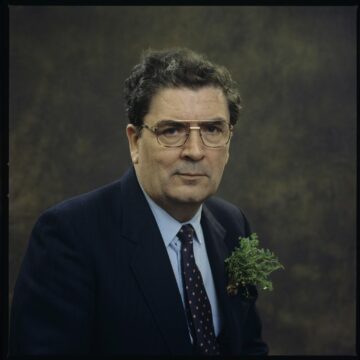
“John Hume would not have tweeted. He would have been on Kinnaird Avenue.” —As stated by Sara Morrison in conversation with Jenny Holland
A twenty-first century version of the Northern Irish “Troubles” erupted this month on Kinnaird Avenue in Belfast. This was not a continuation of the centuries-long war between Catholics and Protestants. It was about race, not religion. The attacker was a Sudanese immigrant. The victim and his main savior were white men born in Northern Ireland. The attacker brutally stabbed his victim, gouging out an eye. The savior ended the attack with a hurley stick, the Irish version of a baseball bat.
The riots that followed—labeled as anti-immigrant which sounds correct to me, if over simplified— involved masked mobs, weaponized bricks, petrol bombs and the ensuing arson, burnt homes, displacements and similar decibels of the fear that has engulfed Ireland for centuries, albeit with different enemies. And then, of course, as happens everywhere riots occur, the police arrived: The Police Service of Northern Ireland, with its riot squads and water cannons.
This happened between June 8 and 11. On June 13, thousands in search of a happier ending, gathered outside City Hall to condemn racism in Northern Ireland.
The above is what I think happened from reading news reports. And social media. Most not from Belfast, itself.
Northern Ireland has long been a place reported on from afar. My husband and I, as American journalists, moved to Ireland to live in both Dublin and Belfast in 1984, as that sectarian violence—religion-based with many eruptions over centuries—was underway. We went on a grant my husband was given from St. John’s University in New York, pushed by Irish-Americans who felt the current “troubles,” were underreported. Despite knowing this, it was shocking to find out that so many other international foreign correspondents reported on Northern Ireland from London. Or from farther away. A New York Times reporter based in London, described how terrified she was to finally spend an overnight—or perhaps more—in Belfast. This was something my husband and I did regularly.
Yes, there was a war going on when we were there. Buses were burned. I rode in a taxi next to a paper bag filled with guns, a delivery stop to be made on the way back. The husband of our Belfast “landlady,” was on the run, as a potential political prisoner. Yet we slept peacefully in a house off the Andersonstown Road in West Belfast, a bastion of Nationalist fervor. There were days when I walked alone around local “housing estates,”—a euphemism for “projects”—feeling safer than covering stories in the jungles of public housing in Manhattan.
In short, you had to be there.
For so many reasons, a number of them connected to the demise of real journalism, I can’t be there now. I don’t know if many foreign reporters are there. Or as the Guardian reported: “Northern Ireland’s justice minister said the disorder was fueled by online commentators who would ‘struggle to find the city on the map.'”
So admittedly from afar, but with some experience in having “lived there,” it occurs to me that while racism does play a major role in what happened this month in Belfast, so does the trauma of war. The people of Northern Ireland have lived with this trauma for centuries—and more recently decades. As have many of the immigrant newcomers in their own countries. For victims of violence, violence so often becomes a habit, as does going after people who are different or seem to be prospering despite their difference. We saw this in America during the Jim Crow era. We see it now in America as so many disenfranchised white citizens rally around Trump’s hatred of immigrants of color.
In search of perspective, I watched a conversation about what happened in June, between two women who live in Belfast. Jenny Holland, an Irish-American born in the United States and Sara Morrison, who is Northern Irish through and through. I have known Jenny for years. I have never met Sara. What I do know is that when it comes to politics I am miles apart from them. They are conservatives, albeit with nuances. And me? Trumpism has pushed me farther to the left than I have ever been—and that is pretty far.
Yet, in this live conversation, now on YouTube, I found much that made sense.
Sara Morrison spoke about the desperate need for leadership in the province, hence her quote about John Hume, which demonstrated to me that she appreciated the need for bi-partisan leadership. She spoke about her own Belfast neighborhood in which she says that the Irish and people of color mesh peaceably. What I gleaned from their talk is this: That the trauma of war affects all sides. It doesn’t matter who is “right” “wrong” “left” or “right.” Who wins or who loses. What matters is what the trauma of war does to people, be they former soldiers or civilians.
Those many years ago, in small and at times amusing but also telling ways, I witnessed how the people of Northern Ireland found ways to accept others who are different. I spent the major Protestant holiday, Orangeman’s Day, on the truck of a Catholic man selling ice cream cones to marchers who, in other situations, might have threatened to kill him. And then, of course there was Mickey Marley, who rode his portable carousel to give rides to children in both Catholic and Protestant neighborhoods.
Our Belfast “landlady” now deceased from natural causes, was a devoted Nationalist who wanted the British out of Northern Ireland. She wanted Northern Ireland to be part of the Irish Republic in the South, to be, as a song she often sang noted: “A nation once again.” She invited my husband and myself to stay in her house gratis whenever we were in town. It didn’t matter to her that we would be writing stories about her Protestant and British enemies. With grace and kindness, she gave up her bedroom whenever one or both of us were in town and slept with her young children. Mornings she cooked us an “Ulster Fry” so that we would know the traditions of her land. This woman, this new friend named Colette, hated her enemies and the intensity of this enmity wounded her soul and the soul of at least one of her children. Yet in that wounded soul of hers she was more complicated than someone who only breathed pure hatred. She also knew the value of reporting both sides of a story, a story oversimplified abroad. She wanted the roots of the Northern Irish conflict to be “seen,” as we say nowadays. Not vilified. And so from her house in the heart of Nationalist West Belfast, we headed out to interview Protestant/Unionist militants and, in my case, the wives of Unionist political prisoners. Colette knew where we were going.
When my Jewish parents from Brooklyn visited, Colette welcomed them with open arms and a fry, even though it was too late for breakfast. She told them that her particular fry—eggs, potatoes and black and white sausage—was kosher, knowing they would not believe her and would eat it anyway.
On that visit to Belfast way back then, my mother came with us to a venue called the Felons Club, because so many of its members had been political prisoners. The man working the door knew my husband and myself as regulars. Foreign journalists who were actually reporting from Belfast were often welcome at the Felons Club. It didn’t hurt that Colette was with us. But something about my mother made him suspicious. He said she could not come in because she had to be an actual felon, or at the least a victim of violence related to prejudice. Perhaps he did not recognize her as Jewish, and someone who might quality as a victim, but rather as a generic American tourist checking out an unbeaten path.
‘I survived an anti-Semitic pogrom in Eastern European,” she told him. “I saved my own life at the age of six by running from a burning building and hiding in a haystack as murderous Cossacks rode their horses over me.” “Why didn’t you say so Maam?” the doorkeeper said, ushering her in. “You’re one of us.”
It did not take my mother long to wheedle her way to a prime a table and sit next to Gerry Adams, who as the head of Sinn Fein, was the most powerful Catholic Nationalist in Northern Ireland. My mother told Gerry Adams how she had managed to get by the doorkeeper and Adams cheerfully ordered one of his minions to scout Belfast for the ingredient of my mother’s favorite bar mitzvah drink, an apricot sour.
I am not saying that these small incidents prove there is no racism in Northern Ireland or that hatred does not still reign there and prompt its own acts of violence, as we saw earlier this month. I am, though, bringing up these incidents to instill hope that the hatred and the trauma is not all-encompassing and can be healed. Was the attack this month—and the protests—prompted by what is said to be widespread racism and denunciations of it in a country where there have not been many people of color until this century? Or was it more vague—and more frightening? Was it the residual anger from a long war, misdirected anger that had to go somewhere, anywhere. Living with long-term violence. even when it is modified with hope and acceptance, morphs into a habit that is hard to break. Somehow, as human beings, we mistrust people whose skin color is different and this works both ways. Perhaps it is often best solved on a person-by-person basis. You get to know someone who doesn’t look like you, eat like you or pray like you and, surprisingly, you find you have much in common.
Sometimes this works. Other times it does not. Or the trauma of war comes out in another form. Over the years I came to realize that certain of my mother’s behaviors could be explained by trauma carried with her from her terrifying childhood. The trauma of a survivor of any war. She was a wonderful mother. But, like Colette at times, she also had odd moments of anger and could be unreasonably, or reasonably, stubborn. As she aged she battled breast cancer for eleven years, at a time when few won that battle. In the midst of a particularly bad bout she refused to go into the ambulance waiting outside her Brooklyn home. My husband carried her into his car, her bodily solids flowing out. An ambulance would have been a lot easier but she didn’t want her accident to be witnessed by strangers, not even EMTs.
I came to understand that being a child fleeing Eastern Europe in 1919 was bad for my mother’s soul, too. And for her psyche. And that there was more. Her family had left behind relatives who were never heard from again. My mother knew they were killed in the Holocaust but she did not not know what actually happened— they perished in a Nazi mass grave a short distance from their home. I often wondered if my mother imagined this death for them. There were many other mass graves. Was this why she was adamant that Israel could do no harm and that all Arabs were awful? She had never met an Arab. She hated Germans more. When, in college, in the 1970s, I set out to travel around Europe. My mother gave me money for my expenses but made me promise I would not go to Germany. She did not want me to spend her money in Germany.
There is trauma. And then, as a by-product, there is anger. Anger is directed to those weaker than ourselves. To new immigrants, And to people whose skin is different from our own. My mother never knew that the Jewish “shtetl,” she left as a child was actually in Ukraine. She was never sure what country it was in. I found out that it was in Ukraine after her death. These days I root for a Ukrainian victory over Russia, knowing that I may, in part, be rooting for the children of Cossacks who tried to kill my mother. It took years but I came to understand how those Cossacks were tortured by Russians, punished for their language and their culture and then took it out on less fortunate Jews, who may—or may not——have been Russian-sympathizing Bolsheviks. It didn’t matter. The Jews were weaker. War makes people crazy, often for generations. Sometimes I feel that my mother’s experiences have affected me as well. Trump, Putin and Netanyahu, please take note.
***