Tuesday poem

after Osip Mandelstam

Streets of Kiev

In Red Square, giant plasma screens loom blank

and wall-eyed, there’s no news today. The Kremlin

thug needs time to think. He never counts his

losses, pays no heed to them. His mongoloid eyes

turn unperturbedly to the southwest. Any day now,

he will perform the prisyadka in Khreshchatyk Street.

Under the black belt moon, he cocks one leg,

a kick to the solar plexus, to the groin, to the temple.

Pectorals flex, Abs ripple. His favourite cocktail,

Polonium-210, he serves up to those who dare oppose.

His expression resembles that of a firing squad,

this former KGB analyst calculates the odds quiet

as frost at midnight, his every move accounted for:

pieces of tibia, femur, cranium, each precious object

finds a place on his chessboard. Any day now,

he will perform the prisyadka in Andreevsky Spusk.

(Prisyadka: the squat-and-kick move that belongs

to the Ukrainian ‘Cossack Dance’, known as Kazatsky.)
.
.
by Stephen Oliver
from Beton, Belgrade Cultural Journal
translation Max Nemstov

Read more »

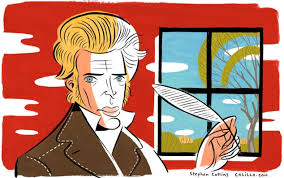
I still love Kierkegaard

Download

Julian Baggini in Aeon:

If Kierkegaard is your benchmark, then you judge any philosophy not just on the basis of how cogent its arguments are, but on whether it speaks to the fundamental needs of human beings trying to make sense of the world. Philosophy prides itself on challenging all assumptions but, oddly enough, in the 20th century it forgot to question why it asked the questions it did. Problems were simply inherited from previous generations and treated as puzzles to be solved. Kierkegaard is inoculation against such empty scholasticism. As he put it in his journal in 1835:

What would be the use of discovering so-called objective truth, of working through all the systems of philosophy and of being able, if required, to review them all and show up the inconsistencies within each system … what good would it do me if truth stood before me, cold and naked, not caring whether I recognised her or not, and producing in me a shudder of fear rather than a trusting devotion?

When, for example, I became fascinated by the philosophical problem of personal identity, I also became dismayed by the unwillingness or inability of many writers on the subject to address the question of just why the problem should concern us at all. Rather than being an existential problem, it often became simply a logical or metaphysical one, a technical exercise in specifying the necessary and sufficient conditions for identifying one person as the same object at two different points in time.

So even as I worked on a PhD on the subject, located within the Anglo-American analytic tradition, I sneaked Kierkegaard in through the back door. For me, Kierkegaard defined the problem more clearly than anyone else. Human beings are caught, he said, between two modes or ‘spheres’ of existence. The ‘aesthetic’ is the world of immediacy, of here and now. The ‘ethical’ is the transcendent, eternal world. We can’t live in both, but neither fulfils all our needs since ‘the self is composed of infinitude and finitude’, a perhaps hyperbolic way of saying that we exist across time, in the past and future, but we are also inescapably trapped in the present moment.

The limitations of the ‘ethical’ are perhaps most obvious to the modern mind. The life of eternity is just an illusion, for we are all-too mortal, flesh-and-blood creatures. To believe we belong there is to live in denial of our animality. So the world has increasingly embraced the ‘aesthetic’. But this fails to satisfy us, too. If the moment is all we have, then all we can do is pursue pleasurable moments, ones that dissolve as swiftly as they appear, leaving us always running on empty, grasping at fleeting experiences that pass. The materialistic world offers innumerable opportunities for instant gratification without enduring satisfaction and so life becomes a series of diversions. No wonder there is still so much vague spiritual yearning in the West: people long for the ethical but cannot see beyond the aesthetic.

More here.

Monday, July 13, 2015

Perceptions

Untitled
Sharon Core. Untitled I, 2014.

Photograph.

“… Core’s photographs replicate as closely as possible those of 17th-century artists (Ambrosius Bosschaert, Jan Brueghel the Elder), and, striving for authenticity, she grew long-lost or out-of-fashion specimens. She then composed and correctly lit them to appear like paintings and titled them the date of the earlier works …”

More here and here.

Sunday, July 12, 2015

Is This New Swim Stroke the Fastest Yet?

Regan Penaluna in Nautilus:

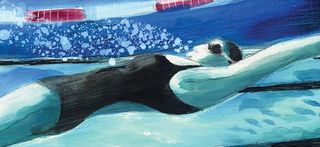
ScreenHunter_1250 Jul. 12 18.11Humans are land animals, and not natural swimmers. We have to learn how to swim, and it is up to us to find the fastest way to do so. The search may finally be coming to an end. In the last few decades, stroke mechanic experts have discovered that swimming under the surface is faster than swimming on the surface. “It’s hard to fathom that this could happen in track and field,” says Rick Madge, a swim coach and blogger. “Nobody is going to come up with a new way of running that is going to be faster than anything else. Yet we just did that in swimming.” And the fish kick may be the fastest subsurface form yet.

More here.

My Letter From Oliver Sacks

David Friedman in The Morning News:

Sacks-featureuse_1260_839_80In 1952, while Oliver Sacks was in England studying medicine at Oxford, the first 3D feature film was released in America: a jungle adventure called Bwana Devil. The New York Times called the movie “puerile” and “crude” but audiences loved it, launching a first wave of 3D films. Unfortunately, the technology of the time left audiences with headaches, and 3D movies quickly faded from mainstream into a long period of novelty. I grew up in the 1980s, when 3D movies were uncommon, but not forgotten. Occasionally a movie like Jaws 3-D came out, and I was amazed. When I saw a diving mask sinking underwater just inches in front of my face, I felt like I could reach out and grab it (forgetting that moments earlier it was worn by a character who was just eaten by a great white shark). If the technology existed to make a movie that immersive, I couldn’t understand why every film wasn’t made in 3D. The mere fact that 3D cinema was possible excited me.

I have always been an “intensely stereoscopic person,” a phrase I borrow from Oliver Sacks, who described himself the same way. The fact that human brains (and those of many other mammals) can take two slightly different flat images — one delivered from each eye — and turn them into a multi-layered world rich with textures and depth and space between objects absolutely amazes me. There are times when I literally pause to look around me and marvel at this. Growing up, I loved 3D photos and illustrations, and eventually made my own. I studied comic book art converted to 3D by Ray Zone, and in high school I drew anaglyph 3D images by hand using red and blue colored pencils. In college, I went through a period where I rented every Alfred Hitchcock movie I could find at my local video store. But I deliberately avoided Dial M For Murder after learning that Hitchcock intended it to be viewed in 3D. When it was originally released in theaters, the 3D fad had passed, and only a 2D version was shown, so audiences never saw the movie Hitchcock really wanted them to see. I finally got my chance to when a restored 3D version was screened at New York City’s Film Forum in December 2001.

It was great.

More here.

What It’s Like to Be Profoundly Face-Blind

Alexa Tsoulis-Reay in New York Magazine:

FaceProsopagnosia is a neuropsychological condition that impairs the sufferer’s ability to recognize faces. It’s also known as face-blindness, and those who are afflicted lack a skill that comes naturally to most humans, forcing them to find ways to work around this deficit. Oliver Sacks, the face-blind neurologist, relied on distinguishing features like flaming red hair or heavy glasses to identify his best school friends, but he still had difficulties: Once, he ignored his own psychiatrist when he saw him in the lobby shortly after their session (as he wrote in the New Yorker, his assistant would instruct their dinner-party guests to wear name tags).

The artist Chuck Close managed his condition through his work — after photographing his larger-than-life portraits, he could remember the person attached to the face: “Once I change the face into a two-dimensional object, I can commit it to memory,” he once told a newspaper. Face-blindness is generally accompanied by a raft of problems, including a lack of interest in people, social anxiety, inattentiveness, and various phobias (Sacks avoided conferences or large gatherings). According to the National Institutes of Health, face-blindness “is thought to be the result of abnormalities, damage, or impairment in the right fusiform gyrus, a fold in the brain that appears to coordinate the neural systems that control facial perception and memory.” At the moment, there aren’t any treatments that are known to be effective — management of the condition, the NIH notes, should focus on “develop[ing] compensatory strategies.”

More here.

Sunday Poem

Bird

When I became a bird, Lord, nothing could not stop me.

The air feathered
as I knelt
by my open window for the charm –
black on gold,
last star of the dawn.

Singing, they came:
throstles, jenny wrens,
jack squalors swinging their anchors through the clouds.

My heart beat like a wing.

I shed my nightdress to the drowning arms of the dark,
my shoes to the sun’s widening mouth.

Bared,
I found my bones hollowing to slender pipes,
my shoulder blades tufting down.
I spread my flight-greedy arms
to watch my fingers jewelling like ten hummingbirds,
my feet callousing to knuckly claws.
As my lips calcified to a hooked kiss

silence

then an exultation of larks filled the clouds
and, in my mother’s voice, chorused:
Tek flight, chick, goo far fer the Winter.

So I left girlhood behind me like a blue egg
and stepped off
from the window ledge.

How light I was

as they lifted me up from Wren’s Nest
bore me over the edgelands of concrete and coal.

I saw my grandmother waving up from her fode,
looped
the infant school and factory,
let the zephrs carry me out to the coast.

Lunars I flew

battered and tuneless

the storms turned me insideout like a fury,
there wasn’t one small part of my body didn’t bawl.

Until I felt it at last the rush of squall thrilling my wing
and I knew my voice
was no longer words but song black upon black.

I raised my throat to the wind
and this is what I sang . . .
.

by Liz Berry
from Black Country
Chatto & Windus, London, 2014

Note:
charm : birdsong or dawn chorus
jack squalor : swallow
fode : yard

.

Christian human rights—An introduction

3041121275_111f51d847_b

Samuel Moyn in The Immanent Frame:

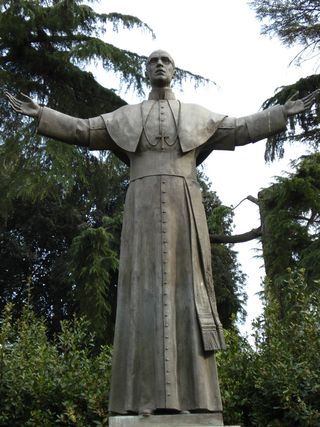
Christmas Day, 1942. The outcome of World War II was undecided, but the pope had something new to say.

A month before, the tide at Stalingrad had turned against the Germans. Just two days before, General Erich von Manstein had abandoned his efforts to relieve the Wehrmacht’s doomed Sixth Army. But there was no telling that the extraordinary German strength in the war so far would now ebb quickly.

The Americans had formally entered the war a year before, but the Allies would not reach mainland Italy for another nine months, or make it to Rome for a year and a half. The pope—Eugenio Pacelli, or Pius XII—was in dire straits. His relationship with Benito Mussolini had long since soured, and he was a prisoner in his own tiny Roman domain.

As for the Jews, the worst victims of the conflict, millions were dead already; the victims at Babi Yar had lain in their ravine for more than a year; Treblinka, the most infernal death camp, had come on line six months before and already completed much of its grim work.

Officially, of course, the Catholic Church and its leader were neutral, and didn’t play politics. Many of his flock were to be found on both sides of the war.

To the extent people have revisited his Christmas message, it has been to argue about whether Pius could or should have said more about the Holocaust than he did. But the real interest in the message is what the pope was for, not what he was against. In this fight, Christianity stood for values, and in the perspective of world history, Pius XII had some new ones.

The very first of the five peace points that Pius XII offered that day ran as follows: “1. Dignity of the Human Person. He who would have the Star of Peace shine out and stand over society should cooperate, for his part, in giving back to the human person the dignity given to it by God from the very beginning…He should uphold respect for and the practical realization of…fundamental personal rights…The cure of this situation becomes feasible when we awaken again the consciousness of a juridical order resting on the supreme dominion of God, and safeguarded from all human whims; a consciousness of an order which stretches forth its arm, in protection or punishment, over the unforgettable rights of man and protects them against the attacks of every human power” (emphases added).

More here.

Is India Headed Towards a Simplification and Dumbing Down of Its History?

Gopinath_vantage_the-caravan-magazine_6-july-2015

Atul Dev in Caravan:

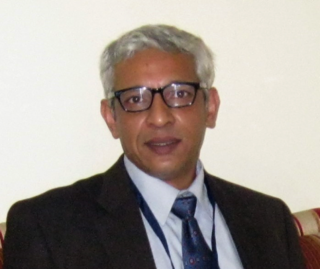
Last month, Gopinath Ravindran, the member secretary of the Indian Council of Historical Research since (ICHR), resigned from his post without completing his term. His decision was reportedly prompted by a disagreement with Y Sudershan Rao, the chairman of the ICHR. The conflict had stemmed from Rao’s dissent over the ICHR Council’s decision to dissolve the editorial board and advisory committee of the “Indian Historical Review” (IHR) that included historian Romila Thapar. Ravindran’s resignation is the latest in a series of individual departures from organisations that function under the Ministry of Human Resource Development. On 1 July 2015, Atul Dev, a reporter at Vantage, visited Ravindran at his home in New Delhi. During the course of their conversation, Ravindran spoke to Dev about his decision to resign, the reorientation of the ICHR under Rao and the potential impact it could have on academic research in India.

Atul Dev: At what point did you decide that your presence in the ICHR as member secretary had become redundant?
Gopinath Ravindran: The immediate reason for my resignation was that I disagreed with the change in the Advisory Committee and that I was not being allowed to put this disagreement on paper. I knew, very well, that institutions such as the ICHR would be undergoing changes with the change in the central government. This was pretty clear to everybody. However, I thought that by remaining there I would at least be able to record my dissent—if the event arose and the protocols of historical research were deliberately breached—in the public domain, as the minutes of all the meetings held by the ICHR Council are put up on the website. With that episode, it became clear that they would not allow me to hold a contrary view even formally. So, I decided that there was no point in continuing anymore.

AD: Was the decision to disband the advisory committee unanimous? Were you the only person in the council meeting to voice any opposition?
GR: I was the only person in that meeting who disagreed. This is also available in the draft minutes, which the chairperson did not sign. He said that I couldn’t disagree with a decision taken by the committee. During the meeting of the council, when I asked for the reason behind taking such a decision, I was not given a satisfactory answer. Various epithets such as “elitists” and “goondas” were used with reference to the former members of the advisory committee. This was clearly unacceptable.

More here.

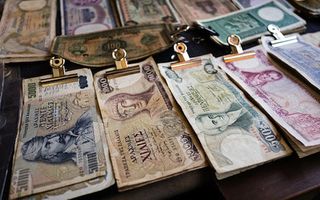
The Greek crisis—trapped in the Eurozone

Drachma-a2027c11ec6e4015c80d55410d3d9794

Wolfgang Streeck over at the Verso blog:

There is progress in Europe after all. When the then Greek Prime Minister Georgios Papandreou wanted to hold a referendum in 2011 on the austerity demands of his European colleagues, they summarily dismissed him.

As his successor, Brussels and Berlin appointed a certain Loukas Papademos, an agent of international finance who in the early 2000s, as head of the Greek central bank, had helped to make his country ready for Europe with the help of Goldman Sachs. There was no repeat this time round – precisely thanks to the remnants of national democracy that German Europhiles want to suspend in favour of a future “European democracy”.

No one can say in detail how things will go after the overwhelming “no” from the Greek people. The situation is too volatile, too much is happening at the same time, the causal connections are weak and untested, predictions are still only guessing games. What we do know, however, is that the whole unspeakable campaign of intimidation was unsuccessful, not even the widely distributed advice of the unanimous German press, which has always known better what is good for Greece than the elected Greek government itself. What has also been shown is that in southern Europe referendums as well as elections can be won with posters of Merkel and Schäuble.

The self-proclaimed “Europeans” in the secure north underestimated the despair of the Greeks after the collapse of the frivolous experiment of their membership of the currency union, as well as their anger at being made the object of secret Brussels negotiations. Whether the Brussels professionals will learn something from their defeat at the hands of the Athenian amateurs is something we may well doubt. They will rather try to make up for their failure to remove the Greek government beforehand.

More here.

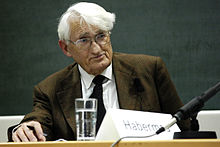
Jurgen Habermas on “Faith and Knowledge”

220px-JuergenHabermas

Michael Welton in CounterPunch (image from wikimedia commons):

Habermas addresses a theme that will preoccupy him in the following decade and half. He points out the “other side of religious freedom”—the “pacification of the pluralism of worldviews” (ibid.)—distributes “burdens unequally” (ibid.). This is a monumental critique and illumination of what has been taken-for-granted and seldom commented upon. Christian, Jewish or Muslim citizens (and other religious faith-communities), unlike secular citizens, have to split their identities into private and public elements. The pressure crushes down on the religious citizenry to “translate their religious beliefs into a secular language before their arguments have any chance of gaining majority support” (ibid.), or of gaining any kind of purchase on public opinion.

Habermas provides the example of German Christians (Protestant and Catholic) who claim the “status of human rights for the gamete fertilized ex utero; this is how they engage in any attempt (an unfortunate one, I think) to translate man’s likeness to God into the secular language of the constitution” (p. 332). Only if the “secular side” remains open to the “force of articulation inherent in religious language will the search for reasons that aim at universal acceptability not lead to an unfair exclusion of religion from the public sphere, nor sever secular society from important resources of meaning” (ibid).

Habermas admits that the boundaries between the secular and the religious are fluid. But the boundaries ought to be guarded by both sides. In post-Enlightenment and secularized societies, the religious segment of the population must not bear the brunt of fending off the dominating and bullying secular self-awareness.

More here.

Saturday, July 11, 2015

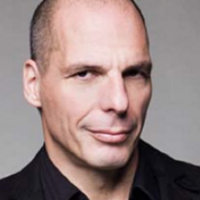
Yanis Varoufakis: Germany won’t spare Greek pain – it has an interest in breaking us

Yanis Varoufakis in The Guardian:

8b2a294e679e0bef245c5573564c1fe6_400x400Greece’s financial drama has dominated the headlines for five years for one reason: the stubborn refusal of our creditors to offer essential debt relief. Why, against common sense, against the IMF’s verdict and against the everyday practices of bankers facing stressed debtors, do they resist a debt restructure? The answer cannot be found in economics because it resides deep in Europe’s labyrinthine politics.

In 2010, the Greek state became insolvent. Two options consistent with continuing membership of the eurozone presented themselves: the sensible one, that any decent banker would recommend – restructuring the debt and reforming the economy; and the toxic option – extending new loans to a bankrupt entity while pretending that it remains solvent.

Official Europe chose the second option, putting the bailing out of French and German banks exposed to Greek public debt above Greece’s socioeconomic viability. A debt restructure would have implied losses for the bankers on their Greek debt holdings.Keen to avoid confessing to parliaments that taxpayers would have to pay again for the banks by means of unsustainable new loans, EU officials presented the Greek state’s insolvency as a problem of illiquidity, and justified the “bailout” as a case of “solidarity” with the Greeks.

To frame the cynical transfer of irretrievable private losses on to the shoulders of taxpayers as an exercise in “tough love”, record austerity was imposed on Greece, whose national income, in turn – from which new and old debts had to be repaid – diminished by more than a quarter. It takes the mathematical expertise of a smart eight-year-old to know that this process could not end well.

More here.

28 Days in Cleveland

Morgan Meis in Art Hopper:

Corrie-Slawson_I-80W-from-CLE-Tonys-East-Peroia-620x417I came to Cleveland carrying the same bias with which most visitors arrive. I thought I was coming to a broken city. Cleveland was broken, I assumed, for the same reason that all the other cities and towns of the Rust Belt are broken. The jobs went away, more or less, when heavy industry collapsed. What was left was a city gutted. The famous Cuyahoga River fire of 1969 still burned in my own consciousness (as I suspect it does for many) as the city’s primary symbolic event. The river itself caught fire. It still seems an incredible and outrageous event. How does a river become so polluted that it catches fire?

I remember listening to the Randy Newman song “Burn On” when I was a little kid.

Cleveland, city of light, city of magic
Cleveland, city of light, you’re calling me
Cleveland, even now I can remember
‘Cause the Cuyahoga River goes smokin’ through my dreams

Burn on, big river, burn on

Mr. Newman was employing a high degree of irony and humor when he called Cleveland a “city of light” and a “city of magic.” Paris is called “The City of Light” because it is so beautiful and because of its historical role in The Enlightenment. Randy Newman called Cleveland the “city of light” because he saw it as a hell on Earth, an environmental catastrophe where the rivers burn night and day.

More here.

40 great quotes about marriage

From The Telegraph:

Marriage“If you are afraid of loneliness, don't marry

Anton Chekhov (1860-1904)

“The trouble with some women is that they get all excited about nothing – and then marry him.”

American singer Cher (1946-)

“Basically my wife was immature. I'd be in my bath and she'd come in and sink my boats”

Comedian Woody Allen (1935-)

“I was married by a judge. I should have asked for a jury.”

Comedian and actor Groucho Marx (1890-1977)

“I was dating a transvestite, and my mother said, 'Marry him, you'll double your wardrobe'”

Comedian Joan Rivers (1933-2014)

“I don't think my wife likes me very much, when I had a heart attack, she wrote for an ambulance”

Irish comedian Frank Carson (1926-2012)

“She was as sated with him as he was tired of her. Emma had rediscovered in adultery all the banality of marriage.”

Gustave Flaubert (1821-1880)

“Love: a temporary insanity curable by marriage”

Ambrose Bierce (1842-c1914)

More here.

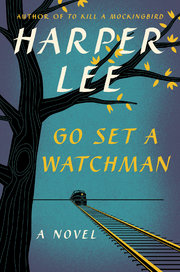
‘Go Set a Watchman’ Gives Atticus Finch a Dark Side

Michiko Kakutani in The New York Times:

BOOKLEE1-master180We remember Atticus Finch in Harper Lee’s 1960 classic, “To Kill a Mockingbird,” as that novel’s moral conscience: kind, wise, honorable, an avatar of integrity who used his gifts as a lawyer to defend a black man falsely accused of raping a white woman in a small Alabama town filled with prejudice and hatred in the 1930s. As indelibly played by Gregory Peck in the 1962 movie, he was the perfect man — the ideal father and a principled idealist, an enlightened, almost saintly believer in justice and fairness. In real life, people named their children after Atticus. People went to law school and became lawyers because of Atticus. Shockingly, in Ms. Lee’s long-awaited novel, “Go Set a Watchman” (due out Tuesday), Atticus is a racist who once attended a Klan meeting, who says things like “The Negroes down here are still in their childhood as a people.” Or asks his daughter: “Do you want Negroes by the carload in our schools and churches and theaters? Do you want them in our world?”

In “Mockingbird,” a book once described by Oprah Winfrey as “our national novel,” Atticus praised American courts as “the great levelers,” dedicated to the proposition that “all men are created equal.” In “Watchman,” set in the 1950s in the era of the Brown v. Board of Education decision, he denounces the Supreme Court, says he wants his home state “to be left alone to keep house without advice from the N.A.A.C.P.” and describes N.A.A.C.P.-paid lawyers as “standing around like buzzards.”

More here.

R.I.P, Omar Sharif

Over at The Wire (India):

When Omar Sharif, as Sherif Ali, rode on a camel on to the shimmering desert in Lawrence of Arabia, the world discovered a new movie star. Cast opposite Peter O’Toole, who played the eponymous T.E. Lawrence, Sharif quickly became a heartthrob among female fans and continued to be one for years afterwards.

Sharif was already a big name in Egypt’s movie scene, having attained fame from his very first film Siraa Fil-wadi (The Burning Sun) in 1954. He had trained in the Royal Academy of Dramatic Arts (RADA), but it was his swarthy good looks that captivated audiences.

Legend has it that India’s own Dilip Kumar was offered the Lawrence of Arabia role by David Lean but he turned it down and Sharif was selected. Sharif later confessed he did not understand why Lawrence was such a success, since it only had shots of people on camels walking from one side to the other.

More here.