The Logic of Effective Altruism: Debate between Peter Singer and others

Peter Singer starts with this initial piece at the Boston Review:

ScreenHunter_1245 Jul. 07 20.31I met Matt Wage in 2009 when he took my Practical Ethics class at Princeton University. In the readings relating to global poverty and what we ought to be doing about it, he found an estimate of how much it costs to save the life of one of the millions of children who die each year from diseases that we can prevent or cure. This led him to calculate how many lives he could save, over his lifetime, assuming he earned an average income and donated 10 percent of it to a highly effective organization, such as one providing families with bed nets to prevent malaria, a major killer of children. He discovered that he could, with that level of donation, save about one hundred lives. He thought to himself, “Suppose you see a burning building, and you run through the flames and kick a door open, and let one hundred people out. That would be the greatest moment in your life. And I could do as much good as that!”

Two years later Wage graduated, receiving the Philosophy Department’s prize for the best senior thesis of the year. He was accepted by the University of Oxford for postgraduate study. Many students who major in philosophy dream of an opportunity like that—I know I did—but by then Wage had done a lot of thinking about what career would do the most good. Over many discussions with others, he came to a very different choice: he took a job on Wall Street, working for an arbitrage trading firm. On a higher income, he would be able to give much more, both as a percentage and in dollars, than 10 percent of a professor’s income. One year after graduating, Wage was donating a six-figure sum—roughly half his annual earnings—to highly effective charities. He was on the way to saving a hundred lives, not over his entire career but within the first year or two of his working life and every year thereafter.

Wage is part of an exciting new movement: effective altruism. At universities from Oxford to Harvard and the University of Washington, from Bayreuth in Germany to Brisbane in Australia, effective altruism organizations are forming. Effective altruists are engaging in lively discussions on social media and websites, and their ideas are being examined in the New York Times, the Washington Post, and even the Wall Street Journal. Philosophy, and more specifically practical ethics, has played an important role in effective altruism’s development, and effective altruism shows that philosophy is returning to its Socratic role of challenging our ideas about what it is to live an ethical life. In doing so, philosophy has demonstrated its ability to transform, sometimes quite dramatically, the lives of those who study it. Moreover, it is a transformation that, I believe, should be welcomed because it makes the world a better place.

More here.

The Five Questions: Tasneem Zehra Husain

From Jonathan David Kranz:

1. What’s the surprising inspiration behind one (your choice) of the articles or books you’ve published?

ScreenHunter_1244 Jul. 07 20.20This year marks the centennial of Einstein’s general theory of relativity, and I was asked to contribute a short story to an anthology that marks the occasion. While I cast around for an idea that would fit, the song “La Vie En Rose” played over and over in my head with annoying persistence. I couldn’t make it stop, so I finally stopped ignoring it and actually considered the lyrics. The instant I thought about life, seen through rose colored glasses, a vivid image flashed to mind: sunset over the Notre Dame, and two lovers separated by the Seine. Suddenly, I knew exactly what the story was going to be about — redshift and increasing distances.

2. If you could rescue one obscure book and make it more widely known to the world, which book would you choose and why?

The Dean’s Watch, by Elizabeth Goudge. Goudge is one of the last Victorian authors, and even though the undertones of faith in her books don’t always sit well with a modern audience, her writing has a lyrical beauty that is timeless. She has a flair for description, and picking just the right detail to zoom in on. She shows an incredible depth of understanding, and compassion, for each of her characters and her ability to completely inhabit their various perspectives is astounding. Her stories feel quiet and restful, there’s no high drama anywhere – yet they keep you engaged while you read them, and stay with you afterwards. I love most of her work, but The Dean’s Watch is up there at the top of my list, so that’s the one I would rescue from obscurity if I could.

More here.

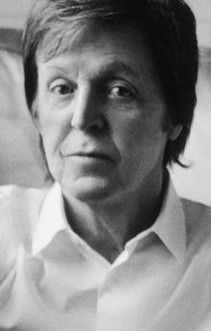
Paul McCartney Opens Up About Lennon, Yoko, and More

Alex Bilmes in Esquire:

ESQ: Many of your songs are autobiographical. One of the reasons they resonate is people know what they're about: 'Let it Be', about your mum; 'Maybe I'm Amazed', about Linda. Are you thinking about those people when you play those songs? Isn't it painful?

ScreenHunter_1243 Jul. 07 16.13PM: No, not always. I'm really doing them just because they're songs. I mean, when I do 'Let it Be' I'm not thinking about my mum. If there's one thing I know it's that everyone in that audience is thinking something different. And that's 50,000 different thoughts, depending on the capacity of the hall. Obviously, when I do 'Here Today' as I do, that is very personal. That is me talking to John. But as you sing them you review them. So I go, [sings] “What about the night we cried?” And I'm thinking, “Oh, yeah: Key West”. We were all drunk. We'd delayed Jacksonville because of a hurricane. We got parked in Key West and we stayed up all night and we got drunk – “Let me tell you, man, you're fucking great” – so I know that's what I'm talking about. I know the night. I do think of that.

ESQ: So you don't find yourself moved, in the way the crowd is, by the emotional content of the songs?

PM: Not all the time. You wouldn't be able to sing. You'd just be crying. But yeah, there are moments. I think it was in South America. There was a very tall, statuesque man with a beard, very good-looking man. And he had his arm round what was apparently his daughter. Might not have been! No, it was, it was clearly his daughter. I'm singing 'Let it Be' and I look out there and I see him standing and she's looking up at him and he glances down at her and they share a moment, and I'm like, “Whoa!” [He shivers.] It really hit me. It's hard to sing through that.

More here.

the anatomy of concentration camps

Evans_1-070915_jpg_600x661_q85Richard J. Evans at the New York Review of Books:

In the popular imagination, the Nazi concentration camp now features mainly as a place where Jews were taken to be gassed. In a recent German opinion poll, most respondents associated the camps with the persecution and murder of Jews; under 10 percent mentioned other categories of camp prisoners, such as Communists, criminals, or homosexuals. The power of the “Holocaust” as a concept has all but obliterated other aspects of the crimes of the Nazis and the sufferings of their victims and driven the history of the camps from cultural memory. No crime in human history outdoes the genocidal extermination of six million European Jews on the orders of the leader of Germany’s self-styled “Third Reich.” Yet the majority of the Jewish victims of Nazi mass murder were not killed in the camps; they were shot, starved to death, or left to die of diseases that could easily have been prevented or treated but were not. The concentration camp was in no way synonymous with the Holocaust.

While facilities such as Treblinka or Auschwitz-Birkenau, constructed for no other purpose than mass murder, were first established during World War II, the history of the concentration camp, as Nikolaus Wachsmann reminds us in his impressive and authoritative new study, begins much earlier. The idea of concentrating a state’s enemies in a camp went back at least to the end of the nineteenth century, following the invention of barbed wire and the machine gun, in the Boer War and the Spanish-American War, and found expression in the Soviet system of labor camps and other products of twentieth-century dictatorships.

more here.

joan didion’s manliness

Joan from Personal CollectionFranklin Strong at The Millions:

Look again at “On Self-Respect.” The whole essay is an act of gender-bending. Didion rejects the role of Cathy from Wuthering Heights, and of Francesca da Rimini. Instead, she compares herself to Raskolnikov and says she wants to be more like Rhett Butler. She puts Jordan Baker’s manhood up against Julian English’s: Jordan wins. And then there are the references to the Wild West, to Waterloo and the playing fields of Eton, and to Chinese Gordon holding Khartoum against the Mahdi.

(By the way, I had to look up Chinese Gordon and the Mahdi. I think that should go on the record if we’re going to make something out of me not knowing about crepe-de-Chinewrappers.)

Besides Didion’s subject matter (wildfires, John Wayne), Jessica zooms in on what she calls Didion’s “glacial emotional distance.” Coolness, hardness, distance: these are characteristics that show up regularly in writing about Didion’s writing. Here’s Roiphe:

There is in her delicate, urban, neurotic sensibility something of the hardy pioneer ancestors she describes, jettisoning rosewood chests in the crossing, burying the dead on the wagon trail, never looking back. At one point she quotes another child of California, Patty Hearst, saying, ‘Never examine your feelings — they’re no help at all.’

more here.

Hannah Arendt and the key to being a 21st-century cosmopolitan

Arendt_archive_1-071113James McAuley at Aeon Magazine:

In the US, Arendt was rewarded handsomely for her intellect and tenacity, becoming a bestselling author published by the most prestigious trade presses as well as the first woman appointed to a professorship at Princeton. She also enjoyed a celebrity presence at the University of Chicago and the New School in New York, the stages on which she fashioned herself an eminence in the republic of letters. This is how she appears in Margarethe von Trotta’s 2012 biopic: a dowager queen of Riverside Drive, sparring with pundits such as Norman Podhoretz and Kurt Blumenfeld by day and entertaining authors such as Mary McCarthy and Philip Rahv by night. Add wine, cigarettes and scandal, and this Arendt becomes a kind of monument, the avatar for a bygone era when the literary feud was still a line in the sand, and the personal was not merely political, but ideological.

But there is more to Arendt’s unsettled legacy than glamour, controversy and a provocative set of historical and philosophical interpretations. Forty years after her death, perhaps the most enduring contribution of this decidedly 20th-century thinker is her thinking about a cosmopolitanism suited to the challenges of the 21st century she’d never see.

more here.

Monday, July 6, 2015

Sunday, July 5, 2015

Of Polymaths and Multidisciplinarians

Jalees Rehman at the website of Lindau Nobel Laureate Meetings:

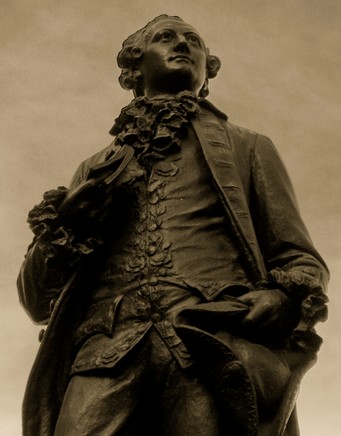
ScreenHunter_1241 Jul. 05 18.23The German poet Johann Wolfgang von Goethe (1749-1832) is also a front-runner in the pantheon of polymaths because of his interests in geology, paleontology and optics. During his lifetime, Goethe assembled one of the largest collections of rocks, minerals and fossils ever owned by an individual person, consisting of 18,000 specimens! Even though he is revered as the greatest poet of the German language, Goethe’s longest published work is his treatise on a theory of color, the Farbenlehre. He devoted two decades of his life to studying light and he thought that this 1000-page tome would be his most meaningful contribution to humankind. In the Farbenlehre, Goethe vehemently disagreed with Newton about the nature of light. According to Newton, white light was a heterogeneous composite of colors and darkness was the absence of light. Goethe, on the other hand, felt that white light was a homogenous entity and that darkness was the polar opposite of light and not just its absence. Goethe also ascribed aesthetic qualities to specific colors such as “beautiful” to red and “useful” to green.

Goethe’s theory of color is not a scientific theory in the conventional sense because it did not offer any clear scientific hypotheses that could be tested and falsified by experiments. This did not prevent Goethe from viciously attacking Newton and those who accepted the Newtonian theory of light and color.

More here.

Justice and Warfare in Cyberspace

Lisa Lucile Owens in the Boston Review:

ScreenHunter_1240 Jul. 05 18.15There was a moment during the First Gulf War when ideologues argued that warfare technology had reached a tipping point. Gains in efficiency would reduce casualties and destruction; supremely accurate weapons would minimize unnecessary suffering without compromising military objectives. This inaugurated the age of target bombings and stealth missions enabled by precision technology. Now, we are at the threshold of yet another tipping point for war and technology. Software interference and cyber technologies threaten mass disruptionand destruction without a shot or bomb explosion. Physically waged wars—populated and won by armed bodies and manned weaponry—have given way to data and coding wars, creating vast, powerful, and yet not fully tapped, spaces and abilities.

Cyberwarfare acts are broadly understood as the use of cyber capabilities for spying or sabotage by one nation against another. However, the term “cyberaggression” can refer to everything from individual cyberbullying and harassment to sabotage that affects national interests. One example of the latter type is the infamous Stuxnet computer worm that targeted and invaded Iranian nuclear facilities in order to derail the Iranian nuclear program. The term ‘cyberaggression’ was also applied to the April 2015 breach of cybersecurity at the White House when sensitive details of the President’s schedule were obtained. It is therefore of little surprise that civilian and military resources to wage and contain cyberaggression are on the rise.Last January, there were reports that North Korea had doubled its military cyberwarfare units to over 6,000 troops.

To be sure, it is not clear when an act is merely an instance of cyberaggression as opposed an act of war. To complicate matters further, our conception of cyberwarfare and cyberaggression is taking shape against a background of increasing state domestic surveillance and other incursions to privacy, often defended on the basis of considerations of safety or convenience.

It is in this context that the Department of Defense (DoD) Cyber Strategy memorandum, published in April, needs to be analyzed.

More here.

The Nobel Prize Is Bad And We Should Feel Bad

Matthew Francis in Forbes:

ScreenHunter_1239 Jul. 05 18.11The Nobel Prizes are not the final say in good science, and Nobel laureates are not necessarily the best scientists — much less the wisest human beings.

It’s easy to forget that. No other prize in science has nearly as high a profile. Nobel laureates are in demand as book authors, university faculty, and speakers to both scientific and public groups. In addition to the prize money itself, they can command large fees for their activities: people pay lots of money to be associated with a Nobel Prize winner.

And like it or not, people listen to Nobel laureates when they speak, even when they are out of their areas of expertise. Sometimes the prize seems to go to the winners’ heads so much that they seem to lose it entirely. William Shockley, a co-discoverer of the transistor, and James Watson, who won the Nobel for discovering the structure of DNA, both used their reputations to promote very racist ideas. Most recently, Tim Hunt said some sexist and insulting things in front of a group of female Korean scientists — who had invited him to speak, no less.

More here.

The Social-Network Illusion That Tricks Your Mind

From the MIT Technology Review:

Majority illussionOne of the curious things about social networks is the way that some messages, pictures, or ideas can spread like wildfire while others that seem just as catchy or interesting barely register at all. The content itself cannot be the source of this difference. Instead, there must be some property of the network that changes to allow some ideas to spread but not others.

Today, we get an insight into why this happens thanks to the work of Kristina Lerman and pals at the University of Southern California. These people have discovered an extraordinary illusion associated with social networks which can play tricks on the mind and explain everything from why some ideas become popular quickly to how risky or antisocial behavior can spread so easily.

Network scientists have known about the paradoxical nature of social networks for some time. The most famous example is the friendship paradox: on average your friends will have more friends than you do.

This comes about because the distribution of friends on social networks follows a power law. So while most people will have a small number of friends, a few individuals have huge numbers of friends. And these people skew the average.

Here’s an analogy. If you measure the height of all your male friends. you’ll find that the average is about 170 centimeters. If you are male, on average, your friends will be about the same height as you are. Indeed, the mathematical notion of “average” is a good way to capture the nature of this data.

But imagine that one of your friends was much taller than you—say, one kilometer or 10 kilometers tall. This person would dramatically skew the average, which would make your friends taller than you, on average. In this case, the “average” is a poor way to capture this data set.

More here.

Sunday Poem

Secret

I shall make a song like you hair . . .
Gold-woven with shadows green-tinged,
And I shall play with my song
As my fingers might play with your hair.
Deep in my heart
I shall play with my song of you,
Gently. . . .
I shall laugh
At its sensitive lustre . . .
I shall wrap my song in a blanket,
Blue like your eyes are blue
With tiny shots of silver.
I shall wrap it caressingly,
Tenderly. . . .
I shall sing a lullaby
To the song I have made
Of your hair and eyes . . .
And you will never know
That deep in my heart
I shelter a song for you
Secretly. . . .
.

by Gwendolyn Bennett
from Modern American Poetry

Bring Us Your Genes: A Viking scientist’s quest to conquer disease

Adam Piore in Nautilus:

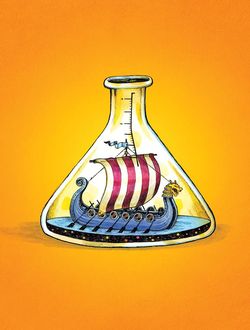
DecodeIn the ninth century there was a Norwegian Viking named Kveldulf, so big and strong that no man could defeat him. He sailed the seas in a long-ship and raided and plundered towns and homesteads of distant lands for many years. He settled down to farm, a very wealthy man. Kveldulf had two sons who grew up to become mighty warriors. One joined the service of King Harald Tangle Hair. But in time the King grew fearful of the son’s growing power and had him murdered. Kveldulf vowed revenge. With his surviving son and allies, Kveldulf caught up with the killers, and wielding a double-bladed ax, slew 50 men. He sent the paltriest survivors back to the king to recount his deed and fled toward the newly settled realm of Iceland. Kveldulf died on the journey. But his remaining son Skallagrim landed on Iceland’s west coast, prospered, and had children. Skallagrim’s children had children. Those children had children. And the blood and genes of Kveldulf the Viking and Skallagrim his son were passed down the ages. Then, in 1949, in the capital of Reykjavik, a descendent named Kari Stefansson was born.

Like Kveldulf, Stefansson would grow to be a giant, 6’5”, with piercing eyes and a beard. As a young man, he set out for the distant lands of the universities of Chicago and Harvard in search of intellectual bounty. But at the dawn of modern genetics in the 1990s, Stefansson, a neurologist, was lured back to his homeland by an unlikely enticement—the very genes that he and his 300,000-plus countrymen had inherited from Kveldulf and the tiny band of settlers who gave birth to Iceland. Stefansson had a bold vision. He would create a library of DNA from every single living descendent of his nation’s early inhabitants. This library, coupled with Iceland’s rich trove of genealogical data and meticulous medical records, would constitute an unparalleled resource that could reveal the causes—and point to cures—for human diseases. In 1996, Stefansson founded a company called Decode, and thrust his tiny island nation into the center of the burgeoning field of gene hunting. “Our genetic heritage is a natural resource,” Stefansson declared after returning to Iceland. “Like fish and hot pools.” Stefansson set sail on an epic journey. He and his crew collected DNA from 150,000 of their fellow countrymen (half the population) and constructed a genealogical chart that accounts for the family tree of virtually every member of the small island nation. Next they succeeded in reading the entire 3-billion nucleotide genetic sequences of more than 11,000 Icelanders. They could now infer the individual genomes of the entire Icelandic population.

More here.

What Every American Should Know

Eric Liu in The Atlantic:

Is the culture war over?

Lead_960That seems an absurd question. This is an age when Confederate monuments still stand; when white-privilege denialism is surging on social media; when legislators and educators in Arizona and Texas propose banning ethnic studies in public schools and assign textbooks euphemizing the slave trade; when fear of Hispanic and Asian immigrants remains strong enough to prevent immigration reform in Congress; when the simple assertion that #BlackLivesMatter cannot be accepted by all but is instead contested petulantly by many non-blacks as divisive, even discriminatory. And that’s looking only at race. Add gender, guns, gays, and God to the mix and the culture war seems to be raging along quite nicely. Yet from another perspective, much of this angst can be interpreted as part of a noisy but inexorable endgame: the end of white supremacy. From this vantage point, Americanness and whiteness are fitfully, achingly, but finally becoming delinked—and like it or not, over the course of this generation, Americans are all going to have to learn a new way to be American. Imagine that this is true; that this decades-long war is about to give way to something else. The question then arises: What? What is the story of “us” when “us” is no longer by default “white”? The answer, of course, will depend on how aware Americans are of what they are, of what their culture already (and always) has been. And that awareness demands a new kind of mirror.

More here.