The Fiction of Auto-Generation: Anish Kapoor

Sandhini Poddhar in ArtAsiaPacific:

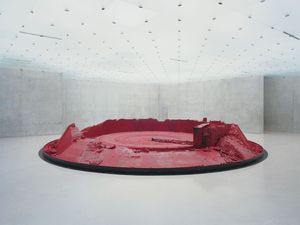
AnishSince the early 1980s, Anish Kapoor’s investigation into notions of scale, volume, color and materiality has redefined contemporary sculpture. From the piles of pigment in his early works to the monumental building-embracing sculptures and installations for which the artist is now known, his focus has always remained on investigating the interaction between the subject and the object. In making his art, Kapoor himself stays hidden, describing his works as resulting from “the fiction of auto-generation.” Kapoor’s term “proto-object”—the object that comes into being before language, before aesthetics, before thought and before conditioning—is a leitmotif in his career. The enigmatic nature of this manifestation attracts viewers to each work, enticing them into a relationship, or even a role, in respect to its completion.

Born in Bombay in 1954, Kapoor moved to England in 1972 to study art at the Hornsey College of Art and later at the Chelsea School of Art and Design. At that time, Kapoor’s creative milieu was dominated by the compositional ideas of abstract sculptor Anthony Caro, known for his assemblages of pre-fabricated metal parts such as I-beams and steel plates. For inspiration, Kapoor turned instead to artists redefining the limits of sculpture through the use of evocative, non-art materials and unconventional presentation, such as Paul Neagu, Joseph Beuys and Paul Thek. Kapoor was also fascinated by another aspect of—in particular—Beuy’s work: a numinous but not ethereal quality that is often qualified as being shamanistic or alchemical.

More here.

Taking on ‘The Vital Question’ About Life

Tim Requarth in The New York Times:

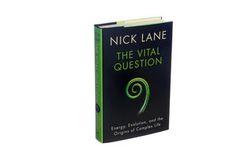
BookHow did rocks, air and water coalesce into the first living creatures on the primordial Earth? Why did complex life like animals and plants arise from a single ancestor only once in the history of our planet? Why two sexes and not three or four or 12? Why do we age and die? In “The Vital Question: Energy, Evolution, and the Origins of Complex Life,” Nick Lane sets out to answer these questions and many more with a novel suite of ideas about life’s emergence and evolution. Dr. Lane, a biochemist at University College London, argues that with just a few principles of physics, we can predict why life is the way it is — on Earth and in the rest of the cosmos. (Read an excerpt.) Dr. Lane’s previous book, “Life Ascending: The Ten Great Inventions of Evolution,” won the Royal Society Prize for Science Books, and he again proves an able guide through treacherous scientific terrain. He writes in lucid, accessible prose, and while the science may get dense, the reader will be rewarded with a strikingly unconventional view of biology.

Dr. Lane’s most surprising idea concerns how complex life arose. For most of Earth’s history, he notes, life was microbial: no trees, no mushrooms, no mammals. While microbes display astonishing biochemical diversity, thriving on anything from concrete to battery acid, they’ve never evolved into anything more complicated than a single cell. So what made the great blooming of biodiversity possible? Dr. Lane, building on ideas developed with the evolutionary biologist William Martin, traces its origins to a freak accident billions of years ago, when one microbe took up residence inside another. This event was not a branching of the evolutionary tree but a fusion with, he argues, profound consequences. The new tenant provided energy for its host, paying chemical rent in exchange for safe dwelling. With this additional income, the host cell could afford investments in more complex biological amenities. The pairing thrived, replicated and evolved. Today we call these inner microbes mitochondria; nearly every cell in our body has thousands of these energy factories. Dr. Lane and Dr. Martin have argued that because of mitochondria, complex cells have nearly 200,000 times as much energy per gene, setting the stage for larger genomes and unfettered evolution.

More here.

Monday, July 20, 2015

Sunday, July 19, 2015

Our Racial Moment of Truth

Isabel Wilkerson in The New York Times:

RaceFOR as long as many Americans have been alive, the Confederate flag stood watch at the South Carolina capitol, and Atticus Finch, moral guardian-father-redeemer, was arguably the most beloved hero in American literature. The two symbols took their places in our culture within months of each other. The flag was hoisted above the capitol dome in April 1961, on the centennial of the Civil War during upheavals over civil rights. Atticus Finch debuted in July 1960 in Harper Lee’s “To Kill a Mockingbird,” a novel that British librarians would later declare the one book, even before the Bible, that everyone should read. Given life by Gregory Peck in the 1962 Oscar-winning film, Atticus Finch would go on to be named the top movie hero of the 20th century. Nearly at once, both icons have fallen from grace in ways that were unimaginable just months ago. They are forcing a reckoning with ourselves and our history, a reassessment of who we were and of what we might become.

The flag was lowered and placed in storage on July 10 after the South Carolina Legislature voted to take it down in response to the massacre of nine black parishioners at Emanuel A.M.E. Church in Charleston. The following Tuesday, as if receiving a message from the gods of history, the world was introduced to a new Atticus Finch with the publication of “Go Set a Watchman,” a young Harper Lee’s earlier manuscript, set 20 years after the fictional events in “To Kill a Mockingbird,” making it as much artifact as literature. Rather than the Atticus who urges his daughter, Scout, to climb into someone’s skin to understand him, this Atticus is now an old-line segregationist, a principled bigot who has been to a Klan meeting and asks his now-grown daughter visiting from New York City: “Do you want Negroes by the carload in our schools and churches and theaters? Do you want them in our world?” It has seemed as if the force of history has led us to this moment, stirred as we have been by the recorded killings of unarmed black people at the hands of the police, the uprisings and hashtags, a diatribe of white supremacy from the young man accused in the Charleston rampage, a former slave ship captain’s “Amazing Grace” sung by a sitting president. History is asking us to confront the wistfulness that we had ever escaped racism’s deep roots.

More here.

Charles Bukowski’s guide to writing and life

Martin Chilton in The Telegraph:

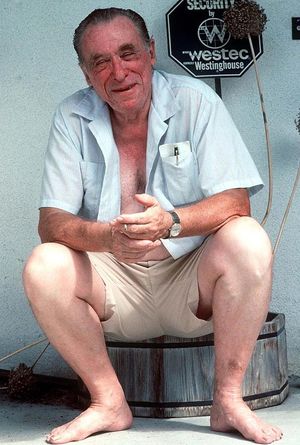
Charlesbukowski2_3377939b“I am a dangerous man when turned loose with a typewriter,” said Charles Bukowski, the author of more than 40 books of poetry, prose and novels, including Ham on Rye and Post Office. Bukowski used his poetry and prose to depict the depravity of urban life in America. He was also an avid reader. A new book called Charles Bukowski: On Writing features previously unpublished letters. Here are 12 things we learned from them:

And don't look ahead

“The future's only a bad hunch; Shakespeare told us that.”

. . . or become famous

“Fame + immortality are games for other people. If we're not recognised when we walk down the street, that's our luck . . . getting famous when you're in your twenties is a very difficult thing to overcome. When you get half-famous when you're over 60, it's easier to make adjustments. Old Ez Pound used to say, 'Do your work'.”

Forget worrying

“Good and evil and right and wrong keep changing; it's a climate rather than a law (moral). I'd rather stay with the climates.”

More here.

The California Drought Is Just the Beginning of Our National Water Emergency

Maude Barlow in The Nation:

ScreenHunter_1263 Jul. 19 16.47For a long time, we in the Global North, especially North America and Europe, have seen the growing water crisis as an issue of the Global South. Certainly, the grim UN statistics on those without access to water and sanitation have referred mostly to poor countries in Africa, Latin America, and large parts of Asia. Heartbreaking images of children dying of waterborne disease have always seemed to come from the slums of Nairobi, Kolkata, or La Paz. Similarly, the worst stories of water pollution and shortages have originated in the densely populated areas of the South.

But as this issue of The Nation shows us, the global water crisis is just that—global—in every sense of the word. A deadly combination of growing inequality, climate change, rising water prices, and mismanagement of water sources in the North has suddenly put the world on a more even footing.

There is now a Third World in the First World. Growing poverty in rich countries has created an underclass that cannot pay rising water rates. As reported by Circle of Blue, the price of water in 30 major US cities is rising faster than most other household staples—41 percent since 2010, with no end in sight. As a result, increasing numbers cannot pay their water bills, and cutoffs are growing across the country. Inner-city Detroit reminds me more of the slums of Bogotá than the North American cities of my childhood.

More here.

Sunday Poem

a third possibility

I fired the brush pile by the creek
and leaping gargoyles of flame
fled over it, fed on it, roaring,
and made one flame that stood
tall in its own wind, snapping off
points of itself that raved and vanished.

The creek kept coming down, filling
above the rocks, folding
over them, its blank face dividing
in gargles and going on, mum
under the ice, for the day was cold,
the wind stinging as the flame stung.

Unable to live either life, I stood
between the two, and liked them both.
.
.
by Wendell Barry
from A Third Possibility
Oxford University Press, 1997

Dylan tunes like you’ve never heard them – in Hindi and Bengali

Nate Rabe in Scroll.in:

Bob Dylan, unlike many of his contemporaries, seems to never have been drawn to India. There were no pilgrimages to Rishikesh, no gurus, no lost years by the Ganga and, to date, I’ve not detected any Hindustani musical influence in his music.

Dylan was far more curious and thirsty for the deep folk roots of Appalachia, Scotland, Mexico and England. Though he had an enduring and close friendship with the most “Indian” of the Beatles, George Harrison, chappatis and ragas were sadly not one their shared interests.

And yet, though the Bobster never ventured to South Asian shores, he has no lack of fans and interpreters on or from the subcontinent.

More here.

Workers: no longer needed?

Empl-gdp

Doug Henwood responds to Paul Mason's piece in The Guardian about the end of capitalism, in the Left Business Observer:

Paul Mason has a breathless piece in The Guardian making grand New Economy claims that sound like recycled propaganda from the late-1990s—though he gives them a left spin: postmateriality is already liberating us. I wrote a book that was in large part about all that ideological froth, published in 2003, and so far I’ve been struck by the nonrevival of that discourse despite a new tech bubble. Uber and Snapchat don’t excite the same Utopian passions that the initial massification of the web did.

I’ll pass on refuting Mason’s article, because I already did that twelve years ago. But I do want to comment on one point that Mason makes—one that’s ubiquitous in a lot of economic commentary today: capitalists don’t need workers anymore. As he puts it:

Postcapitalism is possible because of three major changes information technology has brought about in the past 25 years. First, it has reduced the need for work, blurred the edges between work and free time and loosened the relationship between work and wages. The coming wave of automation, currently stalled because our social infrastructure cannot bear the consequences, will hugely diminish the amount of work needed – not just to subsist but to provide a decent life for all.

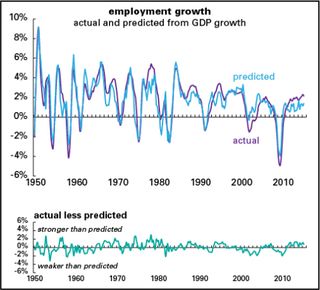
I can’t make sense of the “currently stalled because our social infrastructure cannot bear the consequences”—has capitalism ever skipped an innovation because of its social consequences?—but there’s no evidence that info tech is “hugely diminish[ing] the amount of work needed.” Sure, wages and benefits stink, but that’s about politics and class power, not because of the latest generation of Intel chips or something fresh out of the latest TechCrunch Disrupt.

Expressing this argument in some economically quantifiable way probably means something like “the relation between GDP growth and employment growth has broken down.” If that’s what proponents mean—the presentations are usually light on precision—then it’s just not true.

More here.

Why is Germany so tough on Greece? Look back 25 years

2817

Dirk Laabs in The Guardian:

It was 25 years ago, during the summer of 1990, that Schäuble led the West German delegation negotiating the terms of the unification with formerly communist East Germany. A doctor of law, he was West Germany’s interior minister and one of Chancellor Helmut Kohl’s closest advisers, the go-to guy whenever things got tricky.

The situation in the former GDR was not too dissimilar from that in Greece when Syriza swept to power: East Germans had just held their first free elections in history, only months after the Berlin Wall fell, and some of the delegates from East Berlin dreamed of a new political system, a “third way” between the west’s market economy and the east’s socialist system – while also having no idea how to pay the bills anymore.

The West Germans, on the other side of the table, had the momentum, the money and a plan: everything the state of East Germany owned was to be absorbed by the West German system and then quickly sold to private investors to recoup some of the money East Germany would need in the coming years. In other words: Schäuble and his team wanted collateral.

At that time almost every former communist company, shop or petrol station was owned by the Treuhand, or trust agency – an institution originally thought up by a handful of East German dissidents to stop state-run firms from being sold to West German banks and companies by corrupt communist cadres. The Treuhand’s mission: to turn all the big conglomerates, companies and tiny shops into private firms, so they could be part of a market economy.

Schäuble and his team didn’t care that the dissidents had planned to hand out shares of companies to the East Germans, issued by the Treuhand – a concept that incidentally led to the rise of the oligarchs in Russia. But they liked the idea of a trust fund because it operated outside the government: while technically overseen by the finance ministry, it was publicly perceived as an independent agency. Even before Germany merged into a single state in October 1990, the Treuhand was firmly in West German hands.

More here.

Saturday, July 18, 2015

The universe may have one past (the Big Bang) and two futures

Andrew Grant in Science News:

Arrow_opener_0For nearly 140 years, scientists have tried to rule out the backward flow of time by way of nature’s preference for disorder. Left alone, nature transforms the neat into the messy, a one-way progression that many physicists have used to define time’s direction. But if nature prefers disorder now, it always has. The challenge is figuring out why the universe started out so orderly — thereby allowing disorder to grow and time to march forward — when the early universe should have been messy. Despite many proposals, physicists have not been able to agree on a satisfying explanation.

A new paper offers a solution. The secret ingredient, the authors say, is gravity. Using a simple simulation of gravitationally interacting particles, the researchers show that an orderly universe should always arise naturally at one point in time. From there, the universe branches in opposing temporal directions. Within each branch, time flows toward increasing disorder, essentially creating two futures that share one past. “It’s the only clear, simple idea that’s been put forward to explain the basis of the arrow of time,” says physicist Julian Barbour, a coauthor of the study published last October in Physical Review Letters.

More here.

The end of capitalism has begun

Paul Mason in The Guardian:

F3ba5014-9489-4812-ab90-576a69c35bec-2060x1236Capitalism, it turns out, will not be abolished by forced-march techniques. It will be abolished by creating something more dynamic that exists, at first, almost unseen within the old system, but which will break through, reshaping the economy around new values and behaviours. I call this postcapitalism.

As with the end of feudalism 500 years ago, capitalism’s replacement by postcapitalism will be accelerated by external shocks and shaped by the emergence of a new kind of human being. And it has started.

Postcapitalism is possible because of three major changes information technology has brought about in the past 25 years. First, it has reduced the need for work, blurred the edges between work and free time and loosened the relationship between work and wages. The coming wave of automation, currently stalled because our social infrastructure cannot bear the consequences, will hugely diminish the amount of work needed – not just to subsist but to provide a decent life for all.

Second, information is corroding the market’s ability to form prices correctly. That is because markets are based on scarcity while information is abundant. The system’s defence mechanism is to form monopolies – the giant tech companies – on a scale not seen in the past 200 years, yet they cannot last. By building business models and share valuations based on the capture and privatisation of all socially produced information, such firms are constructing a fragile corporate edifice at odds with the most basic need of humanity, which is to use ideas freely.

More here. [Thanks to Sahabzada A. Samad Khan.]

EDWARD SAID’S SON IS TRYING TO CHANGE TERRORISM PROSECUTIONS

Murtaza Hussain in The Intercept:

Wadie-said-article-headerIn 1999, Wadie Said was finishing his graduate studies at Columbia Law School, unsure of the direction he wanted his career to take.

A year earlier, the U.S. embassies in Kenya and Tanzania were bombed by a little-known terrorist group called al Qaeda. The lawyer for Muhammad al-Owhali, accused of organizing the bombings, reached out to Palestinian-American academic Edward Said for help in communicating with his Arabic-speaking client, as well as in understanding the politics of the region. Said suggested that his son might provide assistance.

“Sure, I guess,” was Wadie’s somewhat nervous reply at the time.

The experience was formative, setting Wadie, now a law professor at the University of South Carolina, down a path of legal practice and activism in the field of post-9/11 terror cases.

“I really absorbed from my father the idea of standing up for people who were persecuted or otherwise down-and-out, and wanted to apply that lesson in a different way, hence my initial decision to become a public defender,” Said says in an interview. “I was fortunate enough to start my career working on a high-profile prosecution like that with political overtones, and I came to the belief that it is always important to try and get the client’s message across, especially given how the overwhelming official hostility towards anyone with the status of terrorism defendant can subvert the legal process.”

More here.

‘A BRIEF HISTORY OF PORTABLE LITERATURE’ BY ENRIQUE VILA-MATAS

Portable-literatureHal Hlavinka at The Quarterly Conversation:

The art movement was one of the early twentieth century’s great revelations. In conditions of war and economic collapse, of revolution and social engineering, artists and writers increasingly banded together under common manifestos to promote an aesthetic agenda. The romantic image of the lone creator, progressing an artistic craft out of a singular style, gave way to the collective. Of course, more personalities also meant more confusion, especially where Tristan Tzara’s and Breton’s camps were concerned. As –ism piled upon –ism, it became increasingly difficult to keep everything straight: What are the rules? Is anyone in charge? Who’s a member? And are they sexually available? Indeed, there’s an aspect of the Rabelaisian carnival at the center of the early manifesto era; the exchange of ideas, urges, and bodies unifies the collective, making it whole and self-aware through pleasure, pain, and laughter. For Enrique Vila-Matas, somewhere in the tangled network of Futurism, Dada, Surrealism, and their attendant bodies is A Brief History of Portable Literature.

Throughout his work, Vila-Matas bends literature, and the literary persona, back onto itself. His essayistic tone, encyclopedic recall of authorial ephemera, and focus on literary failure and erasure (those writers of the “no”) put him in a curious camp of contemporary authors not just openly indebted to their modernist predecessors but overtly obsessed with them. From the turn of the century onward, Vila-Matas’s narrators (and, one might conjecture, the author himself) have fallen under the spell of what he terms “Montano’s Malady,” or “literature sickness.”

more here.

On Not Being There: The Data-Driven Body at Work and at Play

Rebecca Lemov in The Hedgehog Review:

PeriThe protagonist of William Gibson’s 2014 science-fiction novel The Peripheral, Flynne Fisher, works remotely in a way that lends a new and fuller sense to that phrase. The novel features a double future: One set of characters inhabits the near future, ten to fifteen years from the present, while another lives seventy years on, after a breakdown of the climate and multiple other systems that has apocalyptically altered human and technological conditions around the world. In that “further future,”1 only 20 percent of the Earth’s human population has survived. Each of these fortunate few is well off and able to live a life transformed by healing nanobots, somaticized e-mail (which delivers messages and calls to the roof of the user’s mouth), quantum computing, and clean energy. For their amusement and profit, certain “hobbyists” in this future have the Borgesian option of cultivating an alternative path in history—it’s called “opening up a stub”—and mining it for information as well as labor.

Flynne, the remote worker, lives on one of those paths. A young woman from the American Southeast, possibly Appalachia or the Ozarks, she favors cutoff jeans and resides in a trailer, eking out a living as a for-hire sub playing video games for wealthy aficionados. Recruited by a mysterious entity that is beta-testing drones that are doing “security” in a murky skyscraper in an unnamed city, she thinks at first that she has been taken on to play a kind of video game in simulated reality. As it turns out, she has been employed to work in the future as an “information flow”—low-wage work, though the pay translates to a very high level of remuneration in the place and time in which she lives. What is of particular interest is the fate of Flynne’s body. Before she goes to work she must tend to its basic needs (nutrition and elimination), because during her shift it will effectively be “vacant.” Lying on a bed with a special data-transmitting helmet attached to her head, she will be elsewhere, inhabiting an ambulatory robot carapace—a “peripheral”—built out of bio-flesh that can receive her consciousness.

More here.