NIKOLA TESLA, AN ALIEN INTELLIGENCE

TeslaSamantha Hunt at Literary Hub:

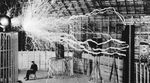
When I first encountered My Inventions it was as a free Internet download, an implausible work titled The Strange Life of Nikola Tesla. I dismissed the text as an invention itself, concocted by a flamboyantly imaginative fan of Tesla’s—a fairly common species. Sentences like, “When I drop little squares of paper in a dish filled with liquid, I always sense a peculiar and awful taste in my mouth,” convinced me that The Strange Life of Nikola Tesla was some sort of Internet hoax. The story it told was too weird to be his. An engineering genius would never draft such an unscientific text; one that reads as if it has been written by a carnival barker. “And now I will tell of one of my feats with this antique implement of war which will strain to the utmost the credulity of the reader.” Indeed.

But The Strange Life of Nikola Tesla is not a fabrication. Though that title was added after his death, the text is in fact Tesla’s work, first published serially in 1919 in the Electrical Experimenter magazine. These essays tell the story of Tesla’s early life, the rotary magnetic field, the Tesla coil and transformer. Each installment is a wondrous hybrid: part autobiography, part science, part ars poetica filled with earnest confessions and self-examinations frank as a child’s. Stories of his boyhood cunning in catching rats, dueling with cornstalks or attempting to fly off a barn roof mingle with sentences like, “It is a resonant transformer with a secondary in which the parts, charged to a high potential, are of considerable area and arranged in space along ideal enveloping surfaces of very large radii of curvature, and at proper distances from one another thereby insuring a small electric surface density everywhere so that no leak can occur even if the conductor is bare.”

more here.
Sweet Home Alabama

Adam Gopnik in The New Yorker:

LeeThough the new book is, to be blunt, a string of clichés, some of them are clichés only because, in the half century since Lee’s generation introduced them, they’ve become clichés; taken on their own terms, they remain quite touching and beautiful. The evocation of Maycomb, with which the new book begins, and which recurs throughout its pages, is often magically alive. There is a little set piece about the arrival of a train at a flag stop that makes one feel nostalgic for one’s Southern childhood even if one never had a Southern childhood:

The countryside and the train had subsided to a gentle roll, and she could see nothing but pastureland and black cows from window to horizon. She wondered why she had never thought her country beautiful. . . . The train clacketed through pine forests and honked derisively at a gaily-painted bell funneled museum piece sidetracked in a clearing. It bore the sign of a lumber concern, and the Crescent Limited could have swallowed it whole with room to spare. Greenville, Evergreen, Maycomb Junction.

She had told the conductor not to forget to let her off, and because the conductor was an elderly man, she anticipated his joke. . . . Trains changed; conductors never did. Being funny at flag stops with young ladies was a mark of the profession, and Atticus, who could predict the actions of every conductor from New Orleans to Cincinnati, would be awaiting accordingly not six steps away from her point of debarkation.

The tone is right and lovely, and is just as right and lovely in other pastoral pieces, in the later pages (though almost exclusively flashbacks), about games played with the heroine’s brother, Jem, and the Truman Capote character, Dill. The other, less potent clichés are either the stage-dramatic clichés of the fifties—the kind of dramaturgy you find in an Elia Kazan movie, with neat “reveals” and passionate scenes in which people driven to a climax of anger suddenly tell one another long-buried secrets—or, more drearily, the clichéd rationales that liberal Southerners used for years to justify a social order that they knew to be unjust.

More here.

Defective telomeres are now being linked to dozens of diseases, including many types of cancer

From ScienceDaily:

TeloThe chromosomes in every single cell are made up of DNA and shaped like strands, with a kind of protective cap at the end of each strand of DNA. Without this end protective cap, the DNA strands would chemically bond to other strands, i.e. the chromosomes would merge and that would be lethal for the cell. The structures that prevent this catastrophe are the telomeres. They were discovered in the 1930s but decades elapsed before someone decided to study them in any depth and since the late 1990s they have always been on the cutting edge of biology research. Biologists are often surprised by their amazing and unexpected complexity, and their health-related significance.

“The biology of telomeres is extremely complex and the more we discover the more we realise what remains to be discovered,” says Paula Martínez from CNIO's Telomere and Telomerase Group. “What surprises me most is the high number of factors we are finding that are essential to the preservation of telomeres and, above all, the precise coordination that is required between them all.” The fact that telomeres have been tightly preserved throughout the evolutionary tree — in most eukaryotes: vertebrates, plants and even unicellular organisms such as yeast — indicates their importance. In addition to preventing the merger of chromosomes, telomeres are needed to prevent the loss of genetic information each time a cell divides.

More here.

Thursday Poem

Just across the border from north Texas,

my car broke, the land’s heat
hovered above

the defunct road I’d rolled it onto

with the clump of empty, yellowish buildings
at the dead end,

the exit on the interstate being

there I guess
really only for the road that actually

goes somewhere

in the opposite direction,
its border as deserted as my part

until the eye caught

dust-colored cardboard-box-like houses
lining the red hill’s foot

far south across

the roar of highway.
The car was dead, useless

—no way away

from this place so I sat in the heat
with the windows up

for as long as I could stand it—and my

dog—waiting for the tow truck,
then rolled them down

a little, just a crack because I

feared some slasher-movie kind of incident,
cruelty that seemed

fitting here,

the sun being cruel
and the sharp sand grains—then

more, rolled the window

farther down, then all the way but even that
wasn’t enough, so I

opened the door

as if it had been years that I’d been
in there,

broke a seal, as if it had been

millennia
since someone,

some sort of mason probably,

with the hope and fear of anarchic times
had sealed me in

to preserve

—what for what?

—as if a living thing could leave its tomb.
I ended up on the car hood

where these birds I didn’t recognize

fed on locusts
it looked like. There was the

click of exoskeletons, a

remarkable display of leaping
—by the birds!

(it wasn’t flying)—

as they went by turns into the cloud, came out
invariably with a bug in the beak,

then went back in,

my dog tugging on the leash
but we were

free, me barely catching breath

in wonderment
at another kind of what.
.
.
by Elizabeth Arnold

Wednesday, July 15, 2015

India: The Stormy Revival of an International University

Sen_1-081315_jpg_600x559_q85

Amartya Sen in the NY Review of Books:

Classes began in early September last year at a small new international university, called Nalanda, in Bihar in northeast India—one of the most backward parts of the country. Only two faculties—history, and environment and ecology—were holding classes for fewer than twenty students. And yet the opening of Nalanda was the subject of headlines in all the major newspapers in India and received attention across the world. “Ritorno a Nalanda” was the headline in Corriere della Sera.

The new venture is meant to be a revival of Nalanda Mahavihara, the oldest university in the world, which began in the early fifth century. By the time the first European university was established in Bologna in 1088, Nalanda had been providing higher education to thousands of students from Asian countries for more than six hundred years.

The original university at Nalanda was run by a Buddhist foundation in what was then the prosperous region of Bihar—the original center of Buddhist religion, culture, and enlightenment. Its capital was Pataliputra (now called Patna), which also served, beginning in the third century BC, as the capital of the early all-India empires for more than a thousand years. Nalanda drew students not only from all over India, but also from China, Japan, Korea, Sumatra, and other Asian lands with Buddhist connections, and a few from elsewhere, including Turkey. It was the only institution of higher learning outside China to which any Chinese in the ancient world ever went for education.

By the seventh century Nalanda had ten thousand students, receiving instruction not only in Buddhist philosophy and religious practice, but also in a variety of secular subjects, including languages and literatures, astronomy and other sciences, architecture and sculpture, as well as medicine and public health.

More here.

What Economics Can (and Can’t) Do

15stoneWeb-thumbWide

Gary Gutting interviews Daniel Hausman in the NYT's The Stone (image Robert Streiffer):

Daniel Hausman: Speaking of predictive power can be misleading. Scientists (and I include economists) are not fortunetellers. Their theories only allow them to predict what will happen if initial conditions are satisfied. Elementary physics enables us to predict how long it will take an object to fall to the ground, provided that gravity is the only force acting on the object. Predicting how long it will take a leaf falling from a tree to reach the ground or where it will land is a much harder problem.

The problems that we want economists to help us solve are more like predicting how leaves will fall on a windy day than predicting how objects will fall in a vacuum. Economic phenomena are affected by a very large number of causal factors of many different kinds. The Greek economic crisis is extraordinarily complex, and it has as many political causes as economic ones. Standard economic theory provides useful tools, but it focuses on a very limited range of causal factors — mainly the choices of millions of consumers, investors and firms — which it simplifies and assumes to be governed entirely by self-interested pursuit of goods or financial gain. When one recognizes all the other factors that affect economic outcomes, from government policies to the whims of nature, it is easy to see that economists cannot predict the economic future with any precision.

In John Stuart Mill’s view, which I believe is basically correct, economics is a separate and inexact science. It is separate from the other social sciences, because it focuses on only a small number of the causal factors that influence social phenomena. It is inexact because the phenomena with which it deals are influenced by many other causes than the few it focuses on.

More here.

“Why the West rules — for now”

Over at the Rationally Speaking podcast an interview with Stanford historian Prof. Ian Morris:

Ian MorrisFor several centuries, historians have tried to answer the question: “Why is Western Europe (and later, North America) the dominant world power?” Past explanations cited culture, or “great men” who influenced the course of history. Stanford historianProf. Ian Morris casts doubt on those explanations, instead taking a data-driven approach to the question that attempts to measure “social development” over history and find explanations for it. In this episode of Rationally Speaking, Julia delves into Morris' method and conclusions, and asks: can we make causal inferences about history?

Ian Morris is Willard Professor of Classics and Fellow of the Archaeology Center, Stanford University. He is a historian and archaeologist. He has excavated in Britain, Greece, and Italy, most recently as director of Stanford's dig at Monte Polizzo, a native Sicilian site from the age of Greek colonization. He is also the author of a number of books, among them: “Why the West Rules–for Now”. “War! What Is It Good For?”, and “Foragers, Farmers, and Fossil Fuels.”

Hope and Scandal in Hungary

Holly A Case in East-Central Europe Past and Present:

ScreenHunter_1254 Jul. 15 18.34This year a new Hungarian film, White God, has been touring the festival circuit. It’s about an abandoned mongrel whose trusting nature is repeatedly tested by abuse and cruelty. The result: what had once been an endearingly naughty pooch turns into a very bad dog.
White God could be an allegory about Hungary—a proud creature, kicked around and abused, diminished and blamed, that eventually lashes out in fury. Or maybe it’s about how Hungary has treated some of its own since the second half of the nineteenth century—assimilating them, but forever suspecting them of betrayal; marginalizing them, persecuting them outright, or even killing them. And so, as in the film, the odd victim leaps up to tear out the jugular of a Hungarian guard in a single snap.
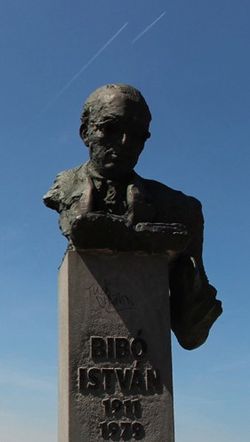
This tortured sense of intractable antagonism was the lifelong preoccupation of the Hungarian thinker and former statesman, István Bibó. Born in Budapest in 1911, Bibó spent most of his life trying to divert the states and peoples of Central and Eastern Europe—and, above all, his native country—away from the extremes of enraged self-pity and self-righteousness and toward responsibility. At the same time he tried to sensitize the Great Powers to the miseries that fed these extremes. As he wrote in 1946, “Men are most wicked when they believe they are threatened, morally justified, and exonerated, and particularly when they feel they are entitled and obliged to punish others.”
Having served the Hungarian government at critical moments in the country’s mid-century history, Bibó’s drive to mediate between extremes assured that his forays into state service would end badly.
More here.

india’s part in WWII

Keay_07_15John Keay at Literary Review:

Seventy years after the guns fell silent, India's part in the Second World War is finally receiving the attention it deserves. The two million Indian combatants (according to Raghu Karnad) – or the two and a half million (according to Yasmin Khan) – comprised the largest volunteer army in the world. They pushed the Italians from the rocky heights of Eritrea, trudged back and forth through the minefields of North Africa, quelled an insurgency in Iraq, and in the 'Forgotten War' for Burma suffered heavier casualties than all the other Allies combined. Nor were civilians spared. Cities such as Calcutta and Vishakhapatnam were bombed, ships were sunk and dockyards were shelled. In 1942 some 80,000 Indians perished in the chaotic exodus from Burma and in 1943 several millions starved to death in the war-induced famine in Bengal. Acts of bravery were applauded, medals were won and loved ones were lost. There is much to record. But if the wartime sacrifice has seldom been recognised, it is because so many Indians were ambivalent about the cause they were serving. After all, it was not their war: they hadn't been consulted about it and they objected to dying for an empire they were trying to get shot of.

As Karnad puts it, Nehru, like most of his colleagues in the mainstream Congress party, 'could not accept that Indian soldiers would die for the freedom of a nation which denied that very freedom to India'. Congress's heroes were not the two million 'mercenaries' of Britain's Indian army but the 43,000 patriotic men and women of the Japanese-sponsored Indian National Army, led by the strutting Subhas Chandra Bose.

more here.

Karl Marx at the Venice Biennale

384519613_1777641445Donald Kuspit at Brooklyn Rail:

The sale in March of Paul Gauguin’s “When Will You Marry?” (1892) to an anonymous buyer for $300 million—the highest price ever paid for a work of art, according to The Economist (April 4, 2015)—brings to mind two of Gauguin’s remarks, both relevant to any discussion of so-called protest art. Gauguin was a protest artist: his “ancient Eve,” as he called his Maori female, was a sort of protest against “the Eve of your civilized conception,” as he wrote in a letter to August Strindberg. She made “misogynists of you and almost all of us”; the ancient Eve, who inhabited a “paradise,” brought a “smile” to a man’s face. Gauguin’s primitivism, as it has come to be called, more pointedly what he called “the barbarism which is for me a rejuvenation,” was a radical protest against, not to say a total rejection of, the “civilization from which you [Strindberg] suffer.”

Ever since so-called “advanced” art—Expressionism, Cubism, Futurism, Surrealism, Abstract Art—has been a species of protest against supposedly retardataire civilized art. It is a clash of opposites, indeed, a fight to the death: Gauguin preferred beauty that “results from instinct” (e.g., Breton’s “convulsive beauty”) to beauty that “come[s] from study” of tradition (e.g., Renaissance beauty, grounded in the study of classical art). Thus Gauguin’s preference for “the wooden hobby-horse of his infancy” to “the horses of the Parthenon” was in effect a nihilistic protest and revolt against the classical tradition—and with it against the ruling powers and establishment ideologies it served and celebrated.

more here.

Azar Nafisi: “Over the years I have often thought of Alice as my ideal reader”

Azar Nafisi in Salon:

Azar_nafisiIt all began one Friday morning, a weekend in Iran, over breakfast. My father had promised me the night before that he would tell me a new story instead of taking me to the movies, which was our usual weekend treat. That was when he first introduced me to Alice. I think he made a fair amount of it up as he went along, as I never found many of his Alice stories when I was old enough to read the books myself. But I can still remember his describing how Alice, having taken a big gulp of a special potion, began to grow smaller and smaller. “And then,” he said, “she discovered a hooka smoking caterpillar.” Now I was quite familiar with caterpillars — in those days we could buy them in cocoons from street vendors with a handful of leaves and watch them turn into butterflies — and everyone had a cousin or uncle who was overfond of a hooka. But Alice, who had never seen a hooka-smoking caterpillar, quite naturally asked him, “Who are you?” And the caterpillar threw the question right back at her, saying: “Who, Who Who are Youuuuuuuuuuuuuuuuuuu?” “Tow Tow Tow, Key Haaaastiiiiiiiiiiii?” my father would say, mimicking the caterpillar in Persian. He repeated this several times and each time I laughed louder, with tears streaming down my face as my mother, glancing at me reproachfully, urged me to refrain from spitting out my bread. But my father was in a playful mood, and he paid no attention to my mother’s protestations as he tickled me and said it again.

Later on I would sit my gentle and compliant 2-year-old brother against the wall of our room and say, “Tow Tow Tow Key Haaastiiiii?” tickling him around the navel. He smiled at me in amazement in what may have been the only time I had the privilege of actually amazing him. Since then I have read “Alice’s Adventures in Wonderland” and “Through the Looking Glass” many times in many different places, carrying her with me on a journey that has had its share of unexpected encounters defying all logic and explanation. “Who are you?” Isn’t this what every book asks of us as we chase its characters, trying to find out what they are reluctant to reveal? Is it not also the one essential thing we ask ourselves as human beings, as we struggle to make the choices that will define us? I can describe myself as a mother, a wife, a friend, a teacher, a sister, a writer, a reader …. So it goes. Yet none of these simple labels provides a satisfactory response. We are how we live, constantly in a state of flux. But it is essential to ask and be asked that question, one which I believe is at the heart both of the act of writing and of reading.

Over the years I have often thought of Alice as my ideal reader, the one I aspire to be.

More here.

‘Organs-on-chips’ go mainstream

Sara Reardon in Nature:

GlowingChip_12905Researchers who are developing miniature models of human organs on plastic chips have touted the nascent technology as a way to replace animal models. Although that goal is still far off, it is starting to come into focus as large pharmaceutical companies begin using these in vitro systems in drug development. “We are pretty excited about the interest we get from pharma,” says Paul Vulto, co-founder of the biotechnology company Mimetas in Leiden, the Netherlands. “It’s much quicker than I’d expected.” His company is currently working with a consortium of three large pharmaceutical companies that are testing drugs on Mimetas’s kidney-on-a-chip. At the Organ-on-a-Chip World Congress in Boston, Massachusetts, last week, Mimetas was one among many drug and biotechnology firms and academic researchers showing off the latest advances in miniature model organs that respond to drugs and diseases in the same way that human organs such as heart and liver do.

“We’re surprised at how rapidly the technology has come along,” says Dashyant Dhanak, global head of discovery sciences at Johnson & Johnson in New Jersey, which announced last month that it would use a thrombosis-on-chip model from Massachusetts biotechnology firm Emulate to test whether experimental and already-approved drugs could cause blood clots. Proponents of organs-on-chips say that they are more realistic models of the human body than are flat layers of cells grown in Petri dishes, and could also be more useful than animal models for drug discovery and testing. A lung-on-a-chip, for instance, might consist of a layer of cells exposed to a blood-like medium on one side and air on the other, hooked up to a machine that stretches and compresses the tissue to mimic breathing.

More here.

Wednesday Poem

God or No God
.
Deer not clacking through snow crust
after apples, crows thankfully asleep,
coyotes whispering to young
not yet ready to test their pipes—
midnight is broken by my sump-pump
disgorging the day’s melt-seep. Yes.
What can I do without?

The first time I rode the ambulance
there was a hole in someone’s head.
Because all matter crumbles, because
chunk and mouth, bone of skull,
because this guy knew where to point.
That my hands did all the right things;
that he died as he meant to; that he made me
wildly alive—all true.

Ten years on, cumin seeds scorching in the pan
are my children, my slipknot, my go-to.
Because I believe myself fragrant
I am spitting me back out.
I renounce dog-eared and dog tired and even
dogged—no, dogged is good.
Because God or no god are both monstrous.
Because wrists don’t age. Because kisses
or memories of kisses. Because
hull and grave equally ravish.

The first time I gave myself an eyelash of a chance
to change, it will be tomorrow, and luckily
I’m watching. Because let the tenses be scrambled.
The world happens momentarily.
.

by Ellen Doré Watson
from Dogged Hearts

Tuesday, July 14, 2015

A New Kind of Weapon in Syria: Film

Abounaddara-Header

Alex Mayyasi in Brooklyn Quarterly (Abounaddara logo; Credit: Abounaddara):

When Syrians took to the streets to denounce the rule of President Bashar al Assad in 2011, protesters in the revolutionary city of Homs summarized their goals in a chant: “It’s a Syrian, Syrian Revolution! For freedom and dignity!”

The inability of Syrians to achieve their demands has been well documented. Despite the unifying rhetoric, conflict has divided Syria and fostered sectarianism. Assad remains in power, and the rebels holding Syrian territory include illiberal groups like the Islamic State.

The anonymous film collective Abounaddara fights for another unachieved goal: Syrians’ dignity. The collective’s name means “the man with glasses,” a reference to documentary cinema, which it uses to “defend Syrians’ right to an image that is dignified and independent of political and media agendas.” The collective works to provide an alternative image of Syrian society, different from the prevailing narrative found in government propaganda and mainstream media. Since 2011, the anonymous filmmakers have released a short — 1- to 12-minute — film every week.

The collective has described its work as “bullet films” and its members as “snipers” who sabotage Bashar al Assad’s propaganda through seemingly innocuous films. Many feature regular Syrians telling a story. In Confessions of a Woman—Part Two, a woman describes how the conflict has increased her awareness of sectarianism. Other films such as Who is the Military Fighting? use more artistry, showing a toy soldier crawling through peaceful urban streets…

– AM

1. When did the first members of Abounadarra found the collective? Was its founding spurred by a specific event?

It was out of desperation that we launched our collective in 2010. For years each of us had been making films of our own without ever getting any interest from producers or distributors. We absolutely had to change the way our society was represented — a representation monopolized by a tyrannical government and a blind culture industry. And we wanted to believe it was still possible to do that.

More here.

Same-Sex Marriage Is Not Sexual Liberation

Samesexflower-web

Judith Levine in Boston Review:

The plaintiffs who moved the Supreme Court to grant homosexuals “equal dignity” in marriage under the U.S. Constitution were the bereaved widower of a man who died of Lou Gehrig’s disease, an Army lifer and his male partner, and a couple of lesbians so devoted to children that they adopted three with severe disabilities.

Like the nine African Americans whose murder in Charleston has persuaded white America finally to consider doing something about racism—“good people, decent people, God-fearing people,” President Barack Obama called the church members—they were as innocent as victims could be.

And like the families of the slain, the gay and lesbian petitioners forgive the people and institutions that have hurt them. Indeed, they “respect [marriage] so deeply that they seek to find its fulfillment for themselves,” writes Justice Anthony Kennedy for the majority. All they want is “not to be condemned to live in loneliness”—apparently the fate of unmarried people. Yet because of “their immutable nature,” they have no option but same-sex matrimony.

In other words, these people did not choose their plight; they do not deserve their punishment. Unlike, say, the hundreds of African American bad guys killed by police every year—the guilty victims.

The morning the Court’s ruling came down, I was sitting in a frigidly air-conditioned room in a Dallas church, listening to a preacher give a motivational speech to a roomful of guilty victims. It was the annual convention of Reform Sex Offender Laws, or RSOL, a national coalition of registered sex offenders (RSOs), men currently incarcerated on sex offense convictions, and their loved ones fighting to end the U.S.’s war on sex.

Texas was a logical place to hold the gathering: the state’s sex offender registry lists 86,000 people—about 10 percent of the nation’s total.

More here.

THE WAR ON TERROR: DELAYED SYMPTOMS

War-on-terror-1David Roth at The Believer:

More than a decade later, it’s still unclear who actually said the words. We think we know that, in 2004, they were said to the journalist Ron Suskind, who published them in the New York Times Magazine. We know that there are perhaps half a dozen members of George W. Bush’s first-term war council who might reasonably be considered suspects. They are not all the way gone, this cast of defective vulcans, men whose acronyms and abstractions and daisy-­cutter diplomacy terraformed nations and upended or just ended a great many lives both half a world away and much closer.

The world we live in still bears the bruises they left, but it is difficult, from our present distance, to remember these people with any degree of specificity. It is, anyway, maybe not worth trying to remember which was who, or how; which was the one with the neat beard who never spoke on the record, which was the bald one and which the one with the crisp LEGO-man brush cut, which the one indicted for lying to Congress a generation earlier, which the professorial one, which the leatherette lifer with the consultancy. The thing is that any one of them could well have been the one who said, to Suskind:

We’re an empire now, and when we act, we create our own reality. And while you’re studying that reality—judiciously, as you will—we’ll act again, creating other new realities, which you can study too, and that’s how things will sort out. We’re history’s actors… and you, all of you, will be left to just study what we do.

more here.

the garden as art

16ca6756-256e-11e5_1161518hNicola Shulman at The Times Literary Supplement:

Gardens are the least enduring of all art forms. Seldom is much left to tell us what they were – an outline in faint pencil, a bill for plants. Detailed painted records, of the type that appear in this handsome exhibition Painting Paradise: The art of the garden, are rare survivors of the general oblivion. Were there no other consideration, that would make them precious. There are many other considerations, however. “The Art of the Garden” is a very broad subject. It must trace the relationship between garden history and art history, making clear what in each picture is the garden maker’s art and what the painter’s, and where their aims coincide – or not. It must ask why a garden looked like it does, who it was for, what went on there. It must ask what was the purpose of recording it. There are gardens here that are built as emanations of a principle, such as godliness, or liberty, or omnipotence, or scientific curiosity. A painter can magnify those properties or make other decisions, reframing elements of the garden to show it as a museum, as nature’s apothecary, as laboratory, as a souvenir of a changing map of the world. The subject is so potentially unwieldy that it must come as a relief to have to stick to objects in the Royal Collection. Wonderful objects they often are too, organized here into broadly chronological sections such as “renaissance garden” and “baroque garden”, with thematic diversions such as “botanic” or “sacred” garden imagery tucked in where they make most sense in the historical narrative.

more here.

Scientists Demonstrate Animal Mind-Melds

Carl Zimmer in The New York Times:

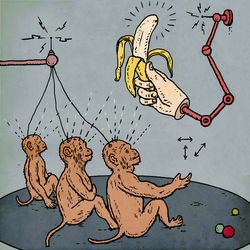
ZimmerA single neuron can’t do much on its own, but link billions of them together into a network and you’ve got a brain. But why stop there? In recent years, scientists have wondered what brains could do if they were linked together into even bigger networks. Miguel A. Nicolelis, director of the Center for Neuroengineering at Duke University, and his colleagues have now made the idea a bit more tangible by linking together animal brains with electrodes.

In a pair of studies published on Thursday in the journal Scientific Reports, the researchers report that rats and monkeys can coordinate their brains to carry out such tasks as moving a simulated arm or recognizing simple patterns. In many of the trials, the networked animals performed better than individuals. “At least some times, more brains are better than one,” said Karen S. Rommelfanger, director of the Neuroethics Program at the Center for Ethics at Emory University, who was not involved in the study. Brain-networking research might someday allow people to join together in useful ways, Dr. Rommelfanger noted. Police officers might be able to make collective decisions on search-and-rescue missions. Surgeons might collectively operate on a single patient. But she also warned that brain networks could create a host of exotic ethical quandaries involving privacy and legal responsibility. If a brain network were to commit a crime, for example, who exactly would be guilty?

More here.