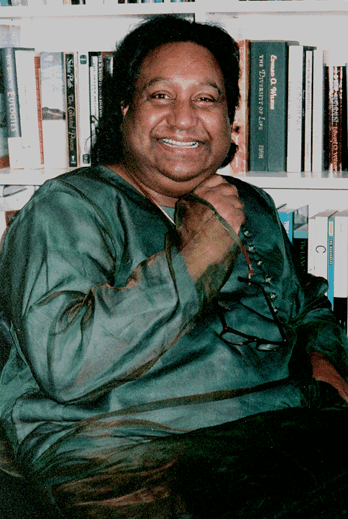
by Hartosh Singh Bal
Somewhere near the town of Renala Khurd in Pakistan is a patch of land (a morabba to be exact) that once belonged to my family. In lieu of this land, through a series of land transfers, complicated but no more complicated than the history of the division of the subcontinent, my family now owns land, far less than a morabba but land nonetheless, on the outskirts of Amritsar. More or less 64 years ago to the day, a series of such transactions and the forced movement of millions of people, created the two countries of India and Pakistan.
My father, barely ten years old, was then staying in our native village of Sathiala, not far from the banks of the Beas and a short distance from the main railway line from Jalandhar to Lahore. Sathiala, like most of the villages in that area, was dominated by the Sikhs who owned much of the land. The Muslims were mostly from the artisan castes, dependant on the Sikh landlords. As the date set for Partition, August 15, 1947, approached, a large number of Sikhs from these villages began gathering together night after night to organize `tiks’ (attacks) on the Muslim processions headed to Pakistan. They would come together in large numbers, some carrying firearms, other armed with spears and daggers, often led by the local police inspector. Every night they would head out on their journey of murder and pillage, every morning they would divide the spoils.
Each day, my father and his elder brother, just out of school, would carry food for the Sikh and Hindu families travelling by train who had made it safely through similar massacres on the other side of the border. When the violence was but beginning, they made an attempt to offer some food to the Muslims in the trains headed in the other direction, no less famished, no less thirsty. Only the intercession of some men from their village saved them from the swords of their fellow Sikhs now drawn against them.