by Quinn O'Neill
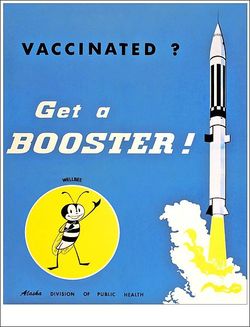
In a recent article for Big Think, David Ropeik argues that the risk posed by unvaccinated people is sufficient to justify coercing them into vaccinating. Measles is a potentially deadly disease and outbreaks are occurring due to declining vaccination rates, he reasons. “What does society do when one person’s behavior puts the greater community at risk? […] We make them stop.” I suppose it depends on the behavior and the degree of risk, but where vaccination is concerned, I disagree that coercive measures are warranted. While measles is not a fun disease and it can kill people, the sacrifice of individual autonomy isn't justified in this case.
The risk of getting the measles in the US is very low.
Between 2001 and 2010, the US saw 692 cases. 292 of these were imported by travelers who caught the disease in another country. Since you can't blame your unvaccinated compatriots if you catch the measles in another country, we'll exclude these. That leaves 400 cases in 10 years out of approximately 297 million people. The odds of getting the measles in the US in a typical year are thus 0.13 in a million. Given that about 10% of the population is unvaccinated, the odds of an unvaccinated person getting the disease are about 1.3 in a million.1 Note that the odds are higher for the unvaccinated, but 1.3 in a million is still extremely rare.
Of course, the risk is undoubtedly higher this year since there were over 150 cases reported by the end of June. However, the majority of these were foreign visitors and US residents who caught the disease abroad. Assuming half of these cases were acquired in the US and that current trends continue until year end, we could expect the odds of an unvaccinated person getting the measles this year to be about 4.9 in a million (150 in 30.9 million). These are pretty slim odds, measly even.
People often argue that it isn’t those who refuse vaccination they’re worried about, but those who are too young to be vaccinated, typically those under a year of age. About 15% of measles cases reported in the first half of this year affected children in this age group. This could end up being as many as 23 infants by year end (again using 150 as an estimate for the year total). So the chances of a child under age one getting the measles this year would be about 5.3 in a million.2 To put this risk in perspective, these odds are about the same as the odds of dying from a fall down the stairs (5 in a million).3 Odds of dying from the measles are less than 1 in 1000 cases. So the odds of an infant getting the measles in the US and dying as a result are about 5.3 in a billion. Panic is not in order.