by Misha Lepetic
No subject has hitherto been so much neglected by the profession
to which the author has the honour to belong.
~Higgins, The House Painter, 1841
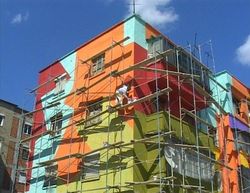 When we move into a new home or apartment, oftentimes the first thing we do (except for setting up the stereo) is to give most every surface a fresh coat of paint. This accomplishes several things. Obviously, there is the satisfaction of meting out a wholesale revisionism – the permanent occlusion, by the thinnest and yet most opaque and decisive means, of the previous inhabitants’ history or even presence. Paint fumes are redolent of fresh beginnings; their smell creates an almost Pavlovian reaction, celebrating a new start, or at least the thorough dismissal of what went before.
But in another sense, it is the first articulation of an implied contract between our new dwelling and ourselves. It is almost as if we are saying to all those empty rooms, “I will take care of you, and you will take care of me. As proof, here is my act of good will.” For those of us who like to paint before even moving in, it is our first, truly physical interaction with the space. We take its measure in a painstaking and intimate way, appreciating the true height of the ceilings, the idiosyncrasies (or shoddy workmanship) that has gone into correctly reconciling floors with walls. We wonder, too, when confronted with a vague and knobby detail, how many times it has been painted over by people, perhaps not dissimilar from ourselves. Inevitably, we leave spatters of paint that will haunt us for the remainder of our time there. But in the end, this act of tabula rasa is meant to broadcast our ownership of the place, in a way that is thorough, satisfying, and simultaneously public and private.
If these are the outcomes of a simple and oft-repeated ritual, then why not apply this kind of thinking to larger scales? It may seem to be a trivial suggestion, when one considers the fact that run-down urban neighborhoods are contending with extreme and persistent problems of economic degeneration, crime and social fragmentation. Budget cuts lead to curtailed services, and potholes, broken street lights and shuttered storefronts pile up in a seemingly irreversible, slow-motion car wreck. What could a few coats of fresh paint possibly do? Isn’t this just another elaborate form of denial, an almost literal act of whitewashing?
On the other hand, consider what would be a guiding principle of anyone attempting a revitalization of a beaten-down neighborhood: What is the smallest action that I can take that will have the greatest effect? There has been much discussion and praise of the movement towards DIY urbanism, or bootstrapping. I have written previously about strivers like Marcus Westbury in Newcastle, Australia, who are bringing nearly abandoned downtowns back to life using innovative financing schemes with virtually zero seed capital. And recently, interesting work has been done establishing the possibility that the simplest way to kick-start economic development in informal neighborhoods is to pave the streets. Conducted in the Mexican city of Acayucan, the study’s central finding noted that “while the price of paving the 28 streets in Acayucan came to roughly 11 million pesos, the land value increased roughly 12 million pesos — or 109 percent of the original investment.” While this is a great multiplier, paving streets is a complex business, costly to organize and prone to corruption. The idea here is to be even simpler than that – and what could be simpler than a few cans of paint? Yet, this story is as much about what paint can obscure, as what it can expose.
Read more »