by Eric Byrd
[the heroic] outlook which regarded action as the main end of life and attached to it an ideal which demanded that a man must make the utmost of his body and his mind.
C.M. Bowra, The Greek Experience
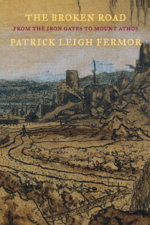
Istanbul (Constantinople he always called it), destination of the famous walk the eighteen year old began in Rotterdam in 1933, the manuscript of The Broken Road was knit together by his biographer Artemis Cooper and the writer Colin Thubron. The draft title of this review was “Patrick Leigh Fermor at Journey's End” – but I realized that was pat, a cheap nod to the posthumous publication, and what is more, false to the story the book tells – the story of a beginning. This last volume of the trilogy has all the freshness and exuberance of the two previous books. It shows Fermor at the end of his peculiar education – the history of Europe studied in huts and in castles, in folk example and in manor archives – and poised on a long life of further adventure. In The Broken Road he enters the Balkans, and the Greater Greek world that would become the focus of his linguistic and ethnopoetic passions, the stage of his military heroism, and his permanent home.
A Time of Gifts (1977) and Between the Woods and the Water (1986) are famous for the digressions in which Fermor, if, say, recollecting a visit to a gallery, climbs into the portals of pictures and stalks around the sitters and figures, drawing elaborate reveries from costume and mien; or if on the march, he drops back, lets the rucksacked youth recede a little down the road, and conjuring from an adult erudition fills the foreground with phantom processions: the migrations of tribes and tongues, nomad cavalcades, royal progresses, coronations and beheadings, triumphs and massacres, the lugging of siege trains toward Vienna.
The best digressions of The Broken Road unfurl in Bulgaria – over a mosque, and over a complex of ruined Slavo-Byzantine churches. Karlovo's Muslims call up the pageant of Ottoman conquest – “Anatolian infantry, wild Asian troops of horse, Bedouin cavalry, mounted archers from eastern deserts, contingents of Albanians, Tartars and Tcherkesses, Negroes from Africa and, under their strange emblems and their fan-plumed helmets, the Janissaries” – which winds down to quiet scenes observed around the mosque. His host the hodja sits “cross-legged and absorbed in prayer,” raises his hands, “his palms uppermost, on either side of his body for a few seconds, as though he were offering a light and invisible gift.” Fermor naps and wakes at sunset to the hodja calling from the minaret: “The last hoop of the prayer had expanded to infinity. The famous words faded from the air and from these infidel mountains. The parapet…was empty; the invisible muezzin was already halfway down his dark spiral.”
Word of the murals of Tarnovo, capital of the Second Bulgarian Empire, the dominant Balkan kingdom of the twelfth and thirteenth centuries, its Czars “rivals and imitators of the Byzantines,” caused Fermor to break his easy southward track to Istanbul and turn north, up and over the Balkan Mountains. In Tarnovo he made friends with a grocer's son, a fiery nationalist student, and together they climbed to a windy ridge planted with the monastic mementos of the Bulgar Czars. Loitering in the churches, they craned their necks “to peer into the pictorial vaults and cupolas and domes” at the haloed ranks of “prophets and paladins and anchorites and holy men and headsmen” who stared down with “a thousand unblinking eyes.” Suddenly “the dim light of this vaulted world of interlocking haloes grew dinner still” – a storm arrives, rages, and passes. Fermor and his companion stepped out from the shelter of a twelfth century porch to see the Tarnovo's “amphitheater of hills” rinsed of late summer's haze and dust. The stones gleamed like mineral nuggets, the dun ploughlands were a “deep chocolate,” and the bushes and flowers and herbs, having shaken off their “long trance,” released “a confusion of scents” which roved the air.