by Matt McKenna
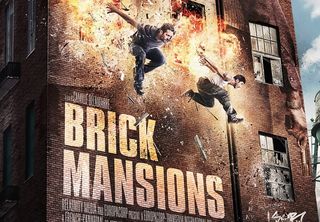
Brick Mansions is an American remake of the 2004 French film, District B13. While the remake does Americanize its subject matter, the larger plot elements of the story remain intact: as crime in Detroit increases to horrifyingly high levels, the government erects walls around the city's most dangerous neighborhood, a large block of rundown high-rises known as Brick Mansions. Lino (David Belle) is a resident of Brick Mansions and parkour enthusiast who is interested in killing drug kingpin Tremaine (RZA) for kidnapping his girlfriend. Lino is joined in his quest by Damien Collier (Paul Walker), a naive cop sent into Brick Mansions to deactivate a rogue neutron bomb that found its way into the area. As to be expected in an action film, our heroes are ceaselessly bombarded by henchmen with terrible aim and a proclivity for standing near the edges of rooftops. As the duo battles their way through the parade of bad guys, Lino's parkour skills prove to be an invaluable resource as he deftly traverses terrain filled with just-out-of-reach ladders, windows, and objects from which he can perform flips and other incredible feats of jumping. Collier is less agile than his counterpart, but a deep-seated rage over the death of his father affords him superhuman tenacity and an exceptionally wry wit.
You'd be forgiven if you read the above description and came to the conclusion that Brick Mansions is nothing but a brainless action movie whose core audience's age tops out at fourteen. In fact, you'd still be forgiven if you watched the movie and came away with the very same conclusion. Because the film is so oblique, it is easy to miss the nuanced social and economic critiques amongst the plethora of kicks and fist-bumps. Thankfully, Thomas Piketty's Capital in the Twenty-First Century, an impressive work in and of itself, decodes Brick Mansions and provides viewers with the opportunity to understand this frequently difficult film.