by Hari Balasubramanian
In January this year, I visited Hospitalito Atitlán, a health care center for the Tz'utujil Maya in the town of Santiago Atitlán, Guatemala. There were two reasons for this visit. First, much of my healthcare work has been limited to the US system; I wanted to get a sense of what was going on in other places. Second, for many years I've been trying to learn about the indigenous cultures of the Americas; this had led me in the past to Mexico, Peru and Bolivia. I welcomed, now, this chance to spend a few days in a Mayan town in Guatemala.
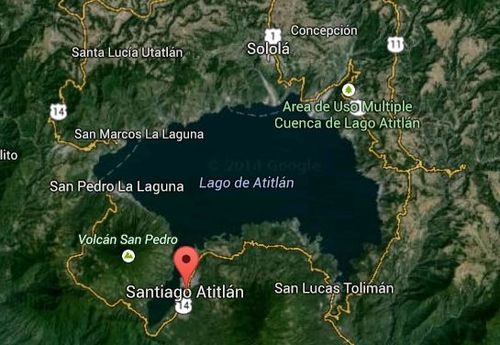
Santiago Atitlán, a town of 30-40,000, is a 3-hour drive from Guatemala City, at the southwestern edge of Lake Atitlán. The lake fills a caldera formed in an eruption 84,000 years ago, and is surrounded by lush-green volcanoes, rising to over 8,000 feet. The majority of the people who live in the surrounding towns belong to one of two Mayan groups: the Tz'utujil and Kaqchikel. Santiago Atitlán is almost entirely Tz'utujil, while San Lucas Toliman is mostly Kaqchikel. Tz'utujil and Kaqchikuel also refer to two of the twenty odd Mayan languages in Guatemala (there are a few others in Mexico). All of them are still spoken, in sharp contrast to the fate of indigenous languages elsewhere in the Americas.
I arrived in Santiago Atitlán on a Sunday morning. The town is set along a slope that eases into the lake; Volcan San Pedro rises dramatically across a narrow section of the water, dominating the view. For a small town, the streets were a maze, and I lost my way each time. Many of the homes were make-shift; the farther I ascended away from the town center, the poorer the homes were. Almost all the Tz'utujil women wore brightly colored yarn based textiles with intricate patterns. On the main road along the lake's circumference, Toyota pick-up trucks – a common mode of shared local transportation – carried passengers who stood in the open rear. Then there were the brightly colored tuk-tuks, exactly like the three wheeler autos I knew in India – every one of them that I saw in Atitlán was made by Bajaj.
The pick-up trucks, the tuk-tuks, and even many of the paved roads were all new, I was told – part of the economic growth here after decades of conflict. In the last half of the 20th century, Guatemala, like other nations of Central America – El Salvador, Nicaragua, Honduras – went through a violent upheaval. The Guatemalan Civil War lasted from 1960-1996. A brutal right wing government fought against insurgents in the largely indigenous countryside. The Lake Atitlán region did not go unscathed; hundreds of people from Santiago were killed or disappeared; “everyone you talk to lost someone in his or her family” [link]. Since 1996, there's been a return to normalcy. While the region still remains relatively poor, its coffee plantations have done well, and the beautiful lake setting draws plenty of tourists.