by Rishidev Chaudhuri
But how to make sense of this confusion if one did not grow up hovering over a mortar and pestle? Or even if one did and was momentarily distracted (perhaps by adolescence)? One route is a close reading of existing recipes and practices, noting patterns, highlighting parsimonious explanations and gradually drawing grander and grander conclusions. Equally useful is naïve phenomenological experimentation: an analytic strategy, where we isolate and examine spices to see what they bring to our senses. In this we should be motivated by Blake's dictum that to know what is enough we must cross it: the most clarifying way to figure out what a spice is doing is to increase its proportions in a recipe ad absurdum, until the structure starts to crack and you glimpse what column of the edifice was being held up by that particular spice. Unfortunately, while this is the right way to conduct disciplined phenomenological inquiry, it is not the right way to make something to eat, and so we will scale our ambitions back and instead simply exaggerate the spice that is being studied and strip away some of the surrounding complexity. This is an ongoing project of mine, as I try to understand subcontinental food, and I'm particularly interested in collecting and devising one-note recipes that highlight a particular spice (see this article on pepper, for example).
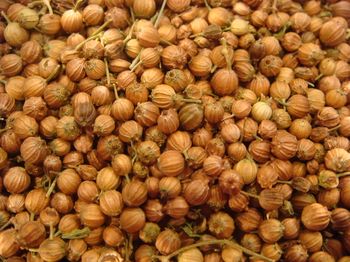
Coriander fruits, also commonly called coriander seeds, are good for this kind of analysis. Their flavors are crucial to many subcontinental foods, and are part of what makes the cuisine distinctive. Yet, unlike a number of other spices, coriander tends to be gentle and forgiving. It's a friendly spice, with flavors of citrus and flowers mixed in with a warm spiciness. If you have coriander seeds in your pantry, chew on a few seeds as you read this and you'll smell and taste the flavors I mean (you can do this with the powder too, but it's less pleasant and it'll dry out your mouth). There's also a slight soapiness, which I'm told some people pick up on more than others. If you're curious about the chemistry of coriander, Harold McGee's book On Food and Cooking is wonderful (as usual).