by Mara Naselli
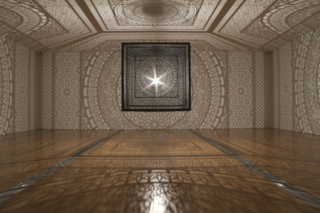 When my children entered the gallery at the Grand Rapids Art Museum that contained Anila Quayyum Agha's installation work, Intersections, they took off at a run. The sound of their little feet filled the space. I felt that cinch of parental panic and scanned the room for what they might inadvertently destroy. The room was empty. Empty in the sense that it contained no objects, save the large wood cube illuminated by single light bulb hanging from the ceiling. The gallery, about thirty-feet square, was transformed into something larger by the tapestry of shadow projected onto the walls. I hesitate to use the word sacred, but it was impossible not to feel a certain vastness. The contrast of light and dark created an immersive architecture. “You should have seen it when they were installing it,” said the security guard. “The whole room spun.”
~
Every September since 2009, Grand Rapids, Michigan, has hosted an open art contest called ArtPrize. Anyone can enter. Anyone can judge. Anyone can win. ArtPrize winners are elected by popular vote. The rules have been adjusted each year, but the basic idea has remained intact: bring art to the public, let the public judge art.
Grand Rapids is a small, quiet city. But when ArtPrize opens, art is everywhere: parking lots, rooftops, bars, bridges, abandoned buildings, churches, even the river. This reserved city transforms into a minimetropolis of raucous, unedited expression.
The cultural context of ArtPrize—that is, the culture of Grand Rapids, Michigan—bears mentioning. When ArtPrize began, I had just moved here from Chicago, and so I watched with some interest at what looked like a large-scale democratic experiment. Some called it a rich kid's art party (the founder, Rick DeVos, is the grandson of the co-founder of Amway). But I thought of it as an experiment in civic discourse, where good art and bad art would duke it out through the intelligent discernment of public opinion. In many ways, the location of ArtPrize made perfect sense. The city has a venerable history in furniture making and design. There's a vibrant arts community here, a grassroots artists' collective, a sculpture garden, a symphony, a ballet, an opera, and a fine art museum—all this in a town of fewer than 200,000. The community in many ways is steeped in arts funded by local philanthropic families such as the DeVoses. Grand Rapids is also conservative and Christian. The fact that ArtPrize was in a very red region of a blue state made the democratic aspect of the contest all the more interesting to me. Taste, culture, and politics would converge as the public would play patron.
Read more »