by Hari Balasubramanian
Decisions under demand uncertainty – the so called newsvendor problem.
In October 2007, my father and I took a day train from Bangalore to Chennai. About halfway into the 7-hour journey is a station called Jolarpet, where the train stops for ten minutes. As at other stations, there were dozens of vendors – each with a simple wheeled stall or a wooden basket or a steel container – engaged in a frenzy of small scale entrepreneurship. All sorts of items were being sold: snacks, tea, coffee, water, bananas, flowers, cheap Chinese goods – toys, combs, and, in what became a curiosity and a topic of detailed conversation among our fellow travelers, pens that doubled as flashlights.
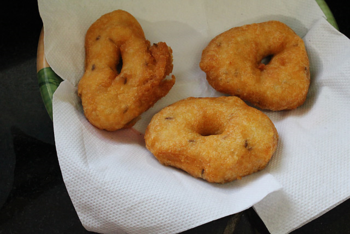
But my father was most interested in those who sold vadas, a South Indian specialty, a round, deep-fried snack with a hole in middle – like a donut but not sweet at all – made from a batter of lentils (I've described just one variety). My father felt the vadas sold by vendors at the Jolarpet station were better than those made in the train's pantry. They were hot, had just the right texture, and the timing – late afternoon – was just right to have them with coffee. Three fairly busy trains – including the Bangalore-Chennai Brindavan Express on which we were traveling that day – arrive at Jolarpet station at roughly the same time. “How many vadas get sold?” my father wondered. “Maybe a thousand of them, maybe even more.”
That comment got me thinking. If you are a vendor, the critical question is how many vadas should I make? The vadas have to be fried right before the train arrives so that they are hot and ready to sell during the ten minutes that the train stops. If I fry too many and not enough passengers buy them then what I am left with is wasted, since a vada that is not freshly made is unappetizing. On the other hand, if I fry too few, then I lose the opportunity to sell to passengers who need them. So what is the right number to make given this uncertainty in demand?
The technical name for this dilemma is the newsvendor problem. Replace vadas with newspapers and you have an identical situation. If a newsvendor on the street doesn't sell enough newspapers, what's left is wasted since today's newspaper won't sell tomorrow. If the vendor has too few newspapers and runs out of them, then potential customers are lost.