by Hari Balasubramanian
During my middle and high school years, I became fascinated with two generations of stray dogs that lived in my neighborhood. This was in the early 1990s. My family lived in the central Indian city of Nagpur, in a 3rd story flat. The flat had a couple of balconies (decks) which gave me the chance to watch the dogs go about their routines. Instead of studying for exams – which involved the dreary task of memorizing entire sections of textbooks – I would get up in the morning and spend time watching the neighborhood strays. The dogs liked the cool air of early mornings. They played frantically, chasing each other down, trying to wrest torn rags from each other as if the rags were of great value. At 8 am, with the sun up and strong, they would be exhausted. They would lie in the shade, front limbs stretched, their snouts nuzzling in between but their noses still twitching and ears still alert for anything untoward.
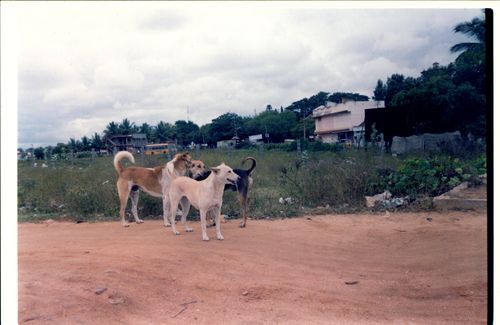
Stray dogs (desi kutta in Hindi, theru nai in Tamil) can be found almost everywhere in India. The term ‘stray', in the South Asian context, does not refer to abandoned pets (although some mixing with pet European breeds does happen). From the genetic viewpoint these dogs are actually very ancient and have been around for millennia. They seem to have evolved independently by natural selection (they were not bred commercially) and have adapted well to living in and around human settlements. And they are still around, living on the dirt shoulders of streets, alleyways, the platforms of railway stations, and the ignored nooks and interstices of infrastructure. Residential families and street vendors may occasionally feed them and look after them informally, but the strays largely fend for themselves, scavenging in rubbish dumps or wherever leftover food is available. They mark their territories with their seemingly bottomless bladders, participate heartily in the chaotic and noisy mating season which happens once a year, and work hard to raise their offspring. In this sense, the strays are as wild and independent as, say, the squirrels and crows we find everywhere. They are not always liked due to the risk of rabies, and there is an ongoing debate on how their numbers should be controlled (see this for another perspective).