by Jalees Rehman
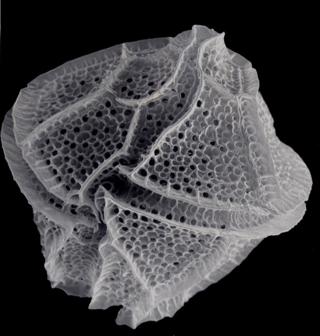
Lingulodinium polyedrum is a unicellular marine organism which belongs to the dinoflagellate group of algae. Its genome is among the largest found in any species on this planet, estimated to contain around 165 billion DNA base pairs – roughly fifty times larger than the size of the human genome. Encased in magnificent polyhedral shells, these bioluminescent algae became important organisms to study biological rhythms. Each Lingulodinium polyedrum cell contains not one but at least two internal clocks which keep track of time by oscillating at a frequency of approximately 24 hours. Algae maintained in continuous light for weeks continue to emit a bluish-green glow at what they perceive as night-time and swim up to the water surface during day-time hours – despite the absence of any external time cues. When I began studying how nutrients affect the circadian rhythms of these algae as a student at the University of Munich, I marveled at the intricacy and beauty of these complex time-keeping mechanisms that had evolved over hundreds of millions of years.
Over the course of a quarter of a century, I have worked in a variety of biological fields, from these initial experiments in marine algae to how stem cells help build human blood vessels and how mitochondria in a cell fragment and reconnect as cells divide. Each project required its own set of research methods and techniques, each project came with its own failures and successes. But with each project, my sense of awe for the beauty of nature has grown. Evolution has bestowed this planet with such an amazing diversity of life-forms and biological mechanisms, allowing organisms to cope with the unique challenges that they face in their respective habitats. But it is only recently that I have become aware of the fact that my sense of biological beauty was a post hoc phenomenon: Beauty was what I perceived after reviewing the experimental findings; I was not guided by a quest for beauty while designing experiments. In fact, I would have been worried that such an approach might bias the design and interpretation of experiments. Might a desire for seeing Beauty in cell biology lead one to consciously or subconsciously discard results that might seem too messy?
I was prompted to revisit the role of Beauty in biology while reading a masterpiece of scientific writing, “Dreams of a Final Theory” by the Nobel laureate Steven Weinberg in which he describes how the search for Beauty has guided him and many fellow theoretical physicists to search for an ultimate theory of the fundamental forces of nature. Weinberg explains that it is quite difficult to precisely define what constitutes Beauty in physics but a physicist would nevertheless recognize it when she sees it.