by Hirsch Perlman
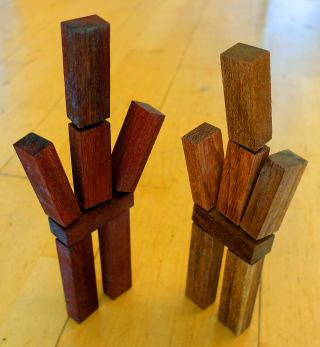
I had a mind to make a mechanical, articulated joint, perhaps for an unknown figure. And for some reason (because this is what artists do— close down the infinite possibilities, the infinite freedom we have to reveal a set of seemingly random finite possibilities) I would have to do this with no hardware, no glue, no fittings, just wood.
Two years of tooling up and experimenting followed and I arrived at an odd daisy chain design of interlocking wooden axles, nuts, and bolts. These parts were infinitely adjustable and could be locked in any orientation. I toyed with a variety of uses, placement, attachments, and configurations of the joint. Many kinds of wood were put to the test. The best wood, lignum vitae (wood of life), comes from South America. It's an extraordinary wood, with a resin that acts as a natural, built-in lubricant that has a lovely smell. Believe it or not, it's used to make large bearings in hydro-electric generators (I purchase the cut-offs from the manufacture of those bearings). It lasts longer than steel in that application. One of the first mechanical clocks was made out of lignum vitae.
Another year of toying and the real meaning of the joint unfolded. It's a mechanical schematic of thinking, the brain as an versatile tool. These parts were too flexible to be regular joints, they were “mind,” not body.
I built a number of prototypes. 10-12 foot tall “stick person” bodies/limbs with my adjustable joint as neurons/hair/headdress, each thinking itself.
If I'd managed to properly anchor any of the them to the ground, they might still stand. I missed the storm and the battle, but not its aftermath. I would need to draw this out, look at the carnage for a long time, before I knew what it meant.





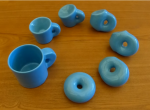 Maybe you've heard by now about last week's Nobel Prize in Physics, awarded to three physicists for their work on topological phase transitions. But if you didn't already know what a topological phase transition was, chances are you still don't. When a friend of mine read a few popular articles on the discovery, I asked him if he felt enlightened. “No, it felt like the authors were just free-associating: first they said ‘topological phase transitions,' then they said ‘topology,' and then ‘bagels.'” I sympathize with my friend, but also with anyone trying to explain this year's prize. It's true: you can't explain topological phase transitions without mentioning the underlying mathematics, a field called topology. And when you mention topology, you're tempted to talk about bagels. In fact, not long after the Nobel announcement, a Nobel committee member was waiving bagels and cinnamon buns on screen.