by Leanne Ogasawara
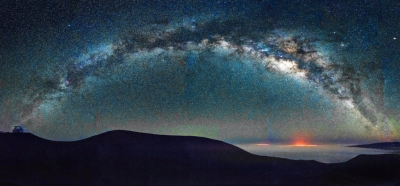 It has been three long years since I was last on the summit of Mauna Kea. But at last, we were heading back up the mountain to see my husband's new instrument being installed on one of the telescopes at the KECK observatory. An experimental astro-physicist at Caltech, he and his team have designed a cutting-edge spectrograph for measuring and imaging the cosmic web. KCWI will be the ninth instrument between the two KECK telescopes on Mauna Kea and will become a wonderful boon to astronomers working in low brightness.
More importantly, though, this instrument had brought me back to Hawaii (Just kidding!).
The summit is other-worldly. In one respect, it reminds me of being in the Himalaya–as Mauna Kea is high enough to evoke that breathless, cloudless, stark lunar-scape quality one finds on the road to Ladakh. But this is Hawaii. So, rather than leaving behind the alpine beauty of Kashmir, on Mauna Kea you are but two hours away from mind-bogglingly gorgeous tropical beaches. It is unreal to see snow up there. Snow on Hawaii. A sleeping volcano, like Mt. Fuji, it is indescribably beautiful standing at the summit and watching the clouds roiling beneath you–on a good day you can see Hilo Bay off in the distance.
As you've no doubt heard, not everyone is happy to see this sublime landscape filling up with observatories. As of today, there are some twelve domes and a few scattered infrared and submilliter telescopes dotting the Martian-like landscape on the summit. In addition to KECK, other well-known observatories include the Gemini telescope (with its twin in Chile) and the Japanese beauty Subaru.
I wonder how many people probably have been reading about the controversy surrounding the Thirty Meter Telescope (TMT)?
Trying to do everything possible to meet the expectations of the native Hawaiian movement, the consortium (Caltech and UC; plus Canada, Japan, China and India) chose a spot not on the summit itself but in recessed spot below the summit, so that the massive dome would not be visible from below. The spot was cleared by archaeologists so as to guarantee it is not a burial place and it was also cleared by ecologists. Despite what would be a huge boon to the economy and great advantage to students in the University of Hawaii system, representatives of the movement felt enough was enough– and the gigantic telescope project is not going forward as planned. When I was there recently, I was talking on the beach with a couple from Canada about the situation, and they reminded me that this issue is not just about Mauna Kea or the native people of the Big Island, but rather all around the world, native peoples are being stepped all over. The pipeline immediately comes to mind. This controversy over TMT is bigger than this mountain. A small group was here protesting at Caltech Friday and one of the protester's signs really sticks in my mind.
It read, "Standing Rock is everywhere." (Article in local paper is here; my husband is the scientist quoted at the end).
So, the scientists might need to go elsewhere. It's not easy, of course, since Mauna Kea is one of only two nearly perfect spots in the world to make astronomical observations.
What makes it so perfect?
Read more »









![Images-w1400[1]](/wp-content/legacy/6a00d8341c562c53ef01b7c8f5efac970b-320wi "Images-w1400[1]")