by Paul Braterman
Ten minutes difference, and Earth would still be Planet of the Dinosaurs
We have suspected for some decades that the dinosaurs1 became extinct as the result of a massive meteorite, an asteroid, hitting the Earth. We have known where the impact site was since 1990, if not before. But it is only last year that we successfully drilled into the impact site, and only now, for the first time, do we really understand why the impact was so fatal. And if the meteorite had arrived ten minutes earlier, or ten minutes later, it would still no doubt have inflicted devastation, but the dinosaurs would still be here and you wouldn't.
Too many suspects
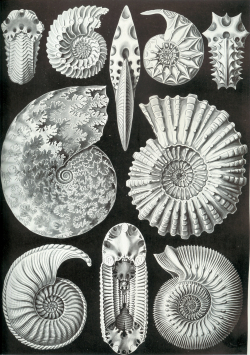 L: Ammonites (Haeckel, 1904, via Wikipedia). Click on this and other images to enlarge
66.1 million years ago, dinosaurs covered the Earth. 66 million years ago, there were none. And not only the dinosaurs, but the pterosaurs in the skies, the long necked plesiosaurs and even the ammonites in the oceans, and 75% of all complex animal life. No terrestrial vertebrate heavier than around 25 kg seem s to have survived. What happened?
There was no shortage of theories. Quite a lot was going on, geologically, at the time. There was massive volcanic activity in India, giving rise to what are known as the Deccan Traps, containing over a million cubic kilometres of basalt. Such major volcanic episodes have been connected with other mass extinctions. They are accompanied by the ejection into the stratosphere of sulphur dioxide, which in turn slowly reacts with atmospheric oxygen and water vapour, forming a haze of sulphuric acid far above the Earth's surface. This partly blocks out the Sun, affecting the plant growth on which almost2 all life on Earth depends. We saw such an effect on a much smaller scale with the 1991 eruption of Mt Pinatubo in the Philippines, which caused a two-year slowdown in global warming and 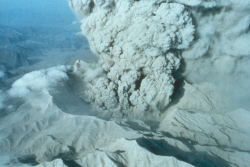 reduced crop yields worldwide, far beyond the reach of the actual dust cloud. Continents were on the move, with the reopening of the North Atlantic, polar icecaps reappeared after prolonged absence and led to lowering of sea levels, affecting ocean productivity, and all these things may have added to ecological stress. But all this hardly seems enough for such a wide-reaching die-back, nor does it account for the suddenness of the process.
Above, Mt Pinatubo, caldera formation phase, USGS
And so, we saw the emergence of the asteroid impact hypothesis. The Solar System still contains fragments of rocky material left over from its formation. This material is mainly concentrated in the asteroid belt, between Mars and Jupiter, but small fragments continually come our way. Most of these are tiny particles, which burn up in our atmosphere (meteors or shooting stars). Some are large enough to survive, falling to earth as meteorites, and their chemical composition tells us a great deal about the stuff from which Earth was originally formed. Very occasionally, the meteorite is large enough to dig out a crater, such as Meteor Crater in Arizona. During the early years of the Solar System, major impacts were frequent and dramatic, as we can see by looking at the Moon and at the other inner planets, but on a geologically active planet such as Earth the evidence will long since have eroded away. However, there are still plenty of small asteroids whose orbits intersect the Earth's. What if one of these happened to crash into the Earth, and trigger catastrophe?
Read more »