Karl Marx Ignites the Millennials
after Mohammad Iqbal
Ah! Come! How can you not be roused! You are nothing but you are everything.
Recharge your IPhones. From each according to his feed to each according to his need. In
times of global deceit tweeting the truth puts you in the driver seat. Road to hell is paved
with fake tweets. Take a knee. Raise a fist. Do it twice: First as history, then as tragedy.
Ask the drones of democracy, Masters of Business Administration, what else is there in
their dens of depravity besides electronic hallucinations, market rallies, blow-dried heads
squawking, mad money spiritualists, Ponzi schemers, daybreak business briefs, nighttime
rundowns, snorting bulls, bashful bears, quarterly yearnings, a spill of crooked graphs?
Women on the March, place a halo back on family values. Disrupt patriarchies that claim
your wombs as mere tombs of production. Ban gunrunners who hawk capitalism past its
sell-by date. Exorcise temples, churches, and mosques for religion is the pox of the poor
hurting for pride. Abolish Wall Street. You have nothing to lose. Unite! Inspire! Reignite!
by Rafiq Kathwari / @brownpundit
 by Christopher Bacas
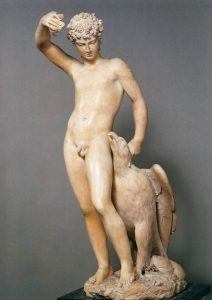 A celebrated altercation between Benvenuto Cellini (1500-1571), the Florentine artist, and fellow sculptor Bartolommeo Bandinello (1493-1560) resulted in the latter exclaiming “Oh sta cheto, soddomitaccio.” [Shut up, you filthy sodomite!]. The accusation had merit in the legal sense at least since Cellini had indeed been accused of the crime of sodomy with at least one woman and several young men. The incident is oftentimes recalled in writings about the period as it provides a compelling illustration of the sexual appetites of the artists of the Renaissance.
 What do 21st century American college faculty and 19th century Church of England Clergyman have in common? A surprising amount. This is one reason I would heartily recommend the novels of Trollope, Austen, and others to my colleagues in academia.
 Since 2014, various student societies at the University of Edinburgh have but on musical performances commemorating the first world war. This article takes a look at one performance in particular. The content is neither highly original nor particularly radical; others have written more insightful and more sophisticated pieces. It constitutes merely an attempt to formulate and to clarify what is problematic with these particular performances, thereby hoping to understand something about the greater memorial tradition in the United Kingdom. In other words, by examining how a nationalistic, martial and oppressive Erinnerungskultur is reproduced in an amateur to semi-professional context – be it deliberately or not -, we may see how these values become normalised and why it matters that this takes place in this particular context.
 When my partner and I were expecting our first child, I remained obstinately distant from all parenting books. I had adapted, and taken to heart, Rainer Rilke’s advice to Franz Kappus about avoiding introductions to great works of art, and reckoning that, in the poet’s words, “such things are either partisan views, petrified and grown senseless in their lifeless induration, or they are clever quibblings in which today one view wins and tomorrow the opposite.” Rilke’s point seems to be that introductions do more to obscure our ability to reach the work of art than elucidate it. Since a child is, among other things, a living, breathing work of art, it took very little for me to translate the great poet’s advice to the work of child-rearing. Surely no book would truly help me approach a task as infinitely arduous and dizzyingly beautiful as bringing a human being into the world.
 One starting point for any philosophical account of language is that the truth of a statement depends both on what it means and on how the world is. Handily for contemporary pragmatists of my stripe, this fits neatly with the post-Davidsonian project of overcoming the dualism of conceptual scheme and empirical content. All we need to do is show that the two factors that make up truth are not so detachable as contemporary dualists claim.
 “You should look into this, perhaps write a little something about it.”
 The cryptocurrency movement may be a mainstream media story but confusion about it is widespread. It evokes deeply polarized opinion, what with daily stories of