by Emrys Westacott
 “Beware of literature!” This warning occurs in Jean-Paul Sartre’s 1938 novel Nausea as an entry in the diary of the narrator, Antoine Roquentin. In context, it concerns the way that literary narratives falsify our experience of events by investing them with an organization and structure that our experiences in themselves, as we live them, do not have. When Bilbo Baggins finds the ring in The Hobbit, Tolkein tells us that although Bilbo didn’t realize it at the time, this would turn out to be a turning point in his life. When married couples recall their first meeting, their account inevitably packages the event as a “beginning,” even though they may have had no inkling of this at the time.
There is, of course, some self-conscious irony in the fact that the warning to “beware of literature” appears in the middle of a literary work. Shades of the liar paradox, in fact. If we should be suspicious of literature, then we must be suspicious of the work that tells us to beware of literature: in which case we should perhaps trust literature, including works that advise us not to…..and so on.
The warning goes against an idea often touted that literature is a vehicle for expressing and revealing Truth. Perhaps not truth of the scientific variety, but some sort of insight, wisdom, or moral lesson concerning human nature, human relationships, and the human condition, that is best communicated through art rather than by means of discursive argument, and which resists reduction to a simple formula. This idea is naturally appealing to the literati, especially at a time when the onus seems to be on anyone not working in STEM fields to justify their existence, or at least their salary.
Recently, though, I have been struck by a particular problem with such claims, at least insofar as they pertain to fiction. Read more »


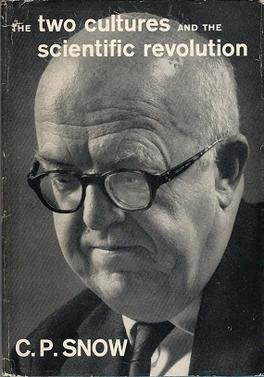 It is a commonplace to say that a divide has occurred in modern academia between the sciences and the humanities. In the anglophone world, this diagnosis is often traced back to a lecture by the British scientist-novelist Charles Snow, who pointed out in 1959 what he saw as a lamentable gap between ‘two cultures’: the literary and the scientific culture. Snow’s Rede lecture has become the main




 Do you find this prospect upsetting? Perhaps you think it is unfair for someone to get a job without a good reason for why they deserve it rather than anyone else. Perhaps you think such a system would decrease your chances of getting the job you want. If so then you may be under the influence of the cult of excellence.

 In the 70s our church caught bus fever as an effort to bring in the sheaves with greater volume (we pass the salvation savings on to you!). We began deploying a fleet of ancient school buses, painted Baptist blue, out into the neighborhoods of town to bring anyone that so wished to church. Heathen parents gleefully signed up their kids so they could read the paper and drink coffee in peace. Today such an effort would be like inviting people to sue you and then providing a free ride to the courthouse. Come for the mass transit; stay for the litigation.
 When the father of your child is in jail, pray even if you don’t believe in God. Pray even though in your head of heads you know it won’t do shit. Stop staring at the walls, at the clock, at the phone. At your baby, now eight, sleeping next to you, his sneakers, caked with mud, still tied to his feet. Pray because it will distract you from what’s coming, from a conversation millions of mothers have already had with their sons. You are not different, not an exception to some rule. Start praying instead of feeling sorry for yourself. Buck the fuck up because he will need you.
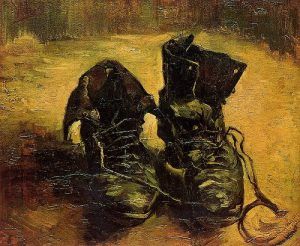 Despite the continued influence of formalism in the 20th Century there were currents of dissent that took an opposing position. Thinkers as diverse as Heidegger, Whitehead and Deleuze were arguing that genuine aesthetic appreciation is not about form but the unraveling of form. Despite their considerable differences, each was arguing that the most important kinds of aesthetic experiences are those in which the dominant foreground and design elements of a work are haunted by a background of contrasting effects that provide depth. It’s the conflict between foreground and background, surface and depth, between what is known and what is mysterious that give art its allure. The uncanny is the key to art worthy of the name. For example, for Heidegger in his famous study of Van Gogh’s A Pair of Shoes, it’s the seemingly insignificant brushstrokes in the background of the painting that allow amorphous figures to emerge and begin to take to shape as we view it. The background figures preserve ambiguity and allow the concealing and unconcealing of multiple interpretations to take place, which Heidegger argues, are at the heart of a work of art.
  Actors come to each role in a new film bearing the stamp of their old ones so they are richer and more interesting in the new incarnation—the whole more than the sum of the parts. Just last week one saw Nargis as the innocent and naive mountain girl pining away for the love of the ‘shehri babu’, and today she is the femme fatale, all hell and brimstone, plotting the downfall of her rival. Or, as Mother India, upholding principles of honesty and justice, shooting her favorite son dead for raping a village girl.