by Pranab Bardhan

As the job-displacing effects of markets and global integration and the cultural shocks of large immigration have rattled workers, particularly the less skilled ones, their reactive turn to populism in different parts of the world has dismayed liberals. This has been reinforced by resentment against centralized bureaucracies (not just in Brussels or Washington but also in Mexico City or Delhi or Jakarta) run by professionals and technical experts whose dispensations often ignore local realities and sensibilities. The alliance between liberals and workers that used to form the backbone of centrist democratic parties is getting frayed, as in the minds of many blue-collar workers the liberals with their mobile professional skills come across as privileged meritocrats and rootless cosmopolitans (‘citizens of nowhere’).
Global markets and mobility of capital have required standardization and harmonization of local rules and regulations, which some communities feel are ironing out their local distinctiveness and proximity-based personalized networks. Increasing market concentration in large corporate firms, their blocking of small business, capturing of state power in democracies through strong lobbies and copious election funding, and weakening of labor organizations and depressing labor share have made many small people precarious in their livelihood and suspicious of markets.
State-provided public services which are supposed to relieve the harshness of the market are everywhere riddled with bureaucratic indifference, malfeasance, and resistance to reform, while the better-off liberals are increasingly seceding from them. In developing countries the public delivery of social services is often so dismal (with inept, corrupt or truant official providers) that in contrast the image of voluntary community organizations (including charitable religious institutions run by Muslim, Hindu or Christian evangelicals) trying to fill in the gap is often much better than that of the state. Even when the state delivery mechanisms work reasonably well, the projects often do not involve the people but simply treat them as passive objects of the development process. (In rich countries communities have sometimes rejected negotiations over their heads by corporate and city officials to help investment in the community—as in the recent case of the failed Amazon investment proposal for Queens in New York). Read more »
 On a whim I decided to visit the gently sloping hill where the universe announced itself in 1964, not with a bang but with ambient, annoying noise. It’s the static you saw when you turned on your TV, or at least used to back when analog TVs were a thing. But today there was no noise except for the occasional chirping of birds, the lone car driving off in the distance and a gentle breeze flowing through the trees. A recent trace of rain had brought verdant green colors to the grass. A deer darted into the undergrowth in the distance.
 Sughra Raza. Enlightened, April, 2019.
 When I returned to school after my first marriage ended, I had to decide what to study. I’d been working toward a degree in history when I dropped out of a community college to get married, but I’d always been drawn to astronomy. One of the reasons I chose astronomy over history, or any other option, was that I felt that astronomy contained many of the other things I was interested in. To put it another way, I thought that if I didn’t study astronomy, I would regret it, but if I did study it, I wouldn’t necessarily lose touch with the other things I was interested in because they were all part of astronomy, in one way or another.





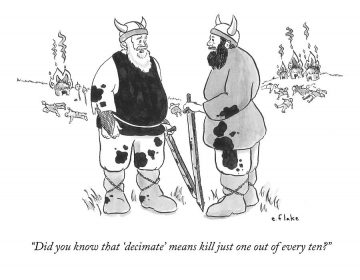 If you took Latin, then you probably have a larger vocabulary than the average bear, and you are more likely to have strong opinions on some words you vaguely remember based on Latin roots (cognates). For example, folks are more commonly using “decimate” to mean destroy or devastate, and it annoys the living materia feculis out of me. Decimate originally meant to kill every 10th person, based on the Latin word for 10 (decem), which is so oddly and satisfyingly specific. “Devastate” and “destroy” are already well known and used, so why do they need another alliterative ally in little weirdo “decimate”?



 Soon after President Obama moved into the White House, Mrs. Obama set up her vegetable garden. She planted tubers like carrots and turnips, leafy veggies such as spinach and kale, and herbs—thyme, sage, mint, and whatnot. But she did not plant beets. Why? I was quite perplexed and tried to find out the reason. I called the White House but did not get a satisfactory answer. “What the hell are you talking about?” said someone who picked up the phone. Maybe her children do not like them, said my child who was not overly fond of the vegetable. Not like beets? How is that possible? Of all the tuberous veggies available to man, the beet in my view is one of the best and the most poetic.