by Carol A Westbrook
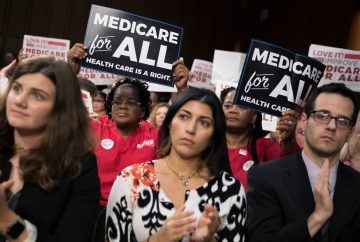
“Medicare for All” is a battle cry for the upcoming national elections, as voters’ health care costs continue to skyrocket. Universal Medicare, they believe, will provide free health care, improve access to the best doctors, and lower the cost of prescription drugs. Is it a dream, or is it a nightmare?
I am 100% in favor of universal health care, but believe me, it ain’t gonna be free. True, I’m not an economist–I’m a doctor–but I can do the math. I’ve had years of experience, both practicing under Medicare’s system and as a Medicare patient, and I understand something about health care costs. Few voters under age 65 understand what Medicare provides, and even fewer have a grasp on what it will cost the government–and ultimately the taxpayer–to extend it to all.
What Medicare provides for free is Medicare A insurance, which covers inpatient hospital, costs. To cover outpatient and emergency room visits, the senior must purchase Part B, which covers 80% of these charges. Medicare B costs $135/month plus a sliding scale based on income. Prescription drug coverage requires purchasing Medicare D from a private company. (Medicare C is alternative private insurance). Medicare A, B and D premiums are all deducted from the monthly Social Security check. Additionally, a senior may purchase a Medicare Supplement from a private insurance company, which covers the un-reimbursed Part A, and B costs. Confusing? Here are two examples. Read more »
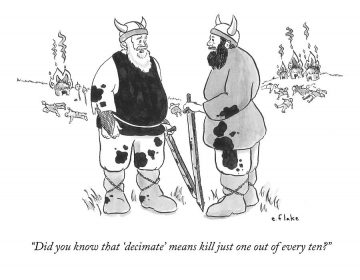 If you took Latin, then you probably have a larger vocabulary than the average bear, and you are more likely to have strong opinions on some words you vaguely remember based on Latin roots (cognates). For example, folks are more commonly using “decimate” to mean destroy or devastate, and it annoys the living materia feculis out of me. Decimate originally meant to kill every 10th person, based on the Latin word for 10 (decem), which is so oddly and satisfyingly specific. “Devastate” and “destroy” are already well known and used, so why do they need another alliterative ally in little weirdo “decimate”?

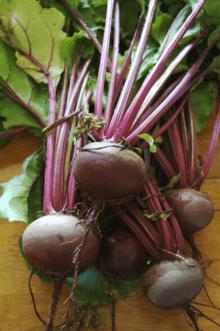 Soon after President Obama moved into the White House, Mrs. Obama set up her vegetable garden. She planted tubers like carrots and turnips, leafy veggies such as spinach and kale, and herbs—thyme, sage, mint, and whatnot. But she did not plant beets. Why? I was quite perplexed and tried to find out the reason. I called the White House but did not get a satisfactory answer. “What the hell are you talking about?” said someone who picked up the phone. Maybe her children do not like them, said my child who was not overly fond of the vegetable. Not like beets? How is that possible? Of all the tuberous veggies available to man, the beet in my view is one of the best and the most poetic.


 Recently, I was waiting to board an American Airlines flight from Boston to Rochester, when, along with ten of my fellow passengers, I was summoned to the desk in front of the boarding gate. There we learned, by listening intently to what the AA gate agent told the first passenger in line, that we were being bumped from the flight, that AA would try to find alternative flights for us, and that we would each receive a voucher worth $250, redeemable on AA bookings, valid for one year.
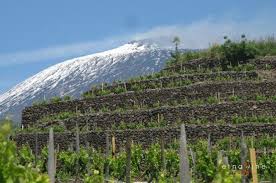 Wine writers often observe that wine lovers today live in a world of unprecedented quality. What they usually mean by such claims is that advances in wine science and technology have made it possible to mass produce clean, consistent, flavorful wines at reasonable prices without the shoddy production practices and sharp bottle or vintage variations of the past.