
by Abigail Akavia
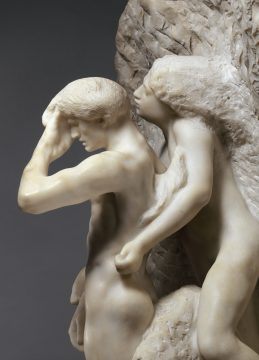
at The Metropolitan Museum of Art
When you opened the door to the apartment where I grew up, you could see all the way to the end of the living room and the large window that spanned its width, an entryway-less structure typical of apartment buildings in Tel Aviv. Our living room was particularly long, though, so that my father’s desk, which sat close to the window but facing the middle of the room, felt far enough away to be considered its own space, set apart from the bustle of a three-kids household that was also my mother’s in-home clinic. Add to the physical distance my father’s ability to immerse himself in whatever he was reading, ignoring anything that was not a direct address to him (one of those universal dad superpowers, my mothering self now knows), and he was almost completely cordoned off from the rest of us when he was sitting at his desk, as if behind a door ajar.
Even when his reading lamp was the only light on in the big room, it was possible to consider his almost immobile figure as not quite there. When my first boyfriend stepped into the apartment for the first time, however, he most definitely recognized my father’s dimly-lit, looming professor-like presence at the edge of the room. He was what you would call “a good kid”—I, in hindsight, have taken to defining him, even at 19, as a mensch—and he took the prospective meeting with my dad seriously. My father, for his part, preferred to act as if nothing out of the ordinary was happening. He put down his glasses, looked up to say a short hello, and then resumed his reading, a combination of simply holding on to his business-as-usual seat at his desk, deliberately extending the gift of privacy to his late-bloomer daughter, and a possibly unconscious urge to avoid the awkwardness of the encounter.
Maybe he also knew, in a parental sixth-sense which I used to think only my mother had but of which I can now also imagine a paternal version, that this very nice guy wasn’t the love of my life—that he was not going to sweep me away, there was really nothing to worry about. So there was no menacing handshake, no steely look into the young man’s eyes to force him to own up to his mythically filthy intentions and metaphorical abduction of my father’s youngest, no once-over to assess his prospective ability to provide for me. In short, no forced and embarrassing macho face-off. Read more »
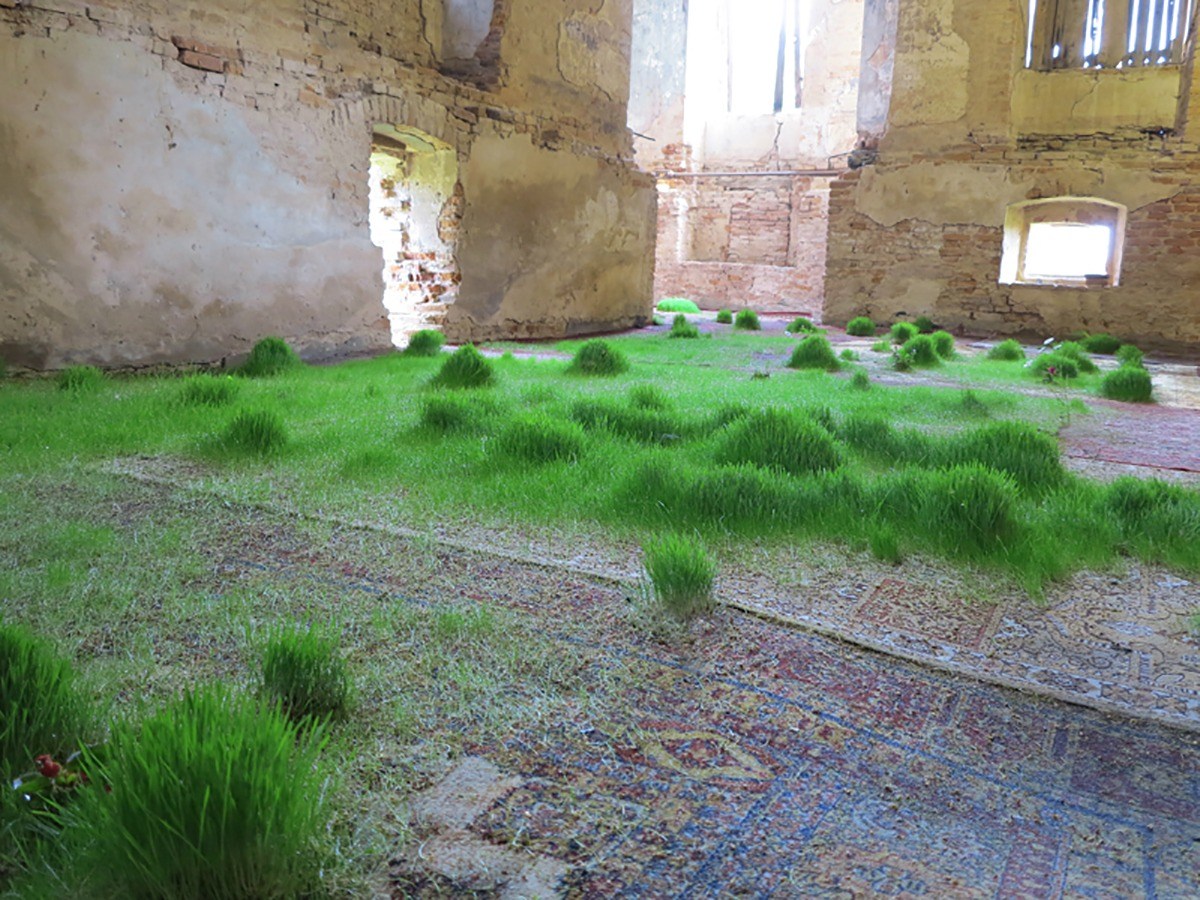
 I suspect there are many who feel that this Dickensian paradox applies to their own life and times. I certainly do. If you’re fortunate enough to have a sufficient income, a comfortable home, loving family and friends, decent physical and mental health, and plenty of interests to pursue, then life is good. But then a lying, narcissistic, cynical, conman like Boris Johnson is ensconced in power in the UK for five years, and things are not good. One dwells in the Slough of Despond.
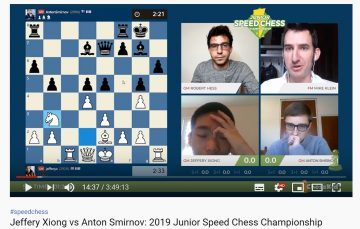 Earlier this year one of the encounters technology has made available for mind games took place – the 2019 Junior Speed Chess Championship. The technology is impressive, with the board, and video commentary by two masters, along with video of the players.
 Mom, why are we always at the doctor? Every week we come here. Are you dying?
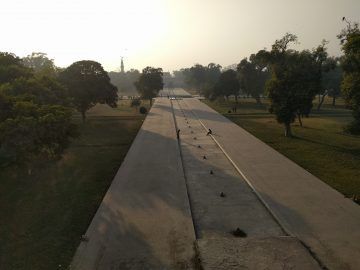 When we were young and living in Sialkot, we went frequently, almost once a week, to Lahore, the grand and hip city just a two-hour drive away. The trips were ostensibly for some real work—father, a district court lawyer, was appearing in a case being heard in the High Court or, his tuxedo in the trunk, was heading to a meeting of the Freemasons. Or it was for mother, who had critical shopping at Haji Karim Buksh, for crystal fruit bowls or the latest coffee cups, things not to be found in Sialkot, or was going to Hanif’s for a hair trim. Mother in the early 1960s sported a Jackie Kennedy cut that needed serious maintenance and only Hanif’s could manage that. For the children it might be to see doctors or dentists at Sir Ganga Ram Hospital—deflected septum (one of the boys was an avid boxer), enlarged tonsils, persistent skin rash, and such. And of course the routine checkups for father’s hypertension. Sialkot at the time did not have specialist doctors or reliable surgical facilities. (Interestingly enough it still does not, despite being a manufacturer and exporter of surgical goods.)

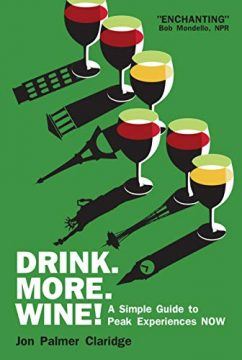 It’s the holiday season and time to think about presents for the budding wine lover in your life. Of course, any season is the right time to think about that. You should always support your local wine lover. One place to begin is this compelling book by long-time food critic Jon Palmer Claridge entitled
 When a song gets really stuck in my head, I break it down. I learn how to play it and even ponder ways to fiddle with it and improve it. In the throes of involuntary obsession, it gives me something to do. It’s a coping mechanism, a way to retain my sanity. And for this project, it also means writing, at least a little bit, about the song and artist. To create some context.
 People sometimes express confusion about what public philosophy is. We see the point as straightforward: it’s a matter of location. Public philosophy consists of all those efforts that aren’t centered on university life. Public philosophers write op-eds for newspapers, work on disability issues and penal reform, serve on expert committees for government agencies, teach in prisons and schools, and help community groups balance considerations of justice with economic development. But while the possibilities for public philosophy are infinite, the distinction is clear: are your attentions directed toward other philosophers? That’s academic philosophy. Are your efforts aimed at the wider world? That’s public philosophy.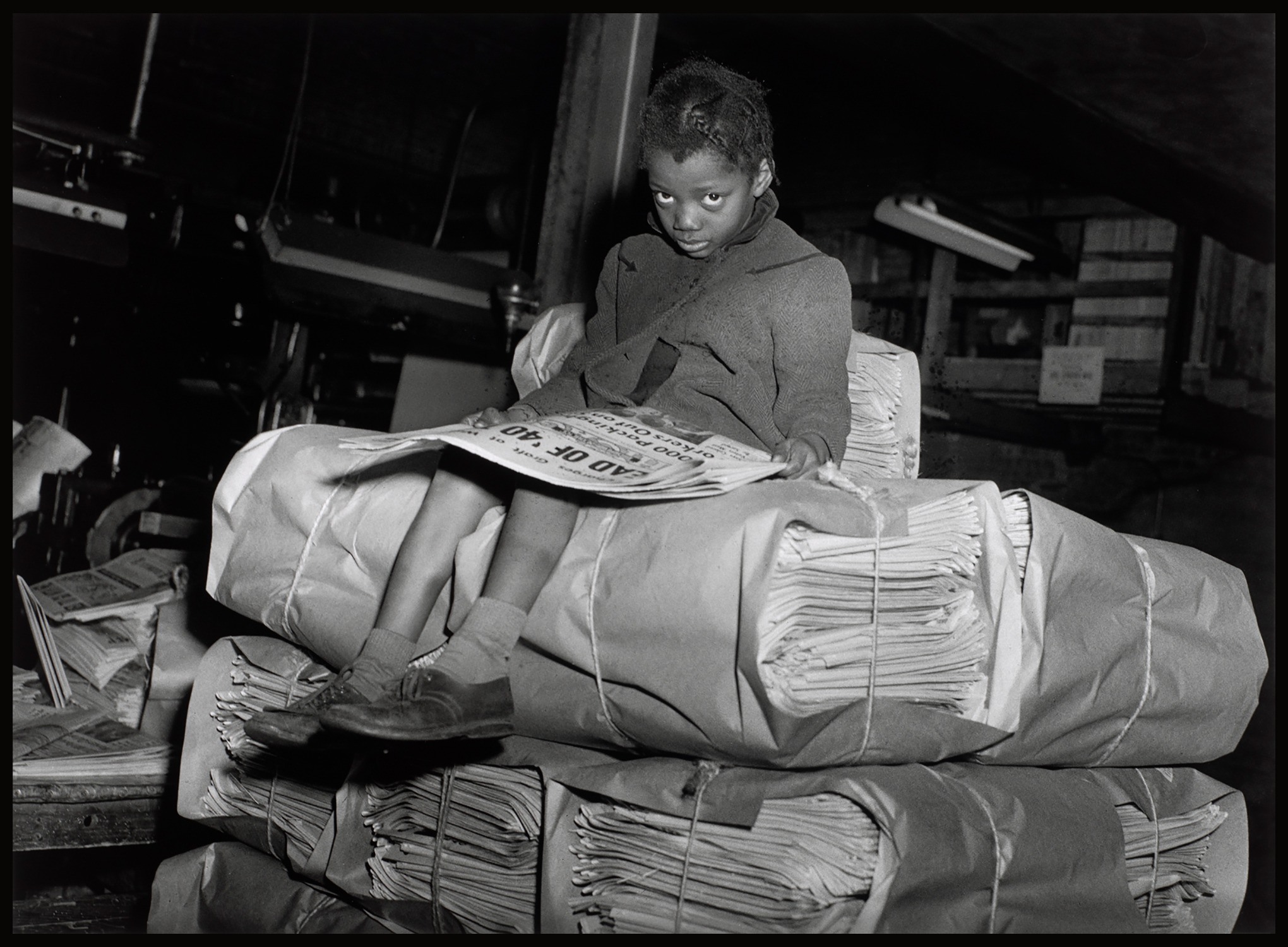
 1.
1.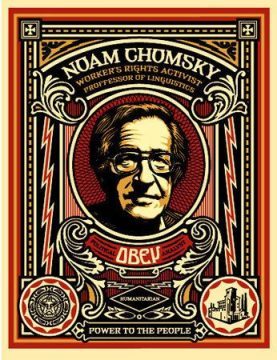 A lot has changed since 1967, the year Noam Chomsky published “The Responsibility of Intellectuals.” His essay threw damning shade at the intelligentsia—particularly those in the social and political sciences—as well as those that supported what he called the “cult of expertise,” an ideological formation of professors, philosophers, scientists, military strategists, economists, technocrats, and foreign policy wonks, some of who believed the general public was ill-equipped (i.e., too stupid) to make decisions about the Vietnam war without experts to make it for them. For others in this cult, the public represented a real threat to established power and its operations in Vietnam, not because they were too stupid to understand foreign policy, but because they would understand it all too well. They had a sense that the public, if they learned the facts, wouldn’t support their foreign policy. Of course, in retrospect, we know that this is exactly what happened. Once the facts of the operation leaked out or were exposed by Chomsky and others like him, the majority of people disagreed with the “experts.” Soon there were new experts to provide rationalizations for why and how the old experts got it wrong, but not before a groundswell of popular protest and resistance turned the political tide and gave a glimpse at the power of everyday people—the “excesses of democracy”—to control the fate of the nation and the world.
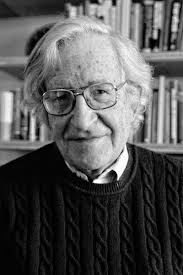 Chomsky has consistently been confident that people who were not considered experts in foreign affairs were as capable if not more so to decide what was right and wrong without the expert as a guide. This is one of the things that continues to make Chomsky such a threat to the established order. He has faith in the public’s ability to think critically (i.e., reasonably, morally, and logically) about foreign affairs and other governmental actions at the local and national levels. For Chomsky, the promise of democracy begins and ends with the people. He does not have the same confidence that those in positions of power will give the public the facts so that they can make good and reasonable decisions. But this does not mean that Chomsky uncritically embraces the public simply because it is the public. He does not support, nor has he ever, the cult of willful ignorance; that is, those members of the public—experts, intellectuals or laypeople—who, as Kierkegaard wrote, “refuse to believe what is true.”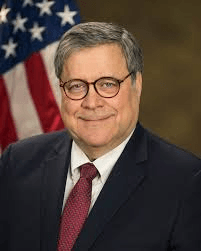
 If you have read reports about Mr. Barr’s remarks, you probably already know they have been criticized for their ferocious partisanship. There is unquestionably a considerable amount of energy devoted to critiquing those who get in President Trump’s way (Congress, the federal courts, Progressives, and private citizens who exercise their right of free speech). But M
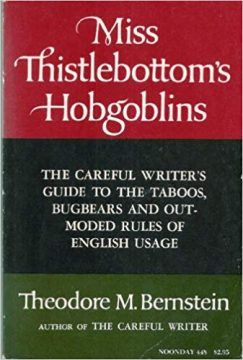 Theodore M. Bernstein – Miss Thistlebottom’s Hobgoblins: The Careful Writer’s Guide to the Taboos, Bugbears, and Outmoded Rules of English Usage (1971)